Artwork
Goldsmiths, Baroda, Guzerat
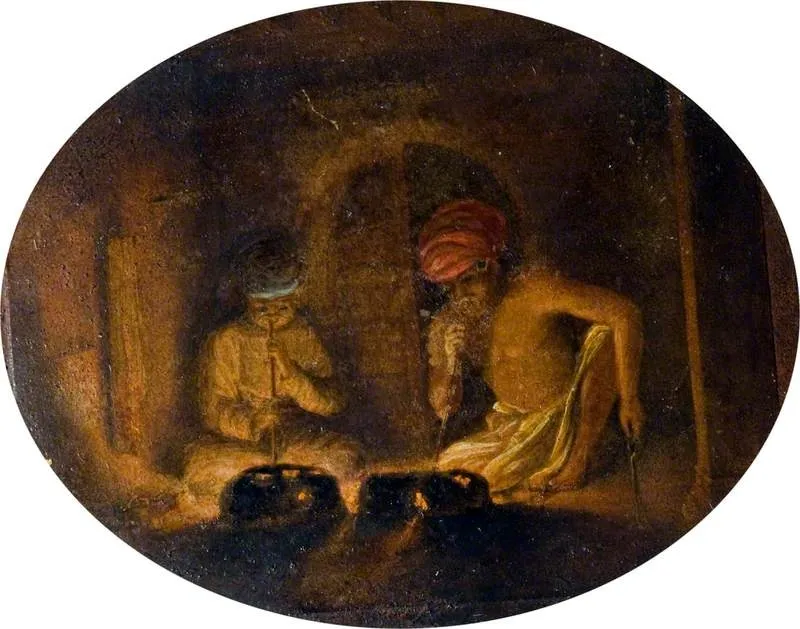
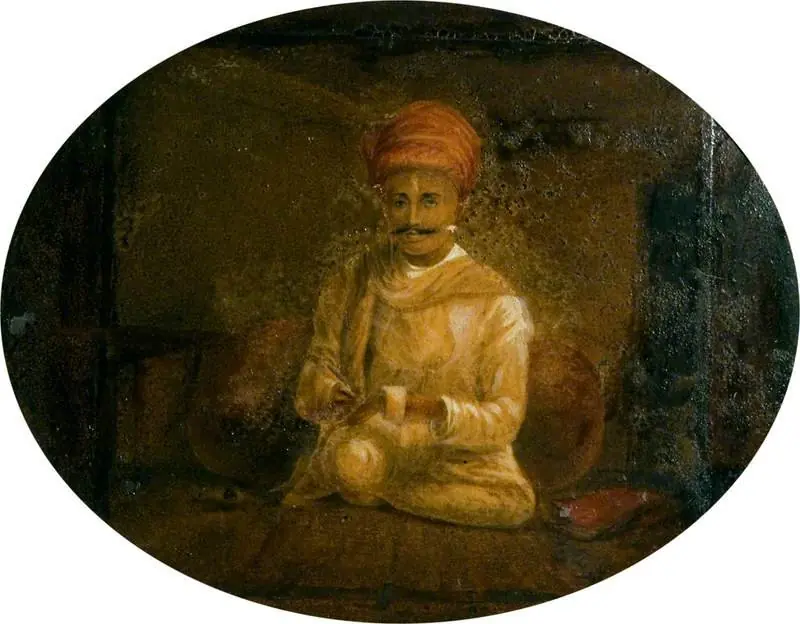
Goldsmiths, Baroda, Guzerat is an oil painting by the Orientalist artist Robert Melville Grindlay. It dates from 1806 and is held in the collection of the Victoria and Albert Museum.
About this work
Overview
Painted in 1806 by Robert Melville Grindlay, this oil work captures two Indian goldsmiths in a quiet interior setting. Executed during the early colonial period in western India, the painting is part of the Victoria and Albert Museum’s collection. Its restrained composition and muted palette reflect a documentary impulse, emphasizing the figures’ labor and environment over dramatic narrative.
Subject & Meaning
The two men, dressed in traditional attire with turbans and loose garments, are engaged in the quiet aftermath of work.
The two men, dressed in traditional attire with turbans and loose garments, are engaged in the quiet aftermath of work. One holds a tool, the other rests against a wall, suggesting a pause in their craft. Their stillness and focused demeanor convey dignity in skilled labor, avoiding romanticization. The absence of elaborate surroundings underscores the modest conditions of artisanal work in early 19th-century Baroda.
Technique & Style
Grindlay employs chiaroscuro to model the figures with soft, directional light, enhancing their three-dimensionality against a darkened background. Warm, earthy tones dominate, with golden hues subtly illuminating skin and fabric. The brushwork is precise yet unobtrusive, favoring tonal gradation over detail, creating a sense of intimacy without theatricality.
History & Provenance
Commissioned during Grindlay’s time in western India, the painting likely originated as a personal record of local tradespeople. It entered the Victoria and Albert Museum’s collection in the 19th century, among other works documenting Indian life under British colonial administration. Its preservation reflects early European interest in ethnographic observation through art.
Context
Created during a period when British officials and artists increasingly documented Indian society, the painting aligns with a broader trend of visual ethnography. Unlike grand historical scenes, it focuses on ordinary labor, offering a rare glimpse into artisanal life outside courtly or religious settings. Its quiet realism contrasts with more stylized portrayals common in colonial art.
Legacy
The painting remains a modest but significant example of early colonial-era Indian portraiture. It contributes to historical understanding of artisan communities in western India, preserving visual evidence of dress, tools, and workspace. While not widely exhibited, it continues to inform scholarly study of cross-cultural representation in 19th-century art.
Artist & collection
Artist
Robert Grindlay never stayed in one place long enough to get bored. The Scotsman bounced between India and England, painting what he saw: bazaars jammed with rice and grains, goldsmiths hunched over tiny cups, and the…

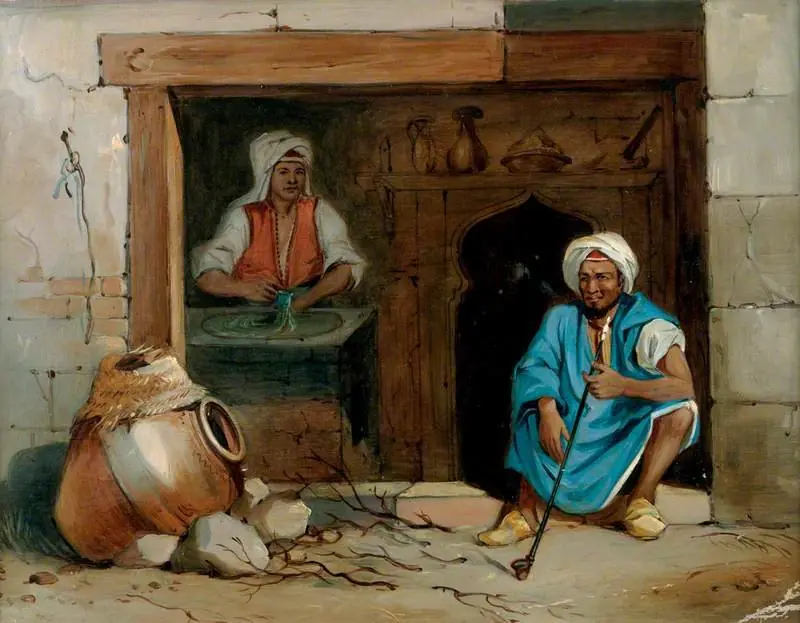 An Egyptian Baker and His Assistant at the Door of a Cake-Shop
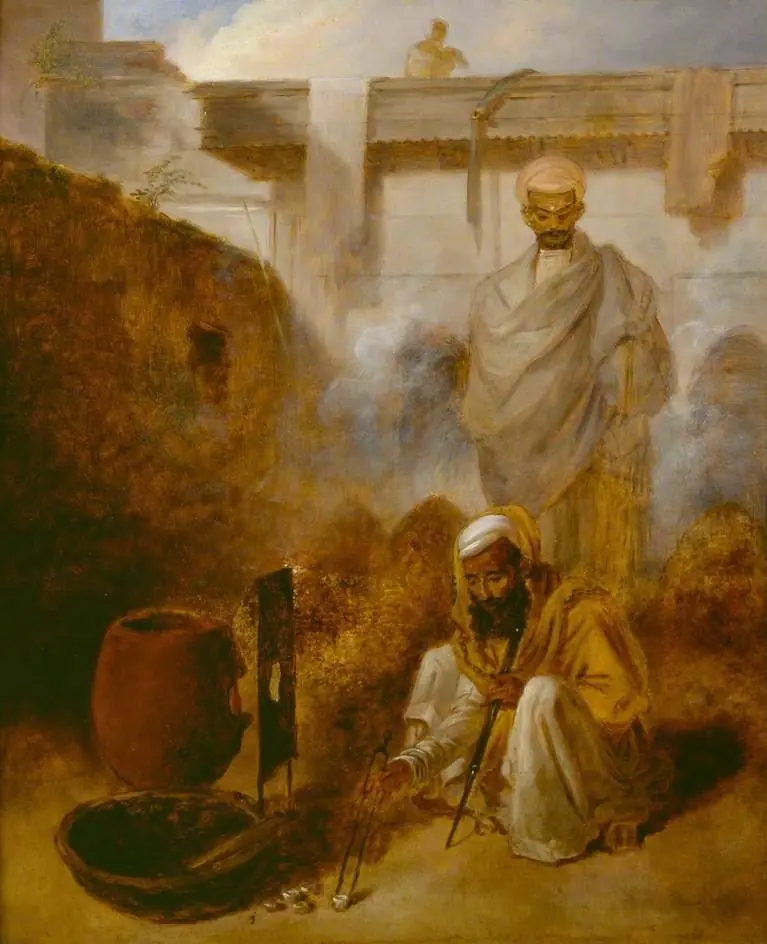 Assayer at Work in the Mint, Calcutta
 Tobit and Anna with the Kid
 Interior de la cocina de una posada del pueblo de Maqueda
 Vânzătoarea de clătite
 Interior breton
 Young Woman with a Candlestick, Old Woman and a Violin Player
 Sketch on the Subject of the Trinity Beneath the Oak of Mambre
 Arabs playing chess
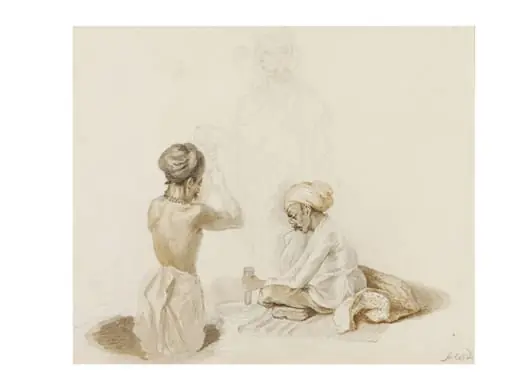 An Indian metal-worker seated cross-legged with his assistant, who raises and hammer, and another figure standing behind
 În atelierul de sculptură