Artwork
Lisieux, Normandy
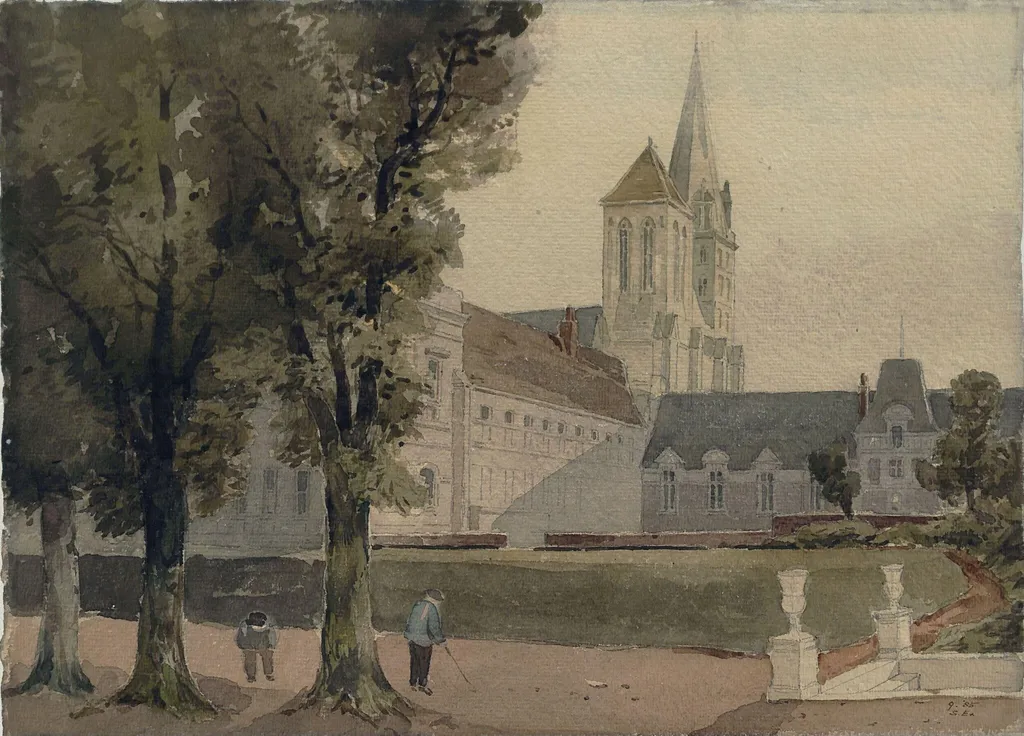
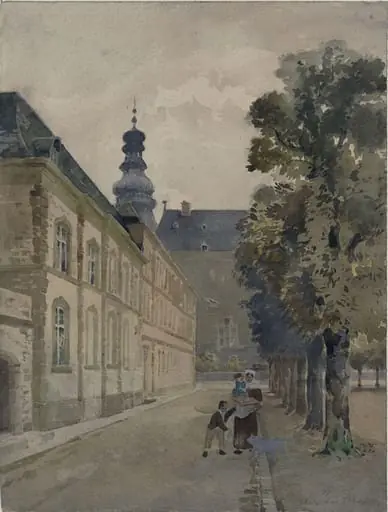
Lisieux, Normandy is a watercolor work on paper by the British Romanticist artist Edward Robinson. It dates from 1840 and is held in the collection of the Victoria and Albert Museum.
About this work
Overview
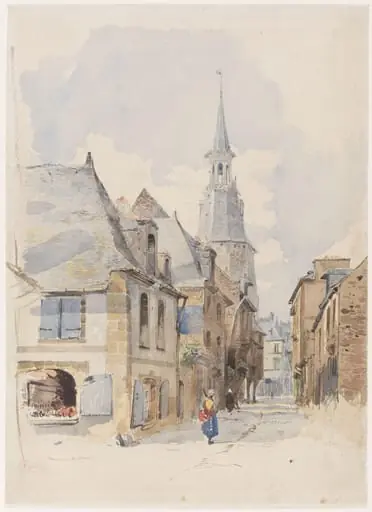
The work is a watercolour portraying a street scene in Lisieux, Normandy, where a prominent church tower rises above surrounding buildings. A solitary figure and a parent with child walk in the distance, while a large tree frames the left side of the composition. The ground appears sandy, bordered by a low wall and a few potted plants near the structures.
Subject & Meaning
The painting captures a moment of everyday life in a small French town, juxtaposing the enduring presence of the cathedral’s spire with the transient activity of pedestrians. The inclusion of both an adult alone and a parent with child suggests a narrative of generational continuity within the quiet urban setting.
Technique & Style
Executed with loose, fluid brushstrokes, the artist renders light and shadow to create a softened, atmospheric effect. The contrast between the sharply defined church spire and the more diffused surrounding architecture emphasizes depth, while the muted palette contributes to a dreamlike ambience.
History & Provenance
Created as a watercolour study of Lisieux’s cathedral and public gardens, the piece reflects the artist’s interest in documenting regional landmarks. Details of its acquisition or exhibition history are not recorded in the available information.
Context
The work aligns with 19th‑century tendencies to depict local scenery with an emphasis on mood and light, echoing broader European interests in capturing the character of specific places through a lyrical visual approach.
Artist & collection
Artist
This artist left dozens of watercolours captured on trips around Britain and France in the 19th century.