Artwork
Laban Searching for his Household Gods (Laban chercant des dieux)
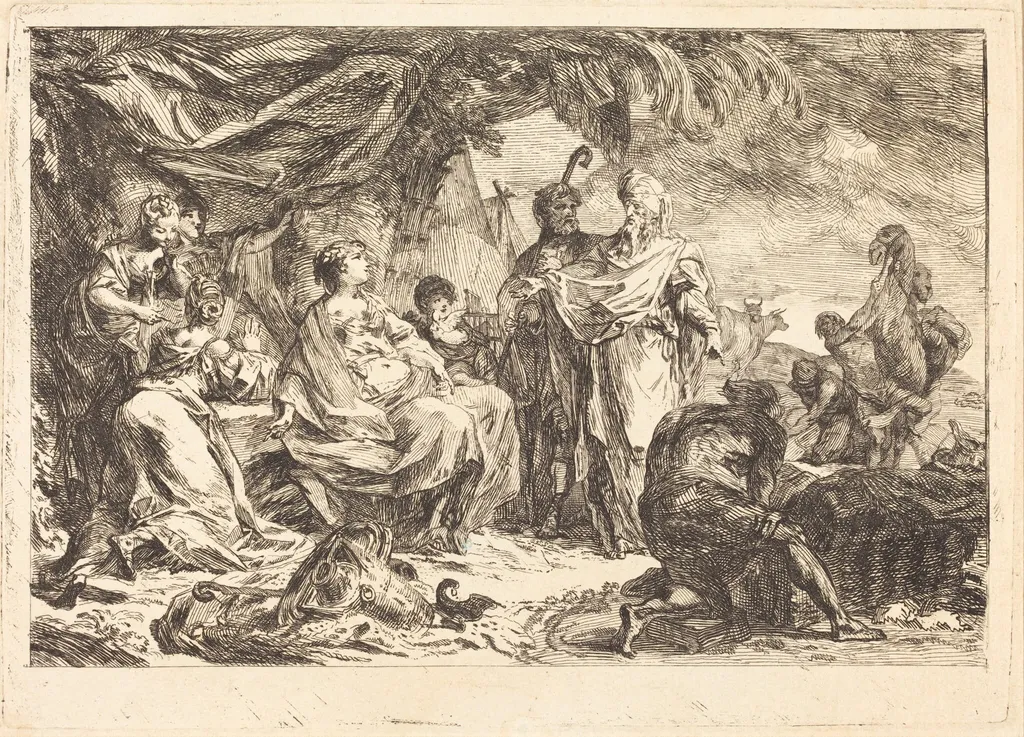
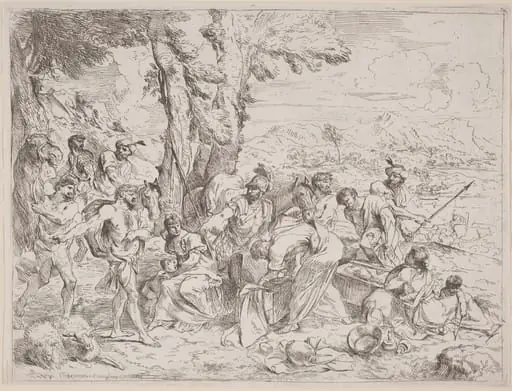
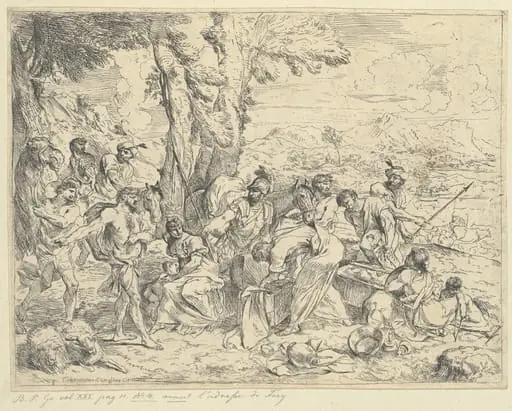
Laban Searching for his Household Gods (Laban chercant des dieux) is an ink print by the Romanticist artist Gabriel de Saint-Aubin. It dates from 1753 and is held in the collection of the National Gallery of Art.
About this work
Overview
Gabriel de Saint-Aubin created this etching in 1753, capturing a moment from the biblical story of Laban pursuing his daughter Rachel.
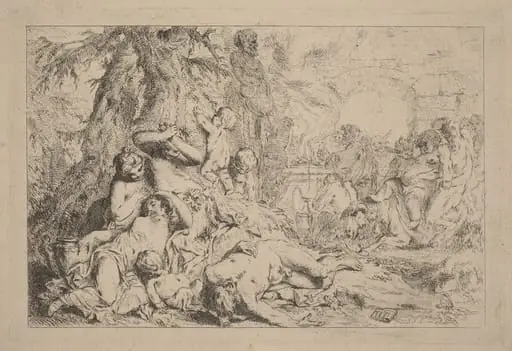
Gabriel de Saint-Aubin created this etching in 1753, capturing a moment from the biblical story of Laban pursuing his daughter Rachel. The scene unfolds on a windswept shoreline, where figures are clustered around a central figure holding a staff. The composition conveys tension and urgency, rendered through delicate, precise lines that define fabric, water, and atmosphere. The work is part of Saint-Aubin’s broader engagement with narrative subjects drawn from religious and classical sources.
Subject & Meaning
The image illustrates Laban’s search for the household gods stolen by Rachel, as recounted in Genesis. The central figure, Laban, gestures skyward, perhaps invoking divine witness or expressing frustration. Surrounding figures—women, children, onlookers—suggest a community caught in the aftermath of theft and pursuit. The stormy backdrop and turbulent sea amplify the emotional weight of the moment, framing the event as both personal and divinely charged.
Technique & Style
Saint-Aubin employed fine, controlled etching lines to build texture and depth, particularly in the folds of garments and the churning waves. The use of laid paper, with its subtle watermark texture, enhances the tactile quality of the print. Atmospheric effects are achieved through varying line density—lighter strokes suggest distant trees and a brooding sky, while sharper contours define foreground figures. The composition avoids idealization, favoring observed detail and dynamic movement.
History & Provenance
Created in 1753, the etching emerged during Saint-Aubin’s active years in Paris, where he documented contemporary life and biblical scenes with equal precision. It likely circulated among collectors of prints and illustrated texts, reflecting the 18th-century fascination with narrative imagery. No definitive early ownership records are known, but its survival in institutional collections suggests continued scholarly interest in his graphic work.
Context
In mid-18th-century France, biblical subjects remained popular in graphic arts, often used to explore moral and familial themes. Saint-Aubin, though better known for scenes of Parisian life, frequently turned to religious narratives in his prints, blending observational realism with classical composition. This work aligns with a broader European trend of illustrating scripture through intimate, human-centered moments rather than grand ceremonial depictions.
Legacy
Though not widely exhibited today, the etching endures as an example of Saint-Aubin’s skill in translating narrative tension into delicate line work. It contributes to the understanding of how biblical stories were visually interpreted in Enlightenment-era France, bridging devotional tradition with emerging interest in psychological realism. Its preservation in public collections ensures its place in studies of 18th-century print culture.
Artist & collection

Artist
Gabriel de Saint-Aubin was a French draftsman, printmaker, etcher and painter.