Artwork
Infant Moses
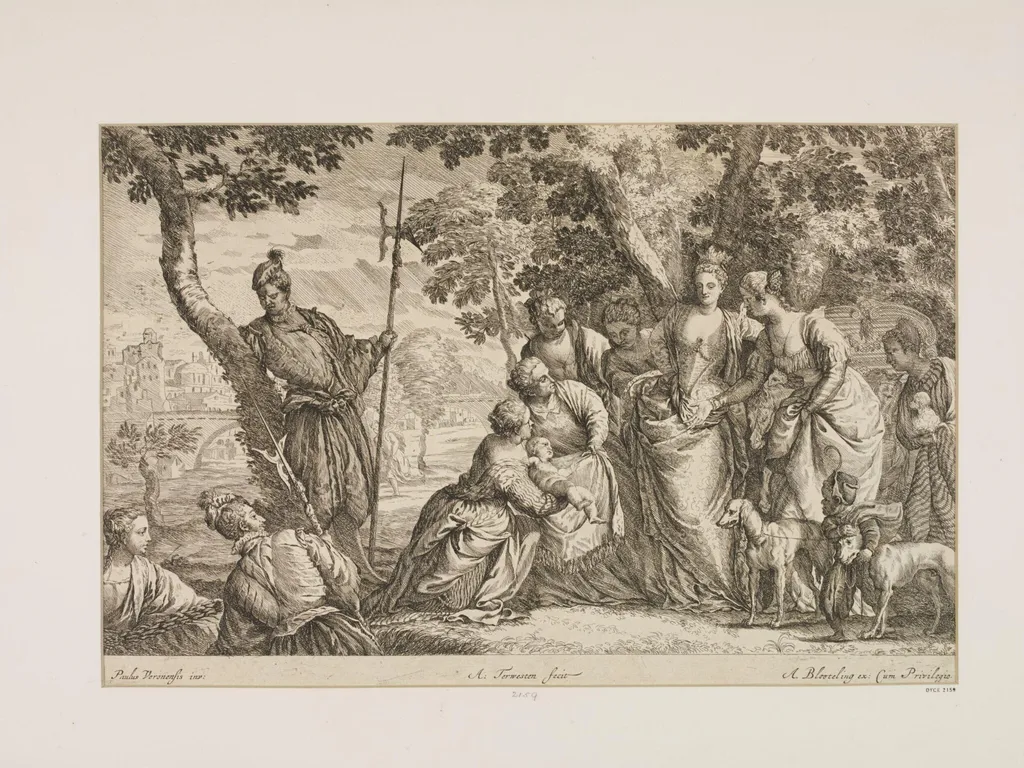
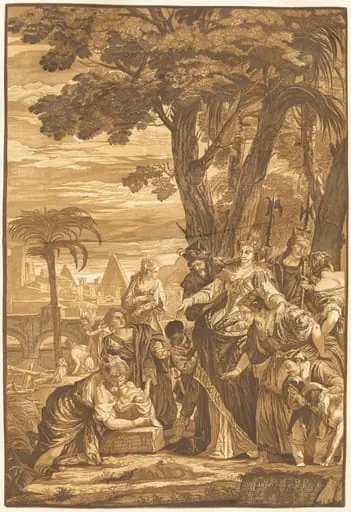
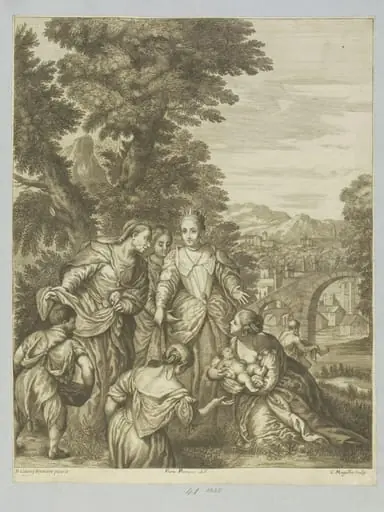
Infant Moses is a print by the Baroque artist Abraham Blooteling. It dates from 1650 and is held in the collection of the Victoria and Albert Museum.
About this work
Overview
This paper engraving, created circa 1650 by the Dutch printmaker Abraham Blooteling, reproduces a composition originally painted by Paolo Veronese.
This paper engraving, created circa 1650 by the Dutch printmaker Abraham Blooteling, reproduces a composition originally painted by Paolo Veronese. The image presents a pastoral setting where a woman in flowing garments cradles an infant, identified as Moses, while a second female figure with a staff stands nearby. Children play, a dog rests, and a man lies on the ground, all framed by trees, a distant town, and a hill topped with a cross.
Subject & Meaning
The central figure of the infant Moses is surrounded by everyday activity, suggesting a narrative that blends the biblical story with a genre scene. The woman holding the child may symbolize maternal protection, while the staff‑bearing figure could represent guidance or guardianship. The inclusion of playful children and domestic animals situates the sacred event within a familiar, rural environment, emphasizing the humanity of the biblical characters.
Technique & Style
Blooteling employed the chiaroscuro engraving technique, using deep shadows and stark contrasts to model the figures and give them a three‑dimensional presence. The line work is fine yet decisive, capturing the textures of clothing and foliage. The composition reflects the Baroque taste for dramatic lighting and dynamic arrangement, translating Veronese’s vibrant palette into a monochrome medium while preserving the original’s sense of movement.
History & Provenance
The print appears in the 1874 catalogue of the Dyce Collection, where it is noted as derived from M. Schietz’s illustrated Bible, the "Bilderbibel." Its inclusion in that catalogue indicates the work’s circulation in 19th‑century devotional publications. The engraving’s attribution to Blooteling and its connection to Veronese’s design highlight the cross‑national exchange of artistic ideas between Italy and the Dutch Republic during the mid‑17th century.
Own this work as a print
Artist & collection