Artwork
Maniere d'exposer les nobles apres leur mort
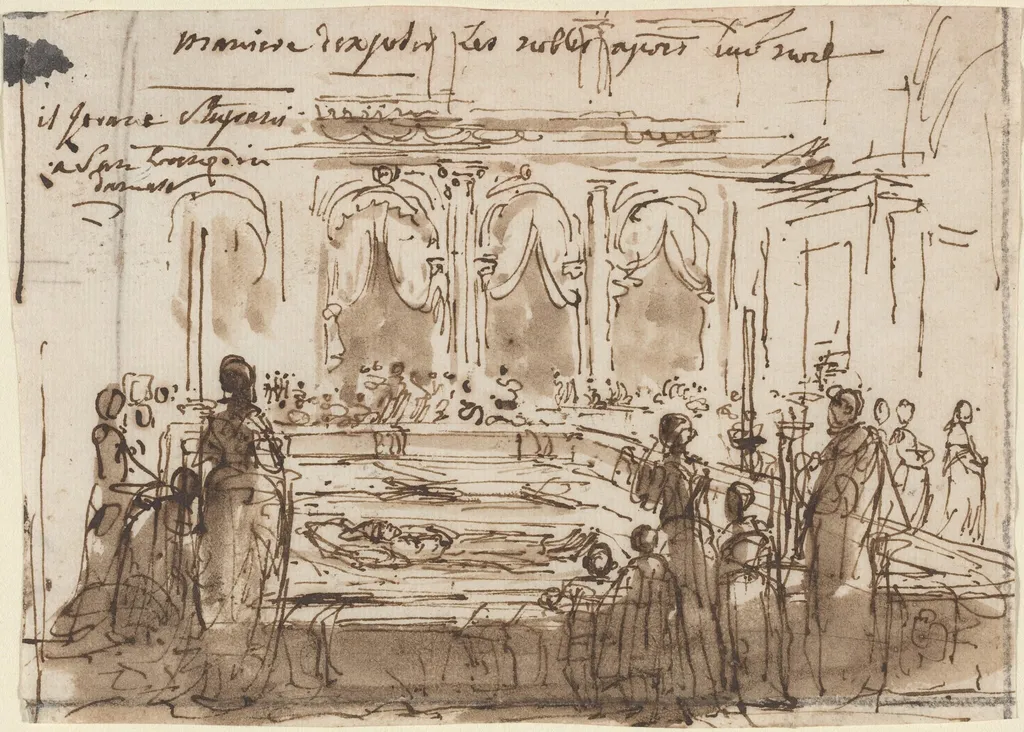
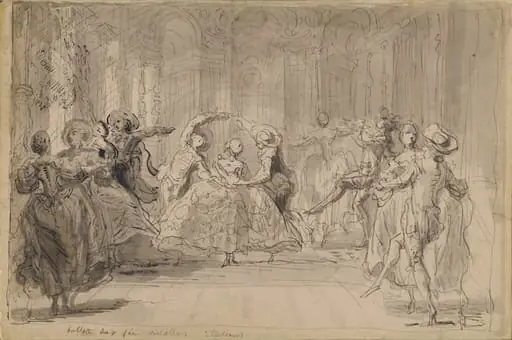
Maniere d'exposer les nobles apres leur mort is an ink drawing by the Baroque artist Gabriel de Saint-Aubin. It dates from 1752 and is held in the collection of the National Gallery of Art. Gabriel de Saint‑Aubin’s drawing, dated 1752, is executed in pen and brown ink on laid paper.
About this work
Overview
Gabriel de Saint‑Aubin’s drawing, dated 1752, is executed in pen and brown ink on laid paper. The work measures a modest sheet size typical of the artist’s preparatory sketches and captures a bustling interior scene populated by figures in period dress. Its title, translated as “The way to display nobles after their death,” hints at a ceremonial context, likely a funeral or memorial arrangement.
Subject & Meaning
The composition presents a crowded hall where aristocrats in long robes occupy the foreground and a raised platform at the rear. Tall‑hatted figures stand prominently, while seated individuals and a child observe from below. The arrangement suggests a formal procession or viewing, reflecting eighteenth‑century customs for honoring deceased members of the nobility.
Technique & Style
Saint‑Aubin employs rapid, expressive pen strokes, building tonal variation through dense cross‑hatching and layered ink washes. The loose line work conveys movement and the texture of fabrics, while darker passages create depth and atmospheric shading. The sketch’s immediacy reveals the artist’s preparatory method, emphasizing gesture over fine detail.
History & Provenance
Created in 1752, the drawing is part of Saint‑Aubin’s extensive oeuvre of studies documenting contemporary social rituals. It has remained in private collections before entering a museum holding the artist’s papers, where it is referenced as a visual record of aristocratic funerary practices in mid‑eighteenth‑century France.
Artist & collection

Artist
Gabriel de Saint-Aubin was a French draftsman, printmaker, etcher and painter.


 Architectural Details for a Wall Decoration with Empress Maria Theresia Embracing the Young Wolfgang Amadeus Mozart
 The Laying Out of Christ
 George III Resuming Royal Power in 1789
 Timotheus Playing the Lyre before Alexander and Thaïs in the Hall of the Palace at Persepolis
 The Sacrifice of Iphigenia (recto) / Study of a Male Nude (verso)
 Saint Matthew
 Interior of Her Majesty's Theatre
 Untitled
 Corner of a Drawing Room
 Italian Comedians Taking Their Bows
 Meeting of Solomon and Queen of Sheba
 A Procession of the Madonna di San Luca