Artwork
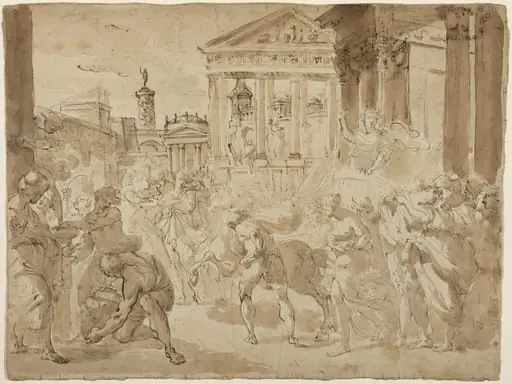
Timotheus Playing the Lyre before Alexander and Thaïs in the Hall of the Palace at Persepolis
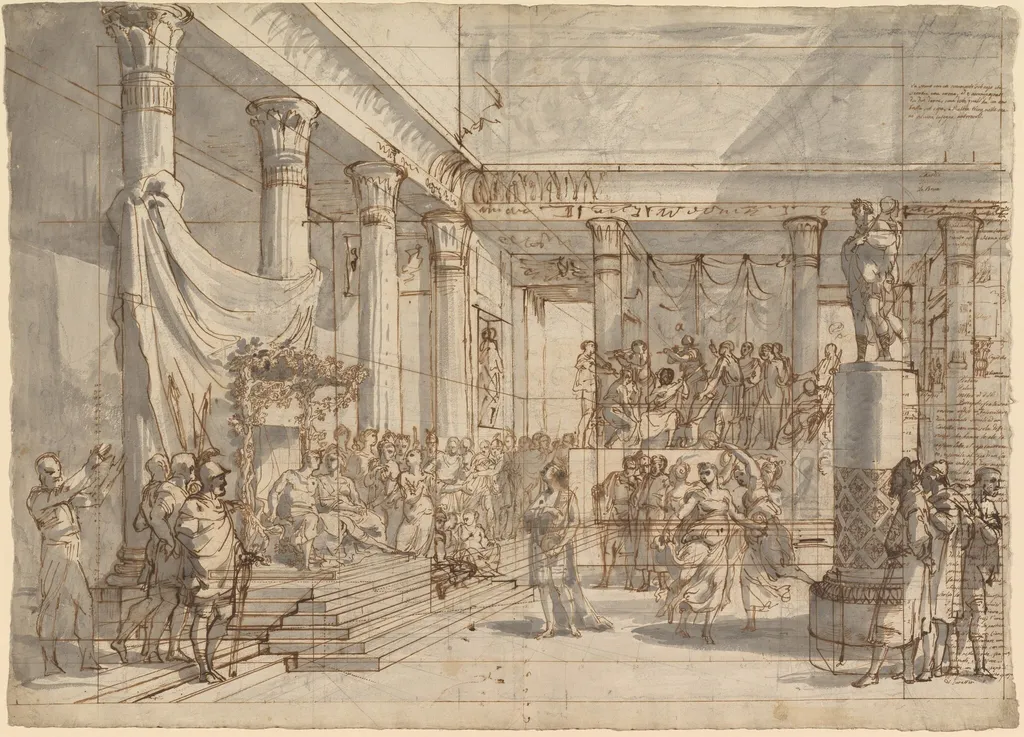
Timotheus Playing the Lyre before Alexander and Thaïs in the Hall of the Palace at Persepolis is a chalk drawing by the Romanticist artist Pietro Fancelli. It dates from 1820 and is held in the collection of the National Gallery of Art.
About this work
Overview
Created around 1820 by Pietro Fancelli, this drawing depicts a moment from ancient legend in the monumental setting of Persepolis.
Created around 1820 by Pietro Fancelli, this drawing depicts a moment from ancient legend in the monumental setting of Persepolis. Executed in pen and brown ink with gray wash over black chalk and graphite, it was made on two joined sheets of wove paper. The precise, squared composition suggests it served as a preparatory study, likely for a larger painting that was never completed. The delicate handling of line and tone reflects a methodical approach to architectural and figural planning.
Subject & Meaning
The scene illustrates the Greek musician Timotheus performing before Alexander the Great and his companion Thaïs, set within the grand hall of the Persian palace. The figures are arranged to emphasize the contrast between the solitary performer and the attentive courtly assembly. The narrative draws from classical accounts of music’s power to move rulers, hinting at themes of cultural exchange and the influence of art in political contexts.
Technique & Style
Fancelli employed fine, crisscrossed hatching to model volume and shadow, building form through layered, controlled strokes rather than broad washes. The use of graphite and black chalk underdrawing, squared for transfer, reveals a systematic method of scaling the composition. Lines are light but deliberate, suggesting a focus on structure over expressive flourish. The absence of heavy ink or color underscores its function as a working sketch rather than a finished piece.
History & Provenance
The drawing remains in private hands, with no public exhibition history documented prior to the 20th century. Its survival as a preparatory study indicates it was retained by the artist or his circle, possibly as a reference for future projects. No records confirm whether the intended painting was ever executed, leaving the drawing as the sole surviving record of Fancelli’s conception of this subject.
Context
Fancelli worked during a period when Neoclassicism dominated Italian art, with renewed interest in ancient history and architecture. The choice of Persepolis as a setting aligns with contemporary fascination with Persian and Hellenistic antiquity. His detailed architectural rendering reflects academic training and the influence of archaeological publications circulating in early 19th-century Europe, which sought to reconstruct ancient spaces with scholarly precision.
Legacy
Though not widely known outside specialist circles, the drawing exemplifies the rigorous preparatory practices of academic artists in the early 1800s. It preserves a moment in the evolution of historical painting, where meticulous draftsmanship preceded monumental execution. As a study, it offers insight into how artists translated literary and historical narratives into visual form, bridging textual sources with spatial imagination.
Artist & collection


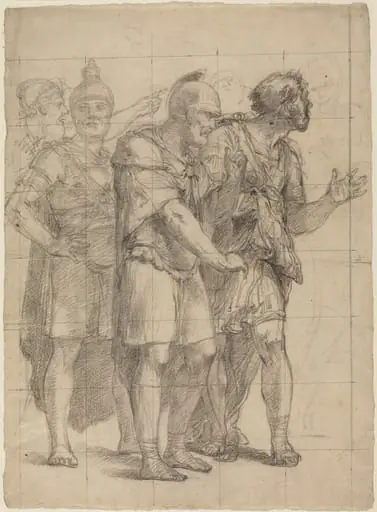 Four Standing Warriors
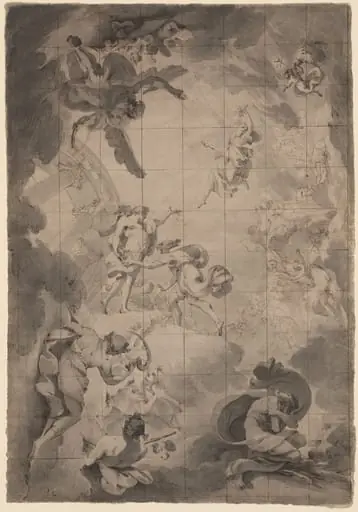 Studies of Aurora and Apollo
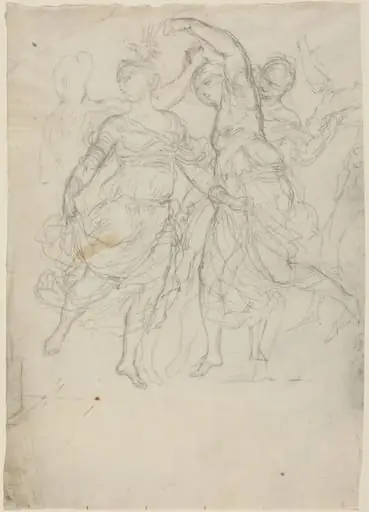 Women Dancing
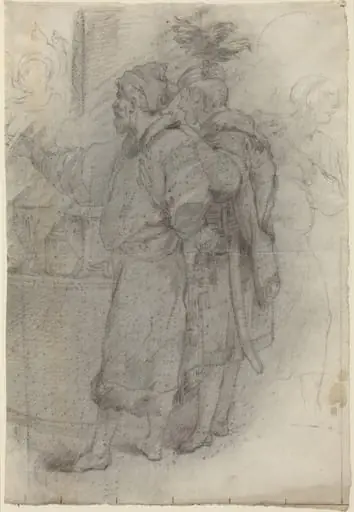 Two Standing Courtiers
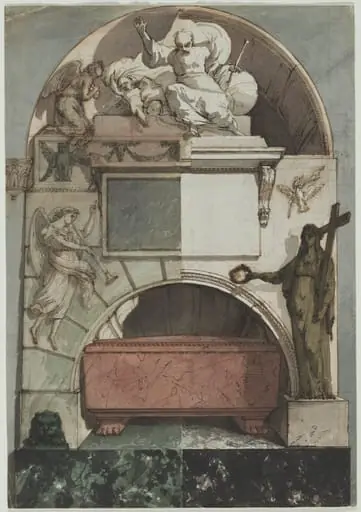 Design for a Fresco of an Artist's Tomb in the Certosa of Bologna (recto)
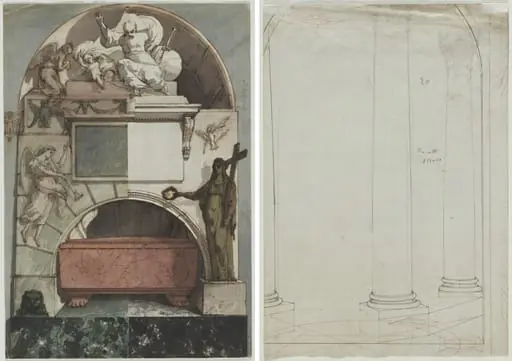 Design for a Fresco of an Artist's Tomb in the Certosa of Bologna (recto); Architectural Drawing of Columns (verso)
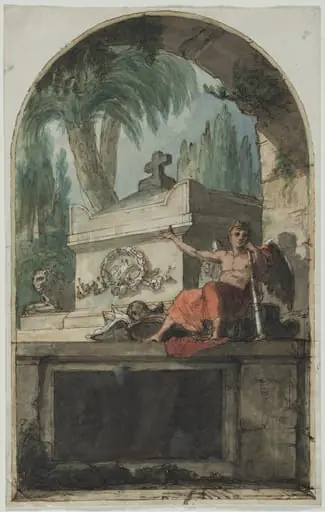 Design for a Fresco of the Tomb of Vincenzo Martinelli (1737-1807) in the Certosa of Bologna
 Architectural Drawing of Columns (verso)
 Meeting of Solomon and Queen of Sheba
 Esther before Ahasuerus
 Study for King Josiah Rending his Garments
 The Disputation of Saint Catherine of Alexandria
 Stage Design for a Domed Temple Interior with a Sun Disk above the Altar
 The Sacrifice of Iphigenia (recto) / Study of a Male Nude (verso)
 Martyrdom of Saint Lawrence
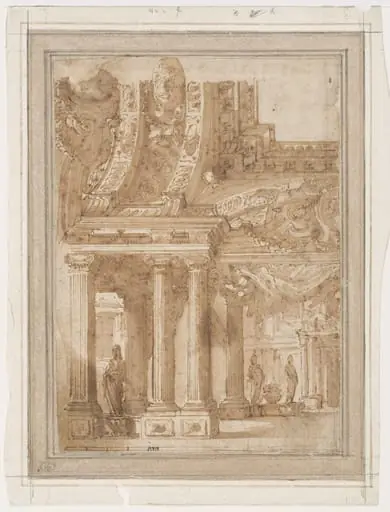 Untitled
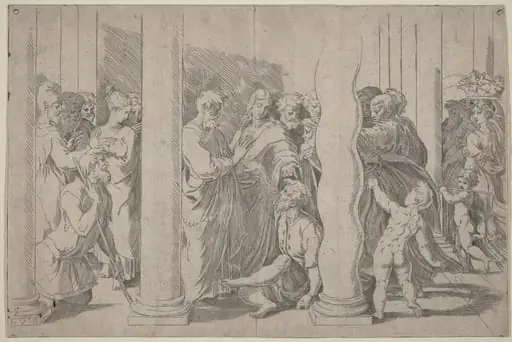 Saints Peter and John Healing the Lame Man at the Golden Gate
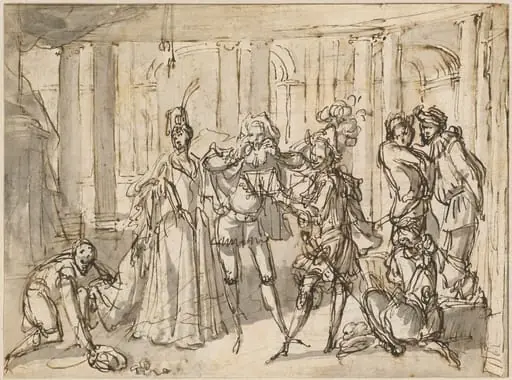 A Performance by the Commedia dell'Arte
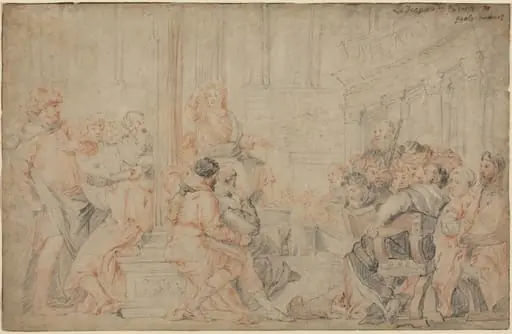 Christ among the Doctors
 A Triumphal Procession in Ancient Rome