Artwork
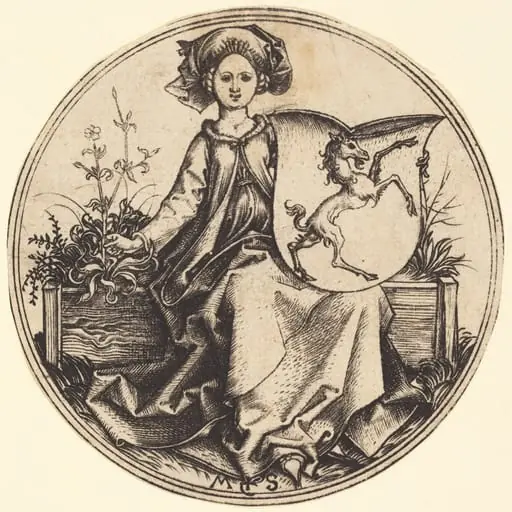
Shields with Rabbit and Moor's Head, Held by Wild Man
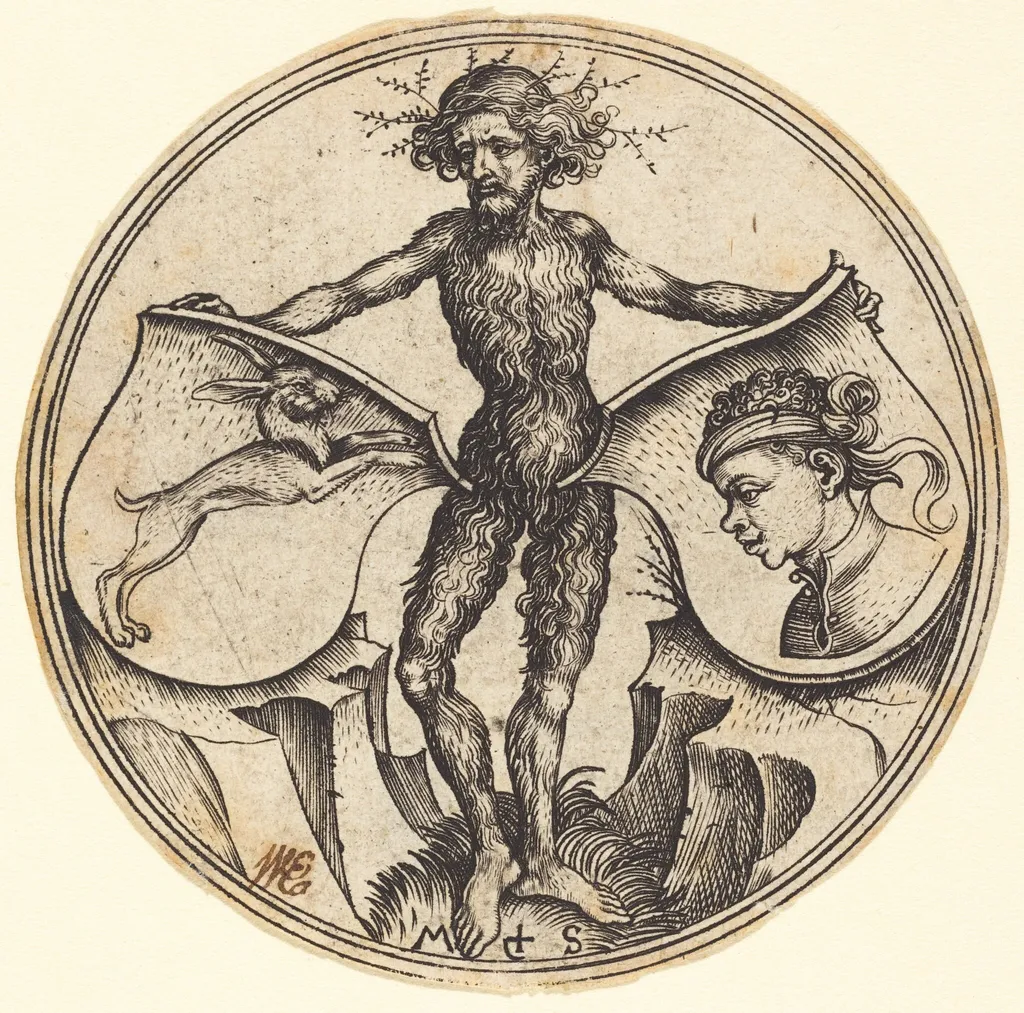
Shields with Rabbit and Moor's Head, Held by Wild Man is an ink print by the Renaissance artist Martin Schongauer. It dates from 1485 and is held in the collection of the National Gallery of Art.
About this work
Overview
The image presents a wild man holding two heraldic shields, rendered with contrasting textures: the figure’s roughness against the shields’ clarity.
Created around 1485, this engraving by Martin Schongauer is one of 116 surviving prints bearing his monogram. Executed in fine, controlled lines on laid paper, it exemplifies the technical precision that established Schongauer as the foremost printmaker in northern Europe before Dürer. The image presents a wild man holding two heraldic shields, rendered with contrasting textures: the figure’s roughness against the shields’ clarity.
Subject & Meaning
The wild man, a figure from medieval folklore symbolizing untamed nature, grips two shields bearing symbolic charges: a rabbit and a moor’s head. These emblems may reference heraldic traditions or allegorical meanings tied to fertility, otherness, or territorial identity. Their placement within the wild man’s grasp suggests a tension between civilization and wilderness, though no definitive narrative is recorded.
Technique & Style
Schongauer employed fine, cross-hatched lines to model form and depth, achieving subtle gradations of tone without wash or color. The wild man’s shaggy body contrasts with the smooth, sharply defined shields, highlighting his mastery of texture. The background is left largely unworked, enhancing the visual prominence of the central figures and their symbolic elements.
History & Provenance
The print emerged from Schongauer’s workshop in Colmar, where he produced engravings for a growing market of collectors and religious institutions. While its early ownership is undocumented, it circulated widely across Europe due to the reproducibility of print. Surviving impressions are held in major collections, reflecting its enduring presence in early print history.
Context
In late 15th-century Europe, engraving was emerging as a respected medium for artistic expression beyond manuscript illumination. Schongauer’s work bridged Gothic traditions and Renaissance naturalism, influencing contemporaries and later artists. The use of heraldic motifs alongside folkloric figures reflects a period fascinated by symbolic systems and the interplay of myth and identity.
Legacy
Schongauer’s technical innovations in engraving set a standard for subsequent generations, including Dürer, who studied his prints closely. This work, though not a narrative scene, demonstrates how symbolic imagery could be rendered with psychological and visual complexity. Its survival in multiple copies underscores its role in disseminating artistic ideas across regions before the age of mass reproduction.
Artist & collection

Artist
Martin Schongauer, also known as Martin Schön or Hübsch Martin by his contemporaries, was an Alsatian engraver and painter.