Artwork
The Archangel Gabriel
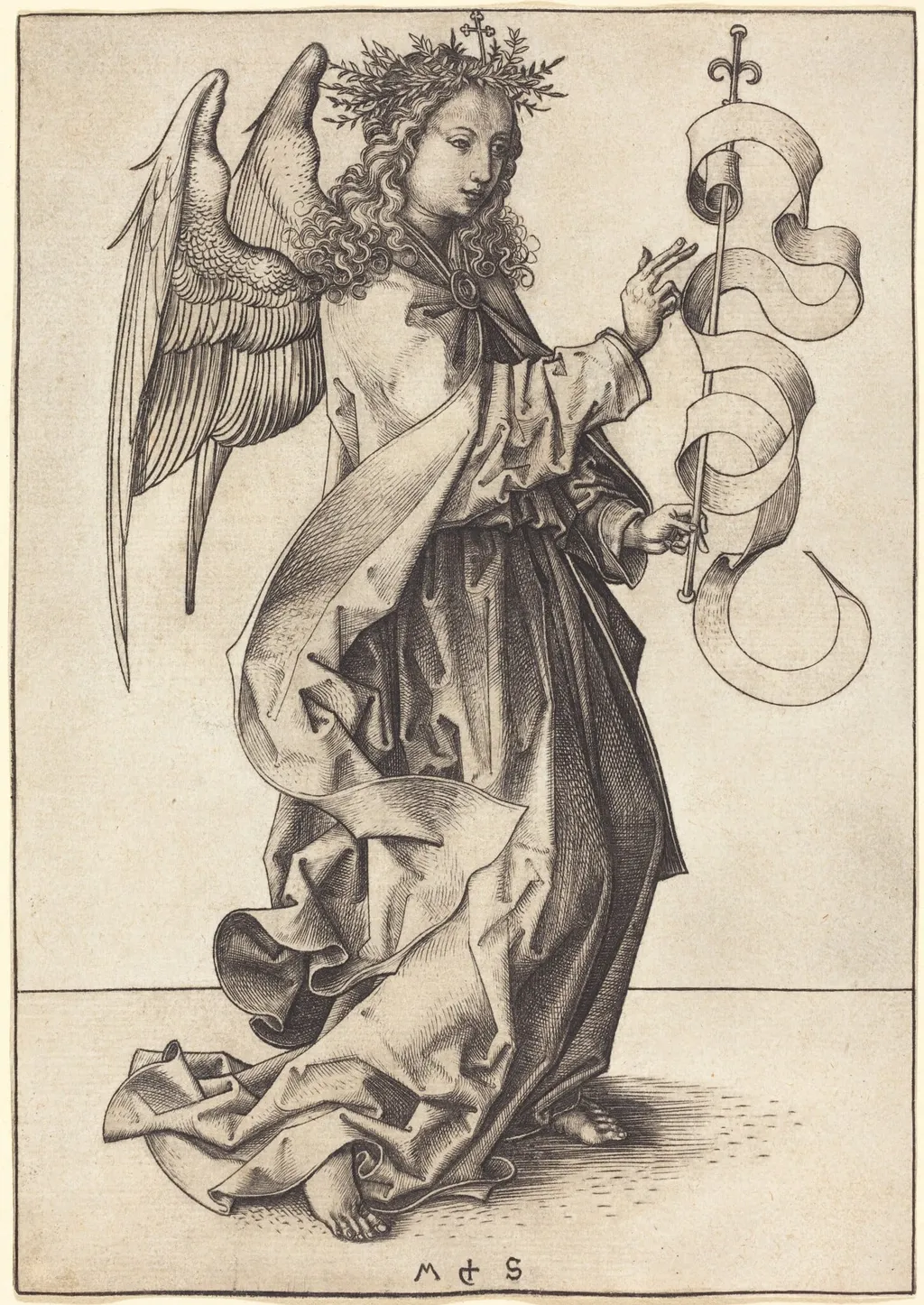
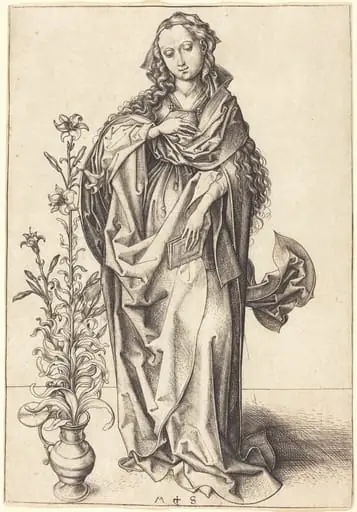
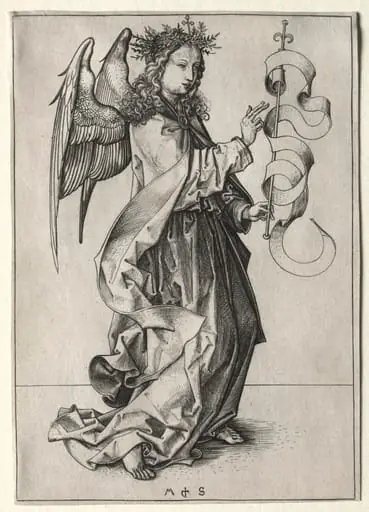
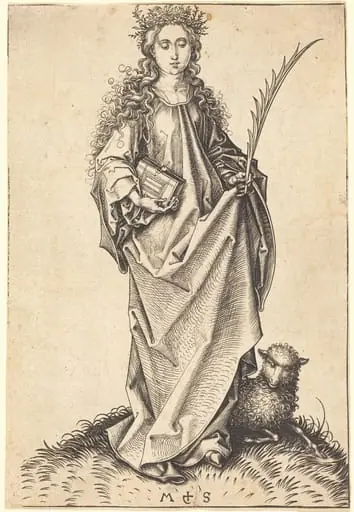
The Archangel Gabriel is an ink print by the Renaissance artist Martin Schongauer. It dates from 1490 and is held in the collection of the National Gallery of Art.
About this work
Overview
Executed on laid paper using the engraving technique, it reflects Schongauer’s mastery of fine-line incision and tonal gradation.
Created around 1490, this engraving by Martin Schongauer depicts the Archangel Gabriel in a moment of quiet solemnity. Executed on laid paper using the engraving technique, it reflects Schongauer’s mastery of fine-line incision and tonal gradation. As one of 116 known engravings by the artist, it stands as a testament to his technical precision and influence in Northern European printmaking during the late 15th century.
Subject & Meaning
The figure represents Gabriel, the divine messenger from Christian tradition, often associated with the Annunciation. Here, he is shown kneeling, staff in hand, as if pausing before delivering a sacred message. The wreath of leaves and flowing robes suggest celestial dignity, while the calm, focused expression conveys divine purpose. The composition avoids overt drama, emphasizing stillness and spiritual gravity.
Technique & Style
Schongauer employed fine, controlled lines to model form and texture, particularly in the angel’s feathers and drapery. The engraving’s depth arises from densely hatched shadows and delicate cross-contours, achieved by incising metal with a burin. The laid paper’s subtle texture enhances the tonal richness, while the intricate detailing reveals the artist’s ability to translate three-dimensional volume into flat, inked impressions.
History & Provenance
Schongauer, active in Colmar until his death in 1491, produced engravings widely circulated across Europe. This work likely entered collections soon after its creation, benefiting from the growing demand for printed religious imagery. Though its early ownership is undocumented, its survival in multiple impressions suggests it was reproduced and distributed through established print networks of the period.
Context
In the decades before Dürer’s rise, Schongauer dominated Northern printmaking, bridging late Gothic traditions with emerging Renaissance naturalism. His engravings were studied by contemporaries and apprentices, influencing the development of the medium. This image of Gabriel aligns with devotional practices of the time, where visual representations of angels served as aids to prayer and meditation.
Legacy
Schongauer’s engravings, including this depiction of Gabriel, set a standard for technical refinement in Northern Europe. His use of line to suggest texture and volume became a model for later printmakers. Though his paintings are fewer and less preserved, his prints endured as instructional examples, shaping the evolution of engraving well into the 16th century.
Artist & collection

Artist
Martin Schongauer, also known as Martin Schön or Hübsch Martin by his contemporaries, was an Alsatian engraver and painter.