Artwork
Women Bathing
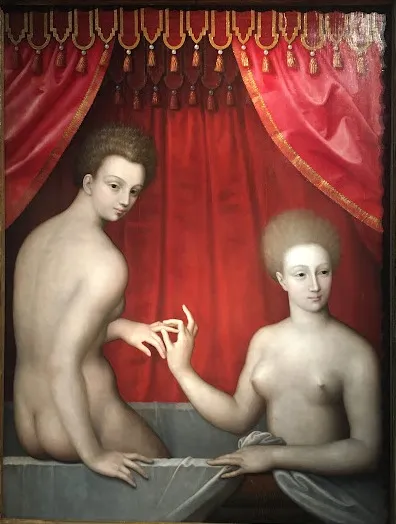
Women Bathing is an oil painting by the Early Baroque Italian artist School of Fontainebleau. It dates from 1598 and is held in the collection of the Uffizi Gallery.
About this work
Overview
The composition centers on quiet interaction rather than narrative action, reflecting the courtly aesthetic favored in late 16th-century French art.
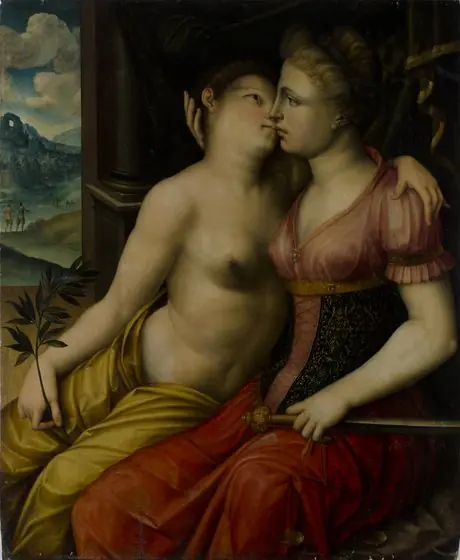
Painted in oil around 1598, this work is attributed to the School of Fontainebleau, a group of artists active in France under the influence of Italian Mannerism. It portrays two nude women in a private bathing setting, rendered with refined detail and a subdued palette. The composition centers on quiet interaction rather than narrative action, reflecting the courtly aesthetic favored in late 16th-century French art.
Subject & Meaning
The figures are widely identified as Gabrielle d'Estrées and her sister, the Duchess of Villars. The scene alludes to a known anecdote in which Gabrielle, mistress of King Henry IV, was depicted in a moment of private intimacy. The gesture of the seated woman pinching her sister’s nipple may symbolize fertility or the couple’s close bond, subtly reinforcing political and dynastic themes tied to the royal court.
Technique & Style
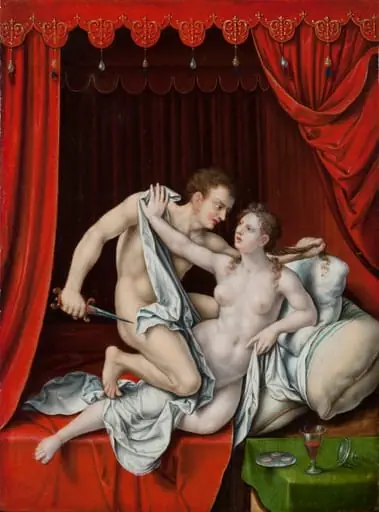
The painting employs smooth, polished brushwork characteristic of the Fontainebleau style, with soft transitions between skin tones and fabric. The red velvet curtains, edged with gold tassels, frame the figures and enhance the sense of enclosure. Light falls evenly, avoiding dramatic contrast, which contributes to the calm, introspective mood. The figures’ elongated proportions and idealized forms reflect Mannerist conventions adapted from Italian sources.
History & Provenance
The painting entered the Medici collection in Florence by the early 17th century and has remained in the Uffizi Gallery since at least the 18th century. Its presence in Italy suggests it was acquired as a curiosity or example of French courtly art. Despite its attribution to the School of Fontainebleau, the exact artist remains unidentified, though it likely originated from a workshop associated with the royal château.
Context
Created during the reign of Henry IV, the painting reflects the blending of French and Italian artistic traditions at the French court. The depiction of a royal mistress in a private moment was unusual in public art, yet tolerated as a symbol of legitimacy and continuity. Such works served both as personal memorials and as subtle political statements within the complex dynamics of courtly life.
Legacy
The painting remains one of the few surviving examples of French Mannerist portraiture that combines intimacy with symbolic depth. It influenced later depictions of female nudes in European art, particularly in its restrained eroticism and psychological nuance. While not widely known outside specialist circles, it is studied for its unique position at the intersection of courtly culture and artistic innovation.
Artist & collection
Artist
The School of Fontainebleau painted elegant nudes in cool, shadowy forests and marble halls, blending myth and luxury.