Artwork
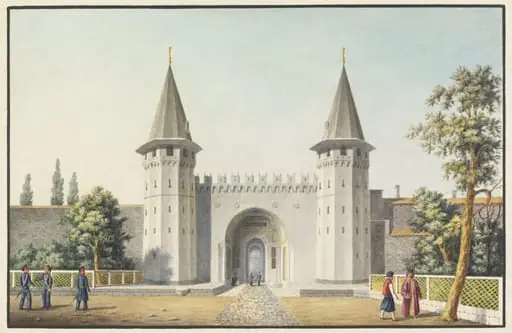
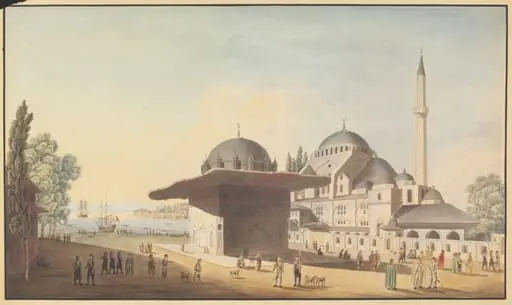
The Bab-i Hümayün or Imperial Gate of Topkapi Sarayi, with the Fountain of Sultan Ahmet III
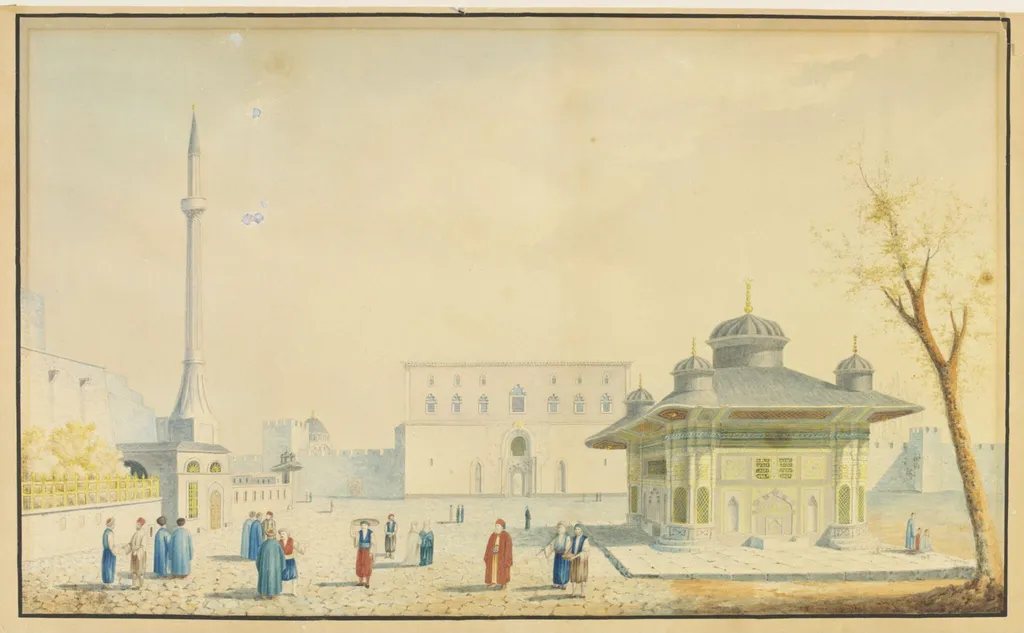
The Bab-i Hümayün or Imperial Gate of Topkapi Sarayi, with the Fountain of Sultan Ahmet III is a watercolor work on paper by the Romanticist artist Giuseppe Schranz. It dates from 1837 and is held in the collection of the Victoria and Albert Museum. This watercolour on paper, measuring roughly 25.
About this work
Overview
5 × 45 cm, portrays the Imperial Gate of Topkapi Palace together with the Fountain of Sultan Ahmet III.
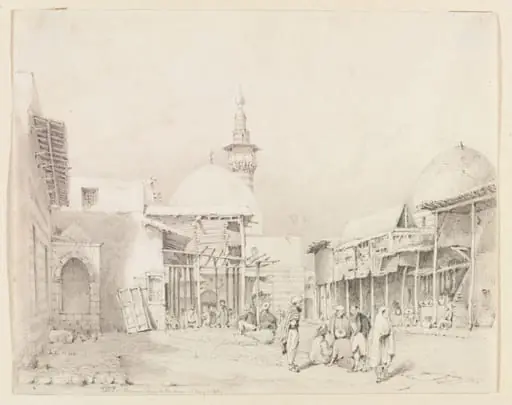
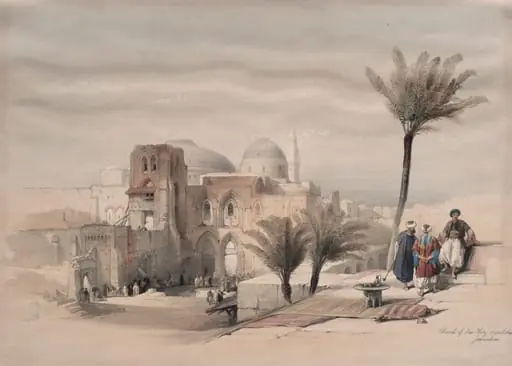
This watercolour on paper, measuring roughly 25.5 × 45 cm, portrays the Imperial Gate of Topkapi Palace together with the Fountain of Sultan Ahmet III. A faint watermark reads “J WHATMAN TURKEY MILL 1834,” indicating the paper’s origin. The composition captures a spacious courtyard, a distant domed structure, and a foreground pavilion beside a tiled fountain, populated by figures in loose robes and hats.
Subject & Meaning
The scene records a ceremonial entrance to the Ottoman imperial complex, emphasizing the architectural grandeur of the gate and the adjacent fountain commissioned by Sultan Ahmet III. By including everyday passers‑by, the image juxtaposes the monumental with the quotidian, suggesting the gate’s role as both a royal threshold and a public thoroughfare.
Technique & Style
Executed in transparent watercolour washes, the work relies on delicate tonal gradations to render the pale sky and dust‑colored pavement. Fine linear details outline the intricate patterns on the domed building, while broader strokes convey the soft illumination that unifies the courtyard’s architecture and its human activity.
History & Provenance
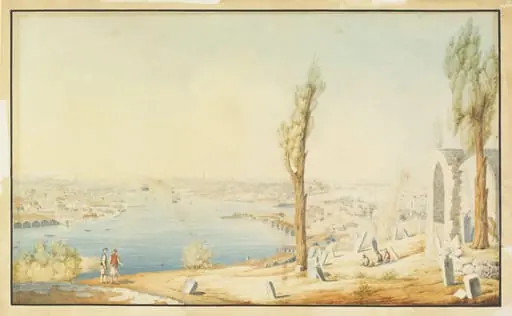
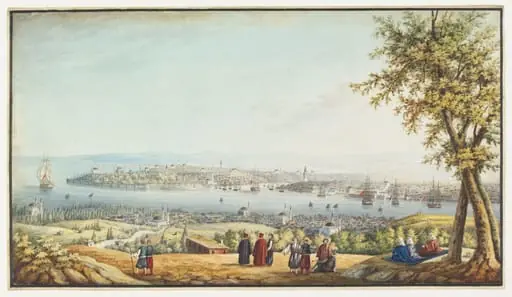
Created as part of a series of seven Constantinople views by Giuseppe Schranz, the drawing likely dates to his residence in the city between 1836 and 1837. An inscription on the reverse records a sale at Sotheby’s in 1981. Although signed to Schranz, scholars note that his sisters, Margerita or Francesca—also present in Constantinople at the time—may have produced the piece.
Context
The work belongs to a broader European fascination with Ottoman architecture during the early nineteenth century, when travelers and artists documented the empire’s landmarks. Watercolour was a favored medium for such topographical studies, allowing rapid yet detailed rendering of foreign sites for audiences back home.
Artist & collection
Artist
Giuseppe Schranz painted watercolours of 19th-century Istanbul. These soft, detailed views show city gates, mosques, and the waterway between Europe and Asia. He captured places like the Middle Gate of Topkapi Palace…