Artwork
Haghia Sophia
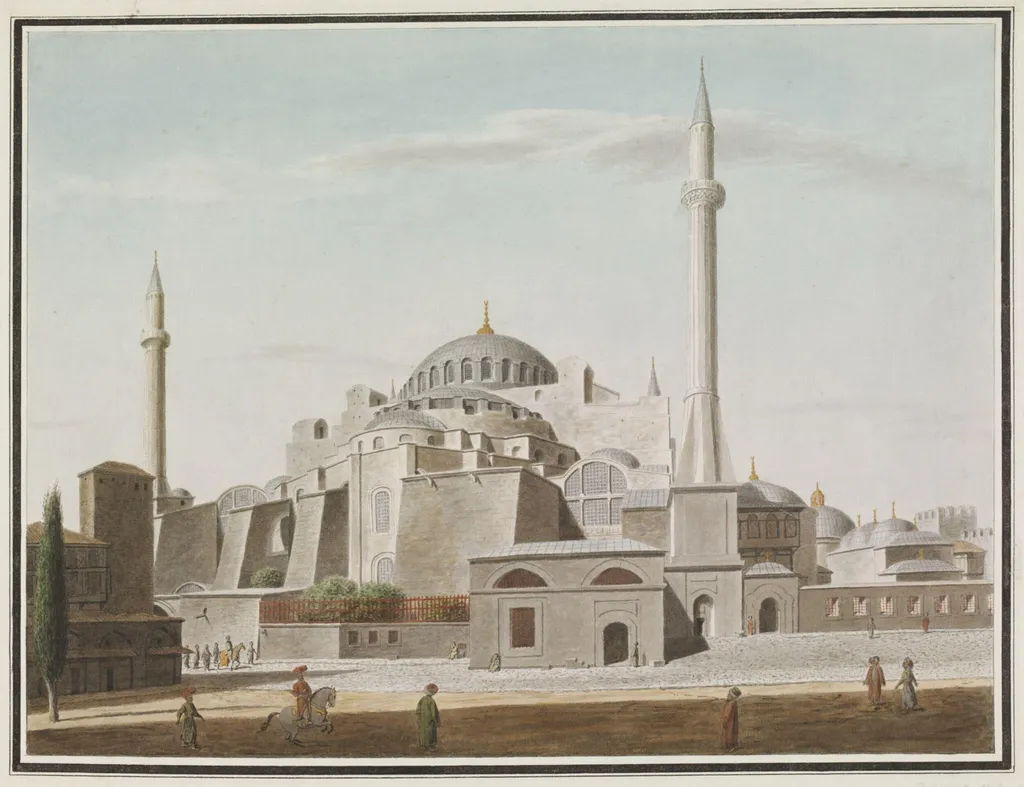
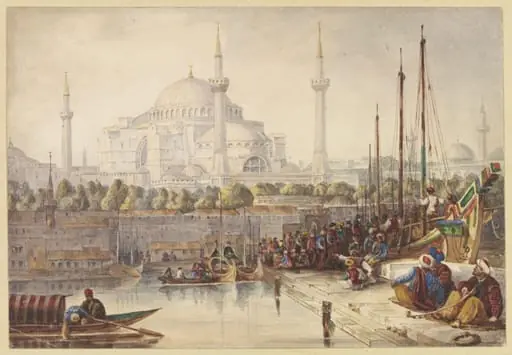
Haghia Sophia is a watercolor work on paper by the Romanticist artist Unknown. It dates from 1810 and is held in the collection of the Victoria and Albert Museum. A watercolour from 1810 depicts the Hagia Sophia, rendered by an unidentified artist.
About this work
Overview
It captures the structure’s monumental form with restrained palette and gentle lighting, emphasizing volume over detail.
A watercolour from 1810 depicts the Hagia Sophia, rendered by an unidentified artist. The work entered the W. T. Spencer collection in January 1970 after being acquired for £20. It captures the structure’s monumental form with restrained palette and gentle lighting, emphasizing volume over detail. The medium’s delicacy contrasts with the building’s enduring scale, suggesting contemplation rather than documentation.
Subject & Meaning
The composition centers on Hagia Sophia’s massive central dome, flanked by smaller domes and arched structures, conveying its architectural hierarchy. Figures on a path below—pedestrians and riders—scale the building’s grandeur, hinting at human presence amid enduring stone. A lone tree to the left introduces natural elements, grounding the sacred structure in a quiet, earthly setting without narrative emphasis.
Technique & Style
The artist employed soft washes and muted earth tones to model form through subtle gradations of light. Surface textures are simplified, with smooth transitions between dome and wall, avoiding fine detail. The pale sky and subdued palette reflect a preference for atmospheric harmony over vivid contrast, aligning with early 19th-century topographical watercolour practices that valued mood over precision.
History & Provenance
Created in 1810, the watercolour remained in private hands until its acquisition by W. T. Spencer in 1970. No record of earlier ownership or exhibition exists. The modest purchase price suggests it was regarded as a modest study rather than a significant artistic work at the time of acquisition, though its subject matter lends it historical interest.
Context
Produced during a period of growing European interest in Ottoman architecture, the work reflects a quiet fascination with Byzantine heritage. Though not overtly Romantic in dramatic tone, its emphasis on scale, solitude, and atmospheric light aligns with broader aesthetic currents valuing contemplative views of historical monuments, particularly in travel sketches of the era.
Legacy
As a modest, unsigned watercolour, it contributes little to the artist’s known oeuvre—assuming one exists—but serves as a quiet record of Hagia Sophia’s appearance in the early 1800s. Its preservation offers insight into how Western observers engaged with the structure before modern restoration efforts, preserving a moment of visual encounter rather than monumental celebration.
Artist & collection

 Domestic Scene
 Giacomo and Cardinal Marco, investing Andrea, Abbot of San Zeno, with his Benefice
 The Nymph of Fontainebleau
 Portrait of a Woman
 Madonna and Child with Saints in the Enclosed Garden
 Venus and Minerva
 Family Group of Four on Sofa
 Wall painting from Room H of the Villa of P. Fannius Synistor at Boscoreale
![Haghia Sophia [Aya Sofia] with the first gate of the Seraglio, Constantinople, by Unknown](https://artifactworldgallery.com/img/unknown--haghia-sophia-aya-sofia-with-the-first-gate-of-the-seraglio--346691ca3173c818-w320.webp)
![Yeni Valide Camii [New Mosque] and Haghia Sophia from the Golden Horn, by John Richard Coke Smyth](https://artifactworldgallery.com/img/john-richard-coke-smyth--yeni-valide-camii-new-mosque-and-haghia-sophia-from-the-gold--da58b2fc47388c7c-w320.webp)