Artwork
Natură moartă
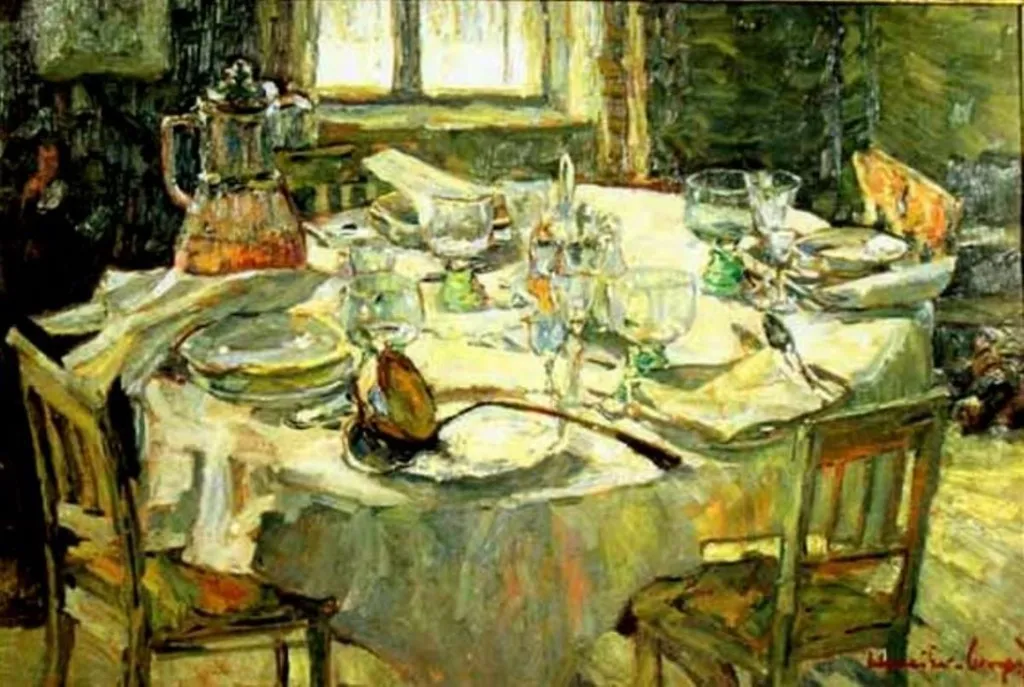
Natură moartă is an unspecified painting by Rudolf Schweitzer-Cumpăna. It dates from 1936 and is held in the collection of the National Museum of Art of Romania.
About this work
Overview
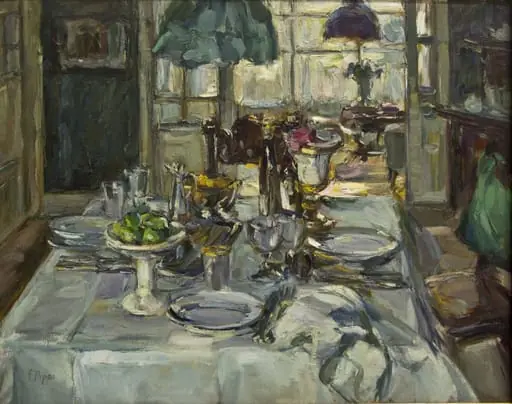
Rudolf Schweitzer-Cumpăna’s *Natură moartă* (Still Life) dates to approximately 1936. The composition centers on a dining table draped in white linen, arranged with glassware, crockery, and cutlery. A window at the rear introduces natural light, while the interior is rendered in muted ochres, greens, and browns, lending the scene a subdued warmth.
Subject & Meaning
The tableau presents an everyday domestic setting, devoid of human presence. By isolating objects typically associated with shared meals, the artist invites contemplation of transience and routine. The absence of food or figures underscores the quiet permanence of inanimate things, suggesting a meditation on the passage of time within familiar spaces.
Technique & Style
Executed in a representational manner, the painting demonstrates precise rendering of textures—fabric folds, reflective glass, and polished metal. Schweitzer-Cumpăna employs chiaroscuro to model forms, using sharp contrasts between illuminated surfaces and shadowed recesses. The palette remains restrained, with tonal variations enhancing spatial depth and material specificity.
History & Provenance
Created around 1936, *Natură moartă* emerged during a period of artistic engagement with still-life traditions in Eastern Europe. Little documentation survives regarding its early ownership, though it reflects the broader influence of interwar realism. The work has since entered private or institutional collections, preserving its status as a representative example of the genre.
Context
The painting aligns with contemporaneous trends that favored meticulous observation over abstraction. Schweitzer-Cumpăna’s approach mirrors regional adaptations of European realism, where domestic interiors served as vehicles for technical mastery. The emphasis on light and volume also echoes earlier traditions, particularly Dutch Golden Age still lifes, though filtered through a modern lens.
Artist & collection
Artist
Rudolf Schweitzer-Cumpăna was a Romanian painter. Born in Pitești into an ethnic German family, he finished high school in his native town before attending the Royal Academy of Arts at Berlin from 1904 to 1909, studying…