Artwork
A toddy-tapper
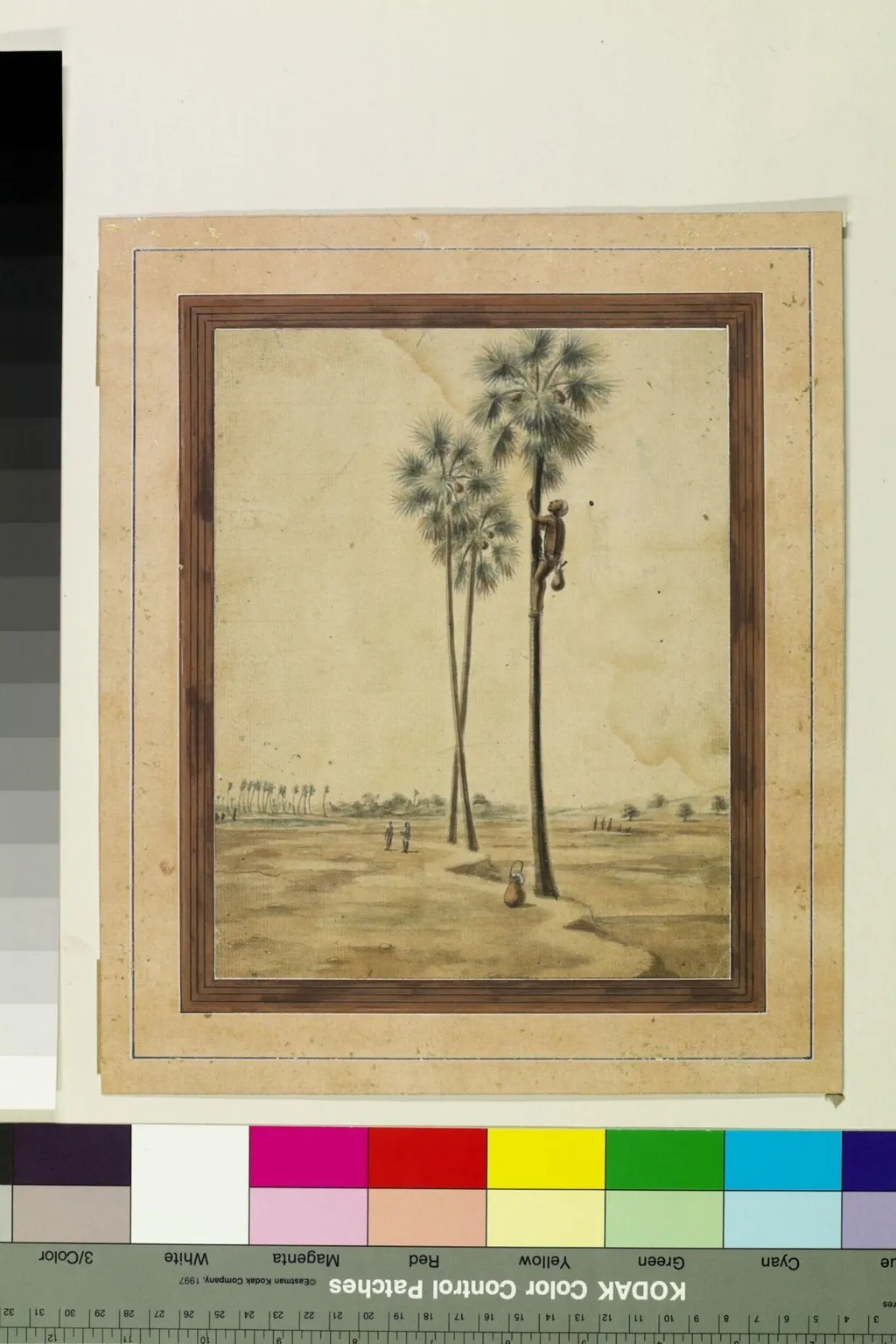
A toddy-tapper is a paint painting by the Patna School of Painting artist Sewak Ram. It dates from 1805 and is held in the collection of the Victoria and Albert Museum. This early nineteenth‑century canvas portrays a solitary laborer climbing a palm tree to harvest its sap.
About this work
Overview
This early nineteenth‑century canvas portrays a solitary laborer climbing a palm tree to harvest its sap. The figure, equipped with a simple tool, directs the flowing white liquid into a vessel, capturing a moment of everyday production in northern India. The work belongs to the genre of paintings commissioned by British officials in colonial India, often termed Company paintings.
Subject & Meaning
The central figure is a toddy tapper, a specialist who extracts the sugary sap of palms such as the palmyra, date or coconut. In local practice the sap, known as tari, serves both as a fermented drink and as a leavening agent for bread. The painting records this routine activity, offering insight into the material culture and subsistence strategies of the region.
Technique & Style
Though the artist’s hand is individual, the overall approach aligns with the pragmatic realism characteristic of Company painters serving colonial patrons.
Executed with clear, economical lines, the composition emphasizes the figure’s posture and the tree’s trunk rather than decorative detail. The palette is restrained, focusing on muted earth tones that highlight the contrast between the white sap and the darker bark. Though the artist’s hand is individual, the overall approach aligns with the pragmatic realism characteristic of Company painters serving colonial patrons.
History & Provenance
Created around 1805, the work is attributed to Sewak Ram (c. 1770–1830), a Patna‑based painter whose name appears on a few surviving pieces. Unlike many anonymous Company paintings, this canvas bears his signature, allowing scholars to link it to a small body of documented Indian artists who worked for the East India Company during its territorial expansion in the eighteenth and early nineteenth centuries.
Context
The painting emerged at a time when the British East India Company was consolidating administrative control over large swaths of the subcontinent. Company patrons commissioned visual records of local customs, economies, and landscapes to inform officials and audiences back in Britain. This image thus functions both as an ethnographic document and as a decorative object for colonial offices.
Artist & collection

 Daphne laureola (laurbær-dafne)
 Faggot Gatherer (recto) Study of a Head seen from Below (verso)
 Red Sea. Date Palms and Arab Fort on the Island of Camaran
 Palm Trees, Red
 Windsor Forest
 明 董其昌 山水圖詩 冊|Landscapes and Poems
 Acrobats
 Vishnu as Kalki avatar
 Palma Real
 Depictions of a Bronze-winged dove and a Goshawk of Northern India
 Treader out of grain