Artwork
Carnival at Algeciras
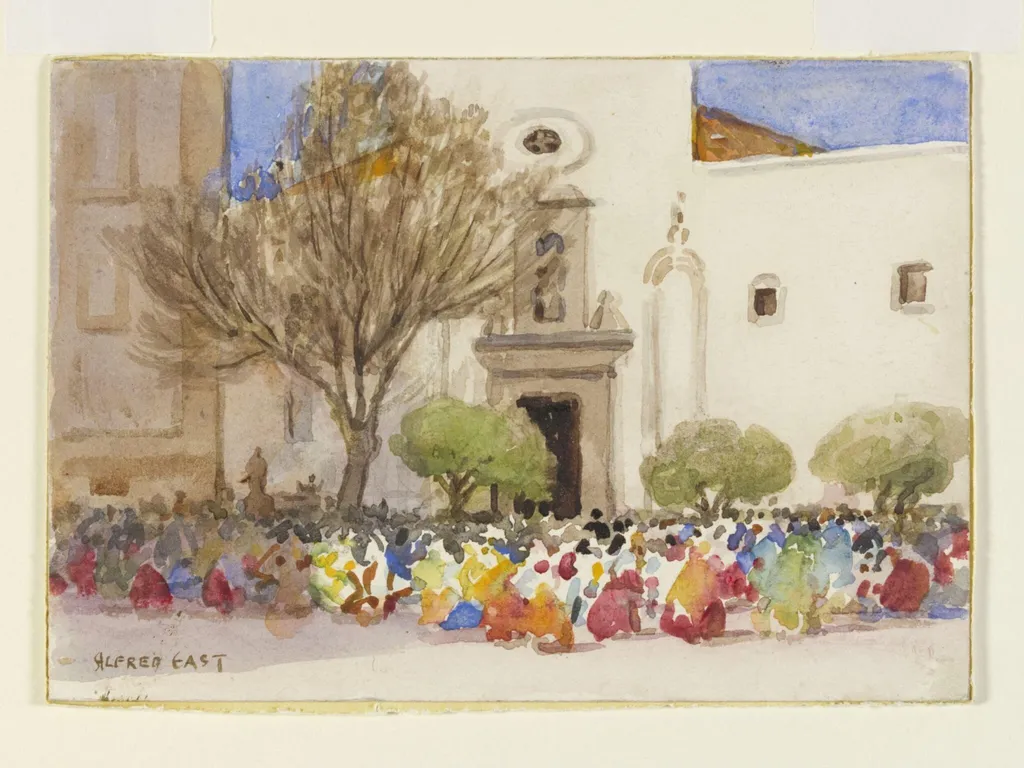
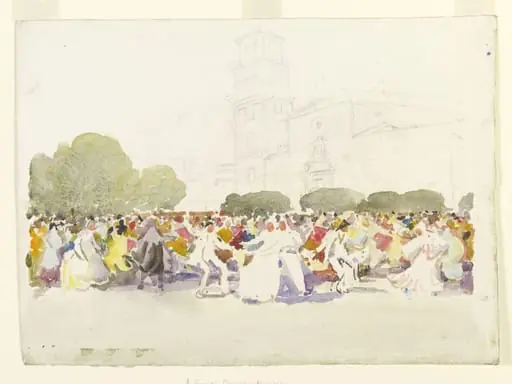
Carnival at Algeciras is a watercolor work on paper by the Impressionist artist Alfred East. It dates from 1870 and is held in the collection of the Victoria and Albert Museum.
About this work
Overview
The work is part of the Victoria and Albert Museum’s collection, where it is preserved as an example of 19th-century British travel art.
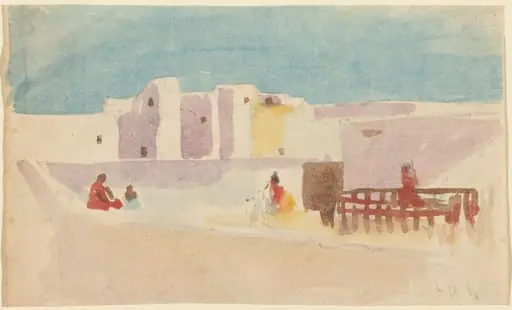
Carnival at Algeciras is a watercolour painting completed by Sir Alfred East in 1870. It depicts a public celebration in the Spanish town of Algeciras, rendered with delicate washes and restrained tonality. The work is part of the Victoria and Albert Museum’s collection, where it is preserved as an example of 19th-century British travel art. East’s approach emphasizes atmosphere over detail, capturing a moment of communal life with quiet observation.
Subject & Meaning
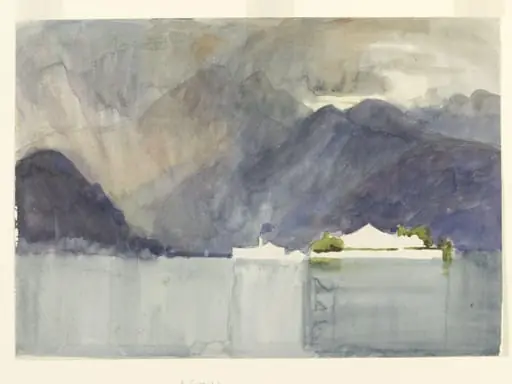
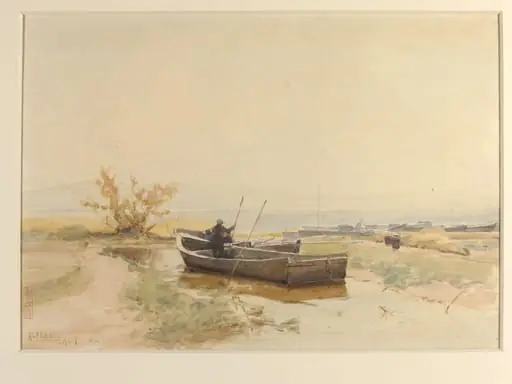
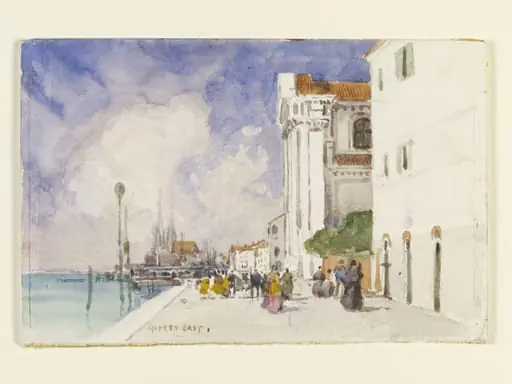
The scene portrays a local festival, with figures gathered before a substantial white building, some seated, others standing in casual postures. The absence of overt spectacle suggests an intimate, everyday celebration rather than a grand public event. The composition invites contemplation of ordinary human activity, reflecting East’s interest in documenting cultural rituals encountered during his travels in southern Europe.
Technique & Style
East employed transparent watercolour to build subtle layers of tone, avoiding bold outlines in favor of soft transitions. The muted palette—pale blues, greys, and ochres—enhances the sense of ambient light and quiet motion. The tree in the foreground, rendered with loose brushwork, frames the scene and provides scale, while the building’s architectural simplicity grounds the composition in realism without romanticizing it.
History & Provenance
Painted during East’s travels in Spain, the work reflects his practice of sketching on location and refining studies into finished watercolours upon return to England. It entered the Victoria and Albert Museum’s collection in the late 19th or early 20th century, likely through acquisition or donation. Its preservation there underscores its value as a record of British artists’ engagement with Mediterranean life during the Victorian era.
Context
In the 1870s, British artists increasingly traveled abroad, drawn by the light and customs of southern Europe. East’s work aligns with a broader trend of topographical and ethnographic watercolour painting, where accuracy and mood took precedence over dramatic narrative. This piece reflects both the influence of French Realism and the British tradition of watercolour landscape, blending observation with restrained aesthetic sensibility.
Legacy
Carnival at Algeciras remains a representative example of East’s travel-based watercolours, valued for their quiet authenticity rather than technical flourish. It contributes to the historical record of how British artists interpreted foreign cultures during a period of expanding imperial and artistic exchange. The painting continues to be studied for its nuanced handling of light, space, and social observation.
Artist & collection