Artwork
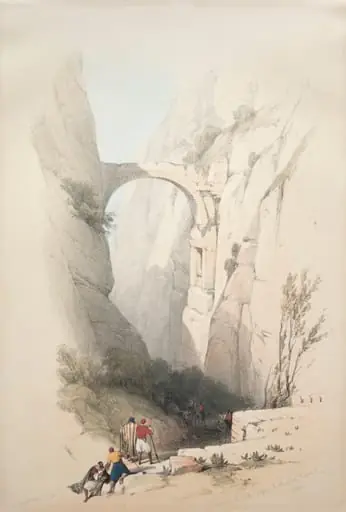
`Entrance to Petra at the Pass of El Syk, Waadi Moosa'
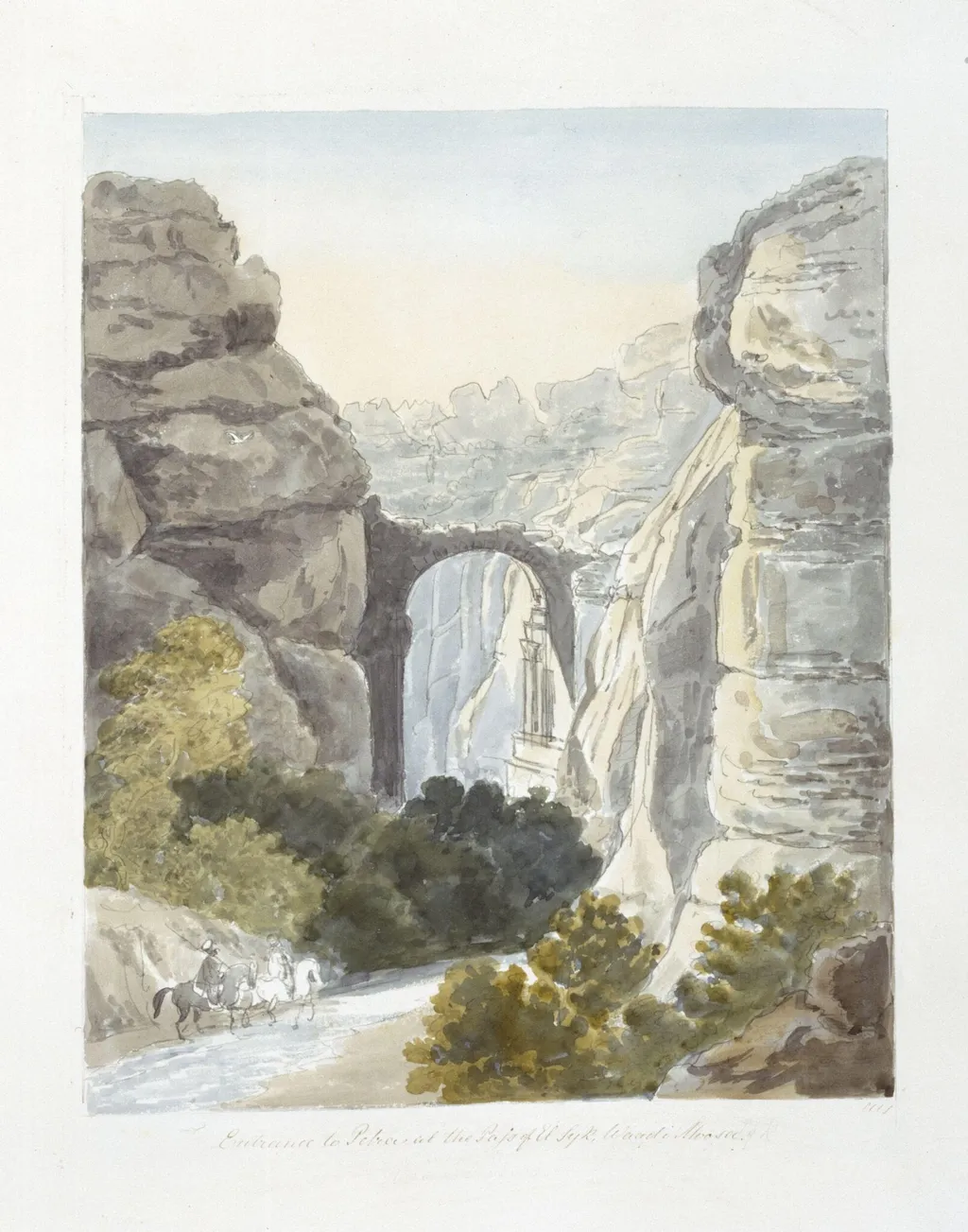
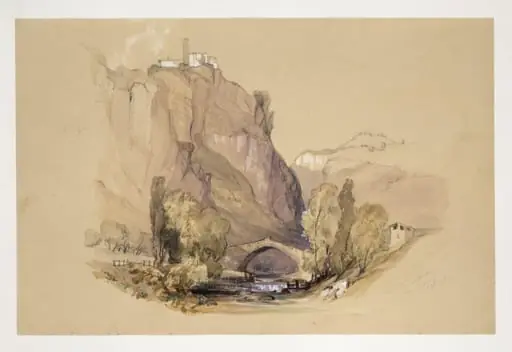
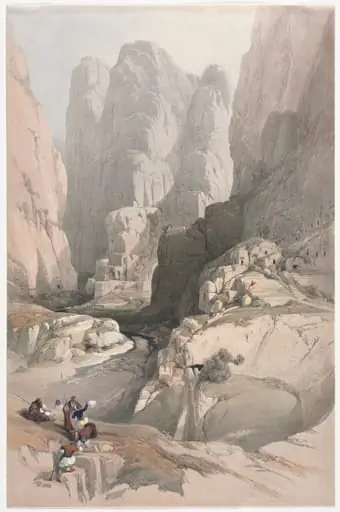
`Entrance to Petra at the Pass of El Syk, Waadi Moosa' is a watercolor work on paper by the British Romanticist artist Charles Hamilton Smith. It dates from 1818 and is held in the collection of the Victoria and Albert Museum.
About this work
Overview
Created as part of a larger collection of Orientalist landscapes, the work belongs to a bound volume of 105 drawings, bound in crimson morocco.
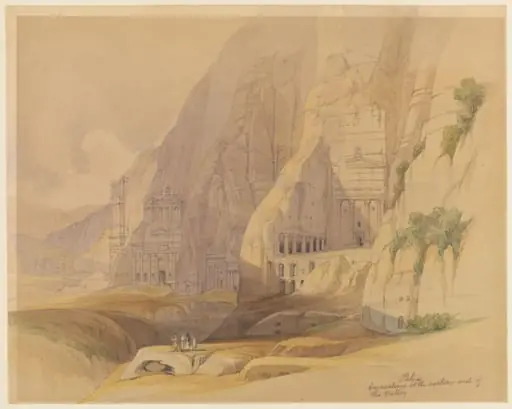
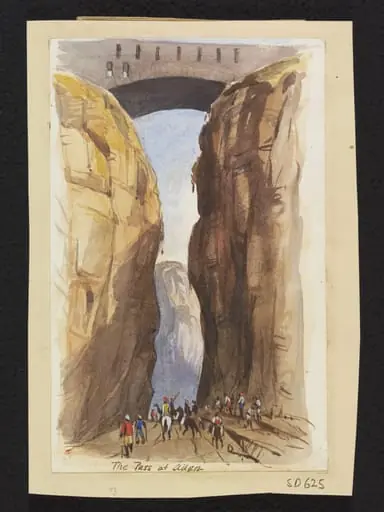
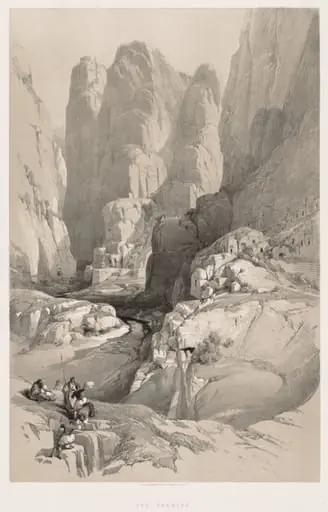
Charles Hamilton Smith’s watercolour depicts the narrow canyon leading into the ancient city of Petra, known locally as the Siq. Created as part of a larger collection of Orientalist landscapes, the work belongs to a bound volume of 105 drawings, bound in crimson morocco. Though the series is titled as depicting Syria, Arabia, and Persia, Smith likely never visited the region, relying instead on published illustrations and secondhand accounts to construct the scene.
Subject & Meaning
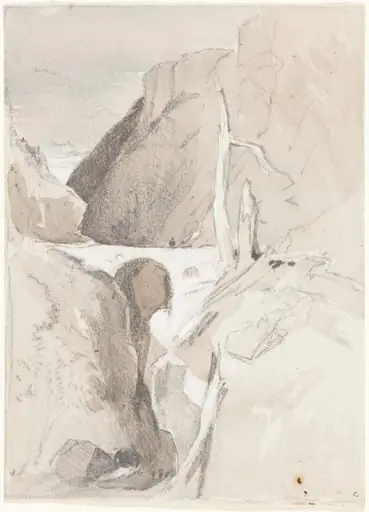
The composition focuses on the dramatic approach to Petra through a winding, cliff-lined pass. The distant archway, rendered with subtle atmospheric perspective, evokes a sense of hidden antiquity. Sparse vegetation and a faint trickle of water suggest life amid arid isolation. The image does not depict a specific moment or event but rather conveys a romanticized vision of the East as mysterious and untouched, aligning with 19th-century European fascination with distant, ancient civilizations.
Technique & Style
Smith employed delicate watercolour washes to suggest the layered strata of sandstone cliffs and the hazy distance of the canyon’s end. Light tonal variations, rather than sharp lines, define form and depth. The sky is rendered in pale, even washes, softening the scene’s edges. Minimal detail in foreground flora and the absence of human figures emphasize the landscape’s solitude, reflecting a restrained Romantic sensibility focused on mood over narrative.
History & Provenance
The watercolour was part of Smith’s personal collection of Orientalist studies, later dispersed among institutional archives. Related drawings from the same series are held in the Victoria and Albert Museum and the Searight Archive. The volume’s crimson morocco binding indicates its intended status as a curated private collection rather than a public publication. Its creation likely occurred in the 1820s–1830s, during Smith’s active period of compiling illustrated travel literature.
Context
In early 19th-century Britain, images of the Near East were often based on secondhand sources due to limited travel access. Smith’s work reflects a broader trend among artists and publishers who compiled exotic landscapes from engravings, journals, and explorer accounts. His depiction of Petra aligns with Romantic-era ideals that valued nature’s sublime scale and the mystique of lost civilizations, even when rendered without firsthand experience.
Legacy
Though Smith never traveled to Petra, his watercolour contributed to the visual mythology of the site in European consciousness. The work survives as a document of how distant places were imagined and reconstructed through available imagery. Its preservation in major archives underscores its role in the history of Orientalist art, not as an eyewitness record, but as a product of mediated perception and cultural curiosity.
Artist & collection
Artist
Charles Hamilton Smith painted the landscapes and ruins he saw while traveling, using fine brushes and watercolors.