Artwork
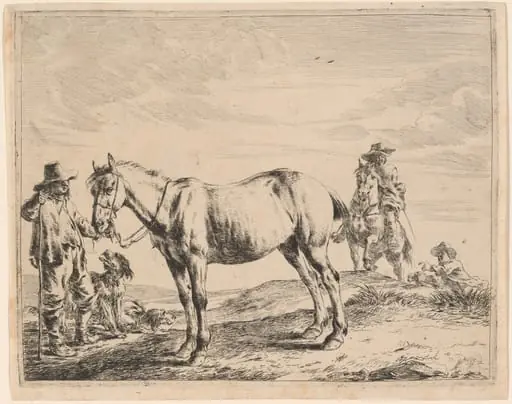
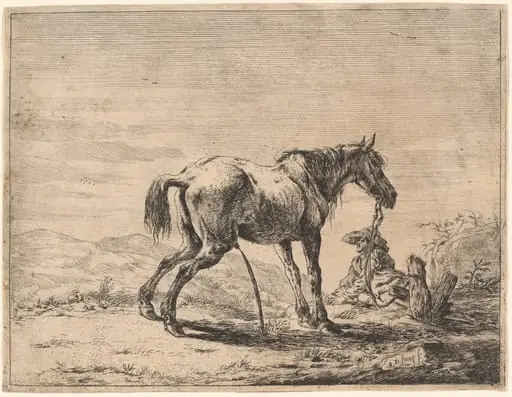
A Pissing Horse Held by a Man
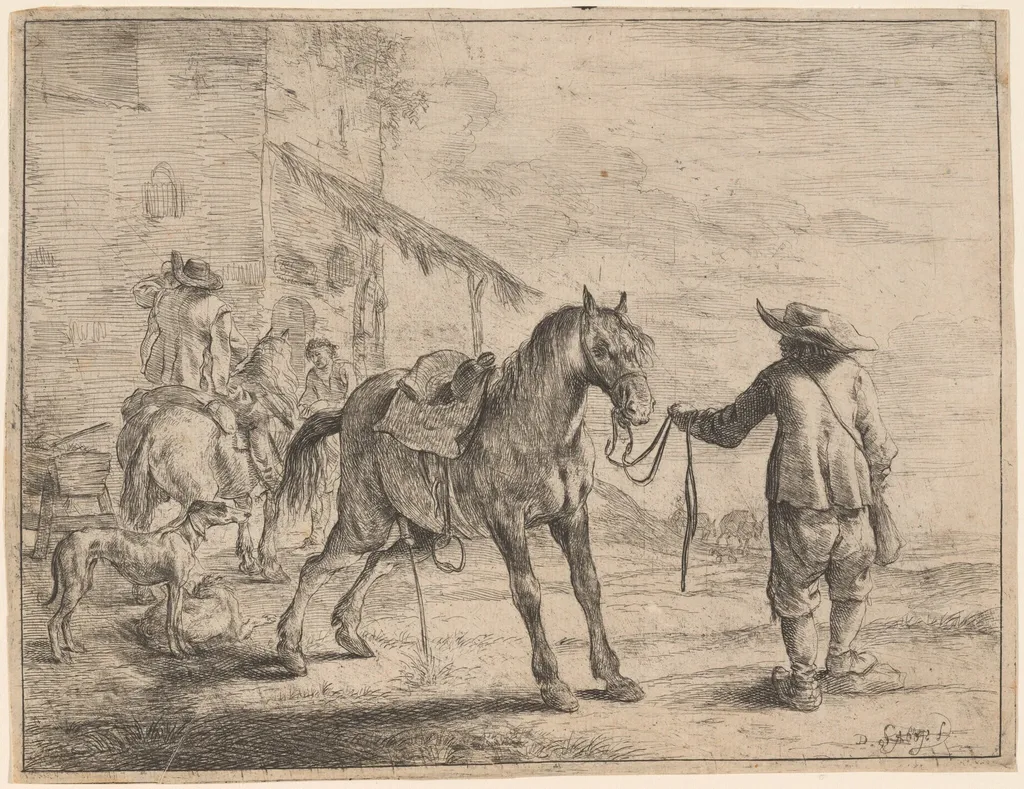
A Pissing Horse Held by a Man is an ink print by the Baroque artist Dirck Stoop. It dates from 1651 and is held in the collection of the National Gallery of Art.
About this work
Overview
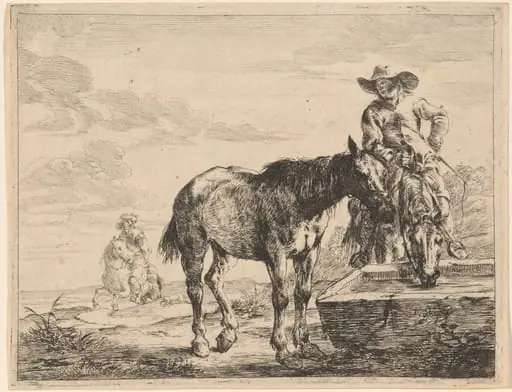
The composition centers on the animal and its handler, with a dog in the foreground and distant figures and structures suggesting a rural setting.
Created in 1651 by Dirck Stoop, this etching depicts a man holding the reins of a horse mid-urination. The scene is rendered in fine linear detail characteristic of 17th-century printmaking. The composition centers on the animal and its handler, with a dog in the foreground and distant figures and structures suggesting a rural setting. The work belongs to a tradition of genre scenes that capture everyday, often humorous, moments.
Subject & Meaning
The image presents a candid, unidealized moment of animal behavior, juxtaposed with human control. The man’s calm grip on the reins contrasts with the horse’s involuntary action, introducing a subtle tension between order and nature. The presence of a dog and distant observers implies a casual, possibly rural setting where such scenes were unremarkable. The work may reflect a dry wit common in Dutch prints of the period.
Technique & Style
Executed as an etching, the image uses acid to bite lines into a metal plate, allowing for fine, controlled detail. Stoop’s lines are precise yet fluid, defining the horse’s musculature, the man’s clothing, and the textured ground with economy. Background elements are lightly suggested, directing focus to the central figures. The tonal range is restrained, relying on line rather than shading to convey form and depth.
History & Provenance
The print was made in the Netherlands during the mid-17th century, a time when etching flourished as a medium for both artistic and satirical expression. While specific early ownership records are undocumented, the work aligns with the output of Dutch printmakers who circulated such images among collectors. Its survival reflects its place in private collections focused on genre and animal subjects.
Context
In 17th-century Dutch art, scenes of animals and rural life were common, often infused with quiet humor or moral observation. This print fits within a broader trend of depicting ordinary moments without grandeur. Unlike religious or mythological subjects, it embraces the mundane, reflecting a cultural shift toward valuing everyday experience as worthy of artistic attention.
Legacy
Though not widely reproduced or studied today, the etching remains an example of how Dutch printmakers captured unembellished moments with technical skill and subtle irony. It contributes to the understanding of genre imagery beyond formal portraiture or landscape, revealing how artists engaged with the physical and behavioral realities of their surroundings.
Own this work as a print
Artist & collection