Artwork
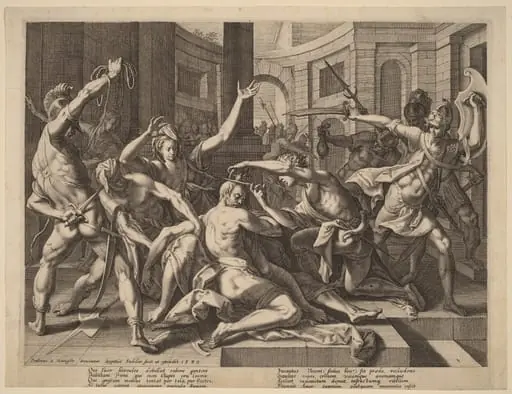
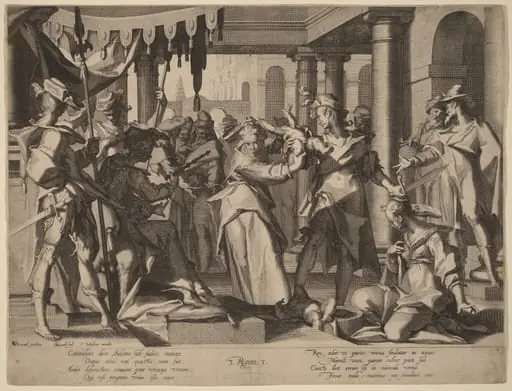
Beheading of the Roman Judge Papinian
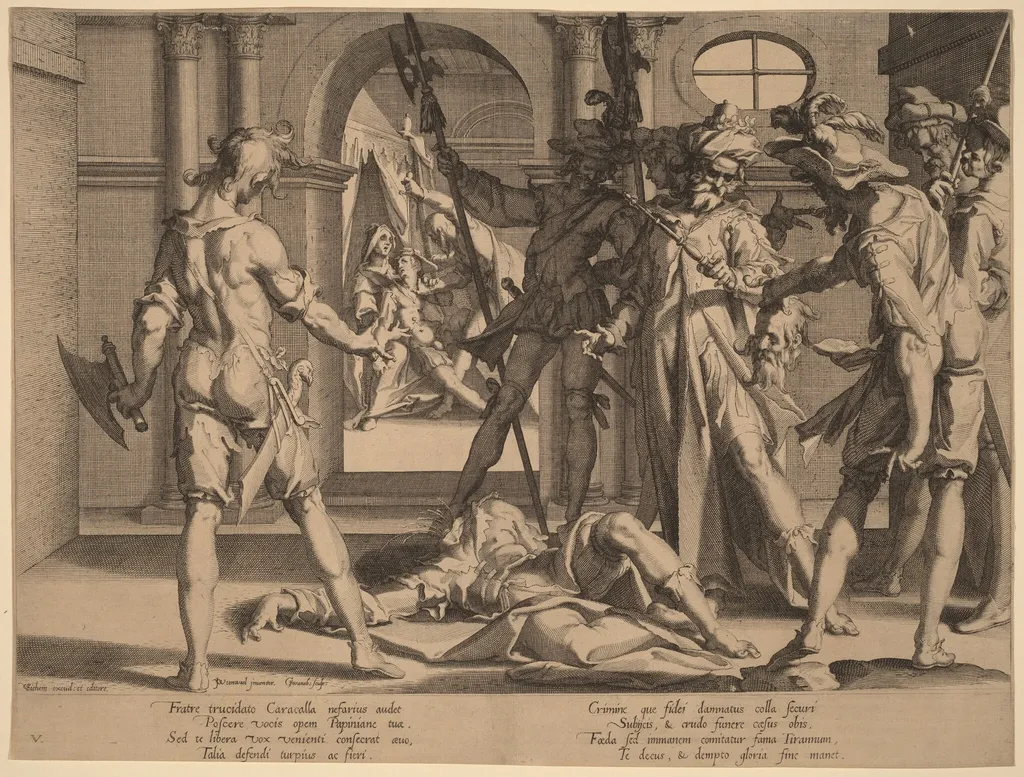
Beheading of the Roman Judge Papinian is an ink print by the Baroque artist Willem van Swanenburgh. It dates from 1606 and is held in the collection of the National Gallery of Art.
About this work
Overview
Willem van Swanenburgh’s engraving titled *Beheading of the Roman Judge Papinian* dates from 1606 and is executed on laid paper.
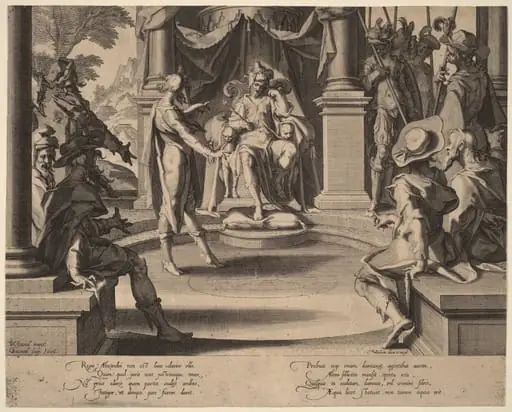
Willem van Swanenburgh’s engraving titled *Beheading of the Roman Judge Papinian* dates from 1606 and is executed on laid paper. The print presents a densely populated, tumultuous tableau in which a sword‑wielding armored figure looms over a kneeling man bound to a block, while a grieving woman clutches a child and another figure collapses nearby. Architectural ruins and a solitary cross loom in the background, underscoring the scene’s violence.
Subject & Meaning
The composition depicts the execution of Papinian, a Roman jurist, as recounted in contemporary Latin inscriptions accompanying the image. The chaotic crowd, anguished gestures, and stark contrast between the executioner’s authority and the victims’ helplessness convey themes of betrayal, judicial cruelty, and the fragility of civic order in the ancient world.
Technique & Style
Swanenburgh employed fine, intersecting lines and cross‑hatching to model flesh, armor, and stone, creating deep shadows that heighten the dramatic tension. The engraving’s meticulous line work allows for intricate detailing of facial expressions and textile folds, while the use of laid‑paper texture adds subtle tonal variation to the overall composition.
History & Provenance
Created in the early seventeenth century, the print reflects the period’s interest in classical antiquity and moral exempla. Although specific ownership records are scarce, the work survives in several European print collections, indicating its circulation among collectors of historical and legal subjects during the Dutch Golden Age.
Context
The early 1600s saw a resurgence of interest in Roman law and its moral lessons, often illustrated through prints for educational or devotional purposes. Van Swanenburgh’s choice of Papinian—a jurist revered for his integrity—aligns with contemporary debates about justice and the consequences of political treachery.
Artist & collection

![The Challenge [right], by Gabriel de Saint-Aubin](https://artifactworldgallery.com/img/gabriel-de-saint-aubin--the-challenge-right--75162e00e6876b27-w320.webp)
![The Martyrdom of Saints Peter and Paul [recto], by Antonio da Trento](https://artifactworldgallery.com/img/antonio-da-trento--the-martyrdom-of-saints-peter-and-paul-recto--a51e90060085a207-w320.webp)