Artwork
Devil Tempting St. Anthony
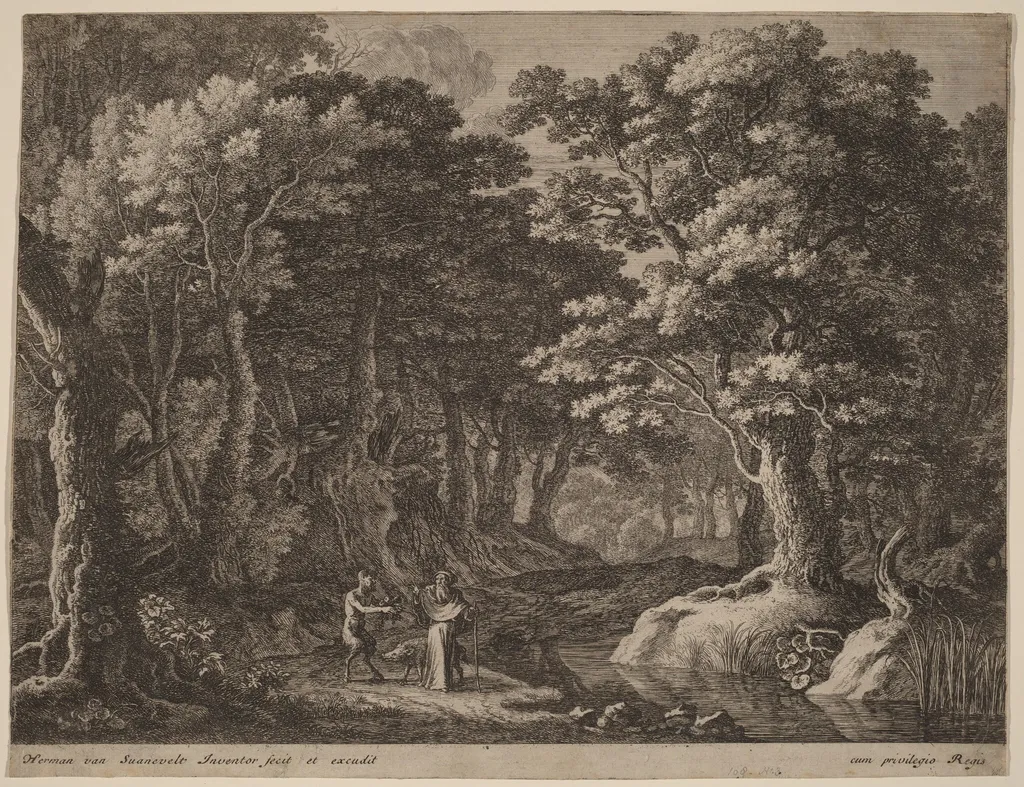
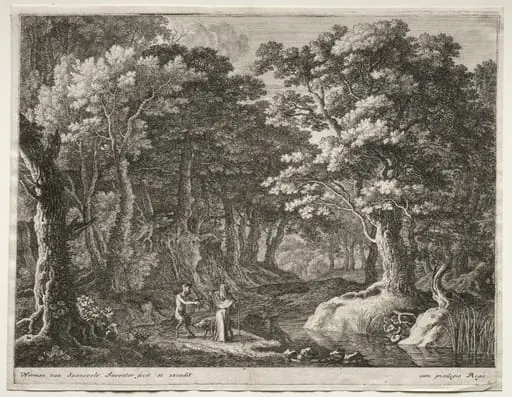
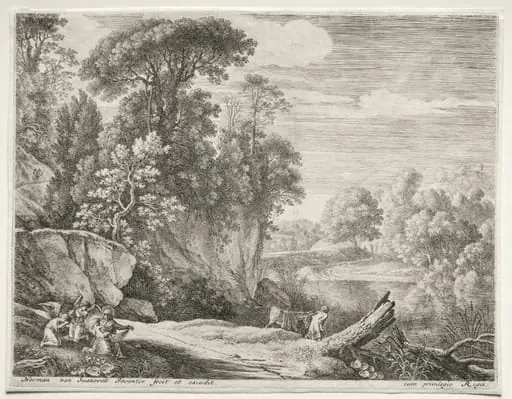
Devil Tempting St. Anthony is an ink print by the Baroque artist Herman van Swanevelt. It dates from 1628 and is held in the collection of the National Gallery of Art.
About this work
Overview
The composition emphasizes stillness and tension, with no overt violence or chaos, suggesting an internal struggle rather than a physical confrontation.
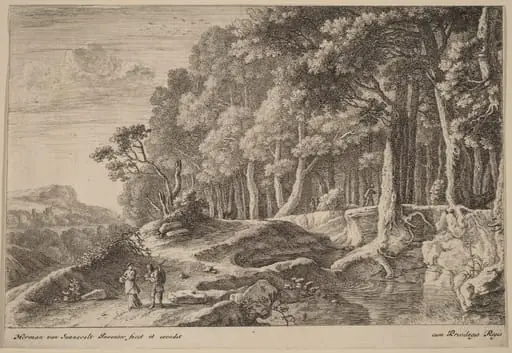
Herman van Swanevelt created this black-and-white etching in 1628, depicting a moment of spiritual trial. The scene unfolds in a shadowed woodland, where two figures interact beside a rocky stream. Fine, precise lines define the dense foliage and uneven terrain, while the sky is barely visible above. The composition emphasizes stillness and tension, with no overt violence or chaos, suggesting an internal struggle rather than a physical confrontation.
Subject & Meaning
The image illustrates the temptation of Saint Anthony by a demonic figure, a common theme in Christian ascetic tradition. One man stands composed, likely the saint, while the other, leaning on a staff, embodies the tempter. Their calm expressions contrast with the wild surroundings, implying that the real battle is internal. The setting—a secluded, overgrown forest—mirrors the isolation and moral complexity of spiritual testing.
Technique & Style
Van Swanevelt employed etching to achieve fine gradations of tone and texture. Delicate lines carve out the tangled branches, rough stones, and rippling water, while areas of dense shadow deepen the atmosphere. The figures are rendered with restrained detail, their simple garments and serene faces drawing focus to their psychological presence. The technique favors subtlety over drama, using line and contrast to evoke mood rather than narrative spectacle.
History & Provenance
Created in 1628 during van Swanevelt’s time in Rome, this print reflects his engagement with Northern European religious themes and Italian landscape traditions. Though few records detail its early ownership, it aligns with the broader circulation of devotional prints in early 17th-century Europe. The work likely served private contemplation, circulating among collectors interested in spiritual imagery and refined graphic art.
Context
In the early 1600s, etchings of saints in solitude were popular among religious and intellectual audiences, particularly in the Low Countries and Italy. Van Swanevelt’s version diverges from theatrical depictions by emphasizing quietude and naturalism. The dense, untamed landscape echoes contemporary interest in wilderness as a metaphor for inner turmoil, resonating with Counter-Reformation themes of personal faith and resistance to sin.
Legacy
This etching contributes to a tradition of intimate, psychologically nuanced religious prints that prioritized atmosphere over spectacle. Van Swanevelt’s restrained approach influenced later artists exploring spiritual themes through landscape and minimal gesture. While not widely reproduced, the work remains a quiet example of how printmaking could convey profound inner states through subtle technical mastery.
Own this work as a print
Artist & collection

 The Penitents: The Temptation of St. Anthony
 Salmacis and Hermaphroditus
 The Little Angels on the Hill
 Woods Bordered by a Stream
 The Donkey Led to the River
 The Flight into Egypt: The Holy Family
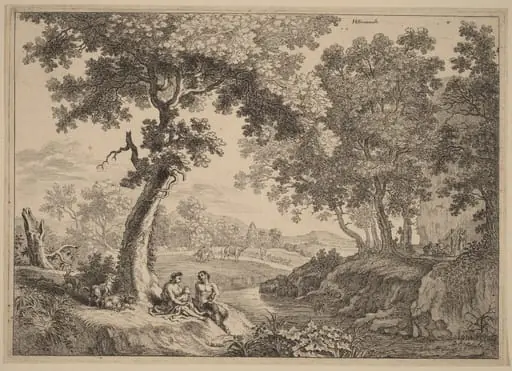 Satyr Family Seated under a Tree
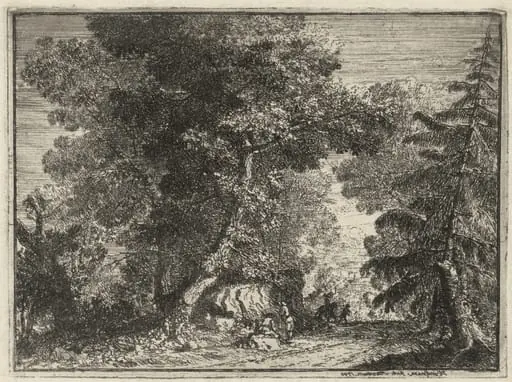 A Road through the Woods
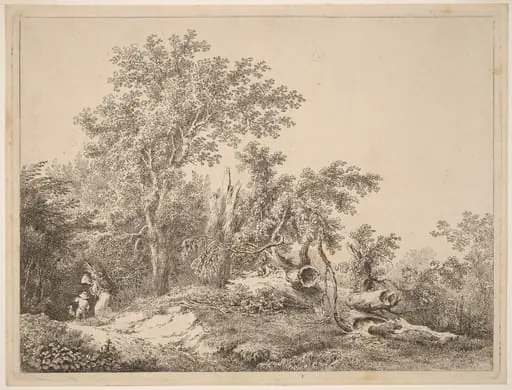 Landscape with Broken Tree
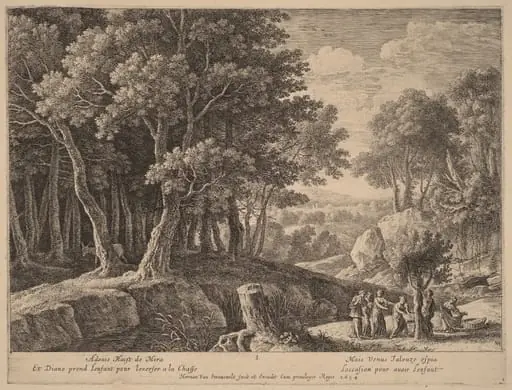 Birth of Adonis
 The Donkey Led to the River
 Winding River