Artwork
Panorama toward Athens from the Garden of Aphrodite
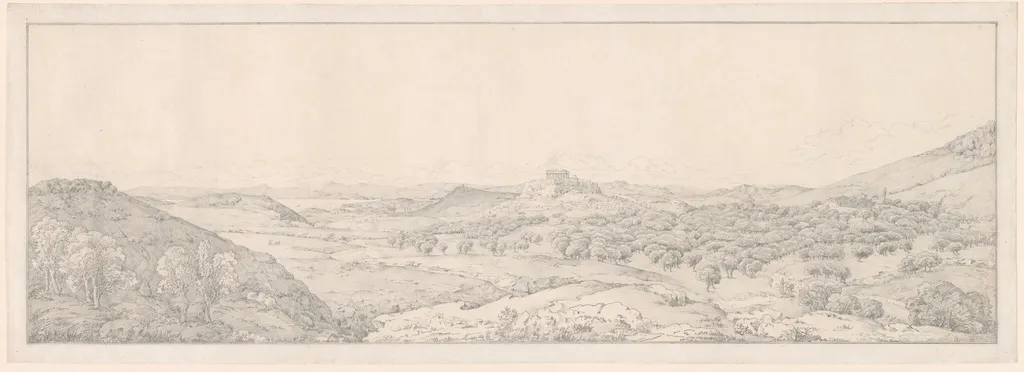
Panorama toward Athens from the Garden of Aphrodite is a graphite drawing by the Romanticist artist Joseph Thürmer. It dates from 1818 and is held in the collection of the National Gallery of Art.
About this work
Overview
The composition presents an expansive, level terrain that stretches toward a distant classical temple perched on a raised platform.
Joseph Thürmer’s 1818 drawing, titled Panorama toward Athens from the Garden of Aphrodite, is executed in graphite on wove paper. The composition presents an expansive, level terrain that stretches toward a distant classical temple perched on a raised platform. Sparse vegetation, winding paths and diminutive figures populate the foreground, while the sky is reduced to a thin line at the top, directing attention to the earth and architecture.
Subject & Meaning
The work depicts a broad, pastoral landscape that merges natural and built elements. The solitary temple, rendered in a style reminiscent of ancient Greek architecture, serves as a focal point, suggesting a dialogue between the cultivated garden and the mythic past associated with Aphrodite’s domain. The tiny human figures imply everyday activity within an idealized, timeless setting.
Technique & Style
Thürmer employs only graphite, allowing for a soft, atmospheric quality throughout the drawing. The line work is delicate, with subtle gradations that convey the rolling hills and distant forms without heavy shading. The minimal treatment of the sky and the sketch-like rendering of trees and figures are characteristic of early‑19th‑century Romantic landscape drawing, emphasizing mood over precise detail.
History & Provenance
Created in 1818, the drawing is an early example of Thürmer’s interest in classical motifs and expansive vistas. While specific ownership records are limited, the piece has been documented in collections focusing on Romantic-era European drawings, reflecting the period’s fascination with antiquity and the sublime landscape.
Context
The drawing aligns with Romanticism’s broader tendency to use landscape as a vehicle for emotional and philosophical expression. Artists of the time often placed ancient ruins within natural settings to evoke nostalgia for a lost golden age, and Thürmer’s inclusion of a temple within a cultivated garden follows this convention.
Artist & collection


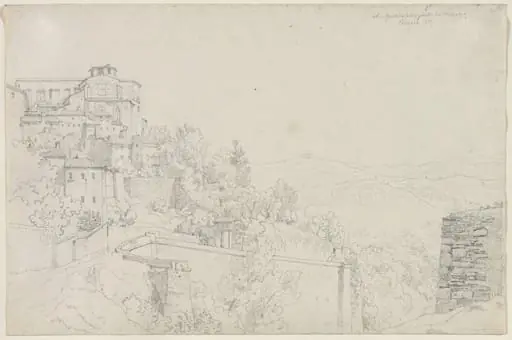 Saint Agostino from Bulagajo, Perugia (San Agostino dalla parte del Bulagajo, Perugia)
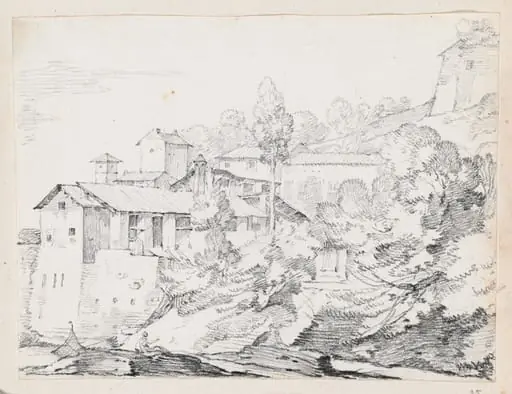 Italian Buildings on a Hillside
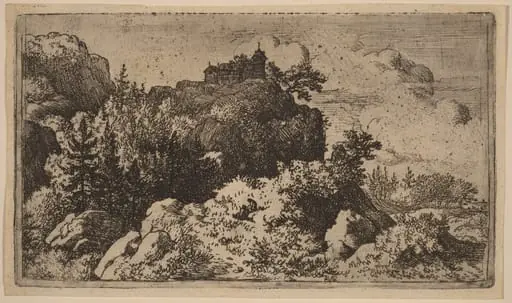 Firs in the Defile
 Valley in Bourgogne (Une vallee en Bourgogne)
 The Stream
 Landscape with the Village of Schenkenschanz, Gelderland
 Castle of Savelli. From the Inn at Albano.
 Valley of Veronne (La vallee de Veronne)
 The Castle Above the Meadows
 Panoramic River Landscape
 Landscape with a fortified wall and a hilltop village
 Landscape (Paysage)