Artwork
Panoramic River Landscape
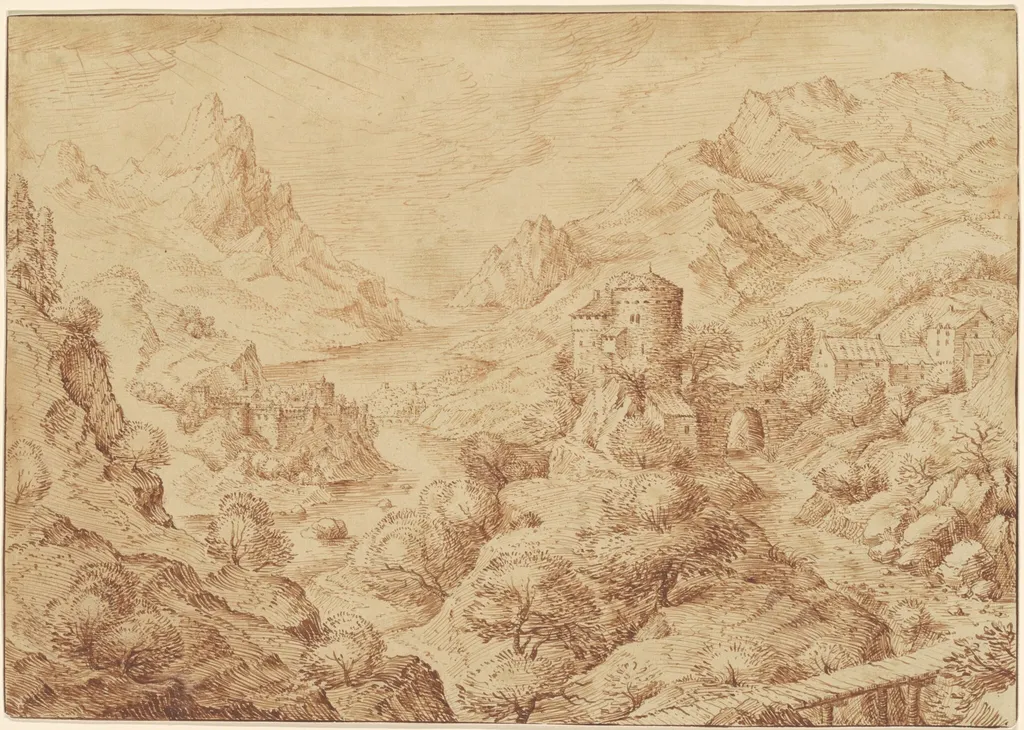
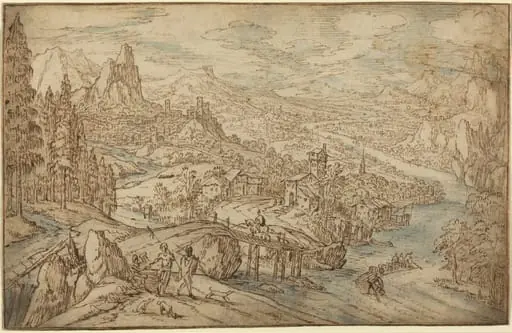
Panoramic River Landscape is an ink drawing by the Renaissance artist Jacob I Savery. It dates from 1590 and is held in the collection of the National Gallery of Art.
About this work
Overview
A landscape drawing attributed to Jacob I Savery, dated around 1590, executed in pen and brown ink with faint remnants of black chalk on laid paper. The work presents a broad, horizontal view of a river valley, emphasizing natural topography and atmospheric depth. Its modest scale and intimate medium suggest it was intended as a study or personal record rather than a public display.
Subject & Meaning
The scene depicts a winding river flanked by rolling hills, scattered trees, and distant settlements, rendered with careful attention to spatial recession. No human figures dominate the composition; instead, the focus lies in the quiet interplay of land and water. The absence of narrative or symbolic elements points to an observational intent, valuing the landscape as a subject in its own right.
Technique & Style
Savery employed fine, controlled pen strokes to define contours and texture, layered over delicate chalk underdrawing to suggest shadow and volume. The ink washes are restrained, avoiding dramatic contrast in favor of subtle tonal gradations. This method reflects a Northern Renaissance tradition of precise, topographical observation, prioritizing accuracy over expressive flourish.
History & Provenance
The drawing has been consistently attributed to Jacob I Savery since at least the early 20th century, based on stylistic parallels with his other known works.
The drawing has been consistently attributed to Jacob I Savery since at least the early 20th century, based on stylistic parallels with his other known works. Its provenance traces through private European collections, though its early ownership remains undocumented. It entered public collection holdings in the mid-20th century, where it is now preserved as part of a broader study of Flemish draftsmanship.
Context
Created during a period when landscape drawing was gaining scholarly interest in the Low Countries, the work aligns with a growing trend of recording natural scenery for its own sake. Savery, part of a family of artists known for topographical studies, contributed to this shift away from purely religious or mythological subjects, reflecting broader cultural curiosity in the natural world.
Legacy
Though not widely exhibited, the drawing is cited in scholarly literature as an example of early Flemish landscape observation. It contributes to understanding how artists of the late 16th century approached naturalism without idealization, laying groundwork for later developments in Dutch landscape painting.
Own this work as a print
Artist & collection


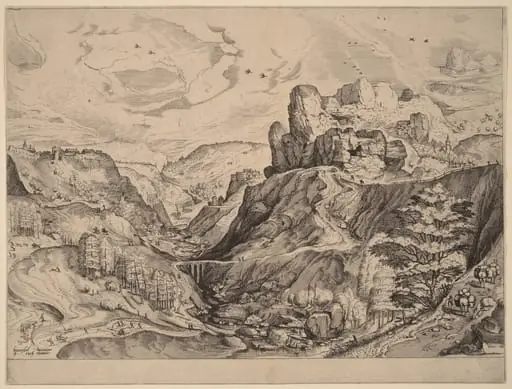 Alpine Landscape
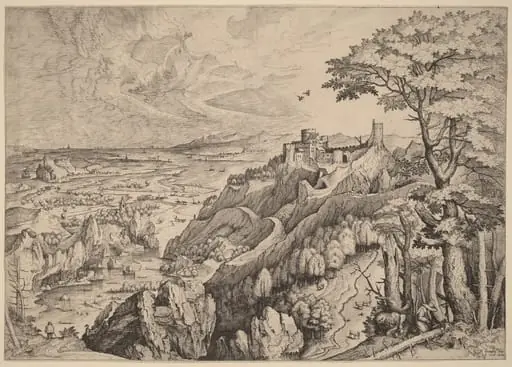 S. Hieronymus in Deserto (Saint Jerome in the Desert)
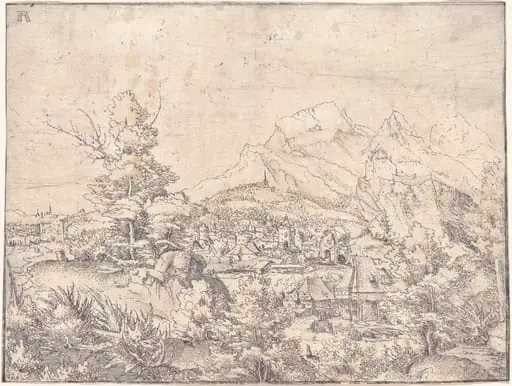 The Great Landscape with the Water Mill
 Magdalena Poenitens (The Penitent Magdalene)
 The Stream
 A Rocky Landscape with a Stone Tower and a Waterfall
 Solicitudo Rustica (Rustic Concerns)
 Firs in the Defile
 Landscape with a River and Aqueduct
 Large Alpine Landscape
 Landscape with the Penitence of Saint Jerome
 River Landscape