Artwork
Ο Ήρως Αθανάσιος Διάκος το 1821
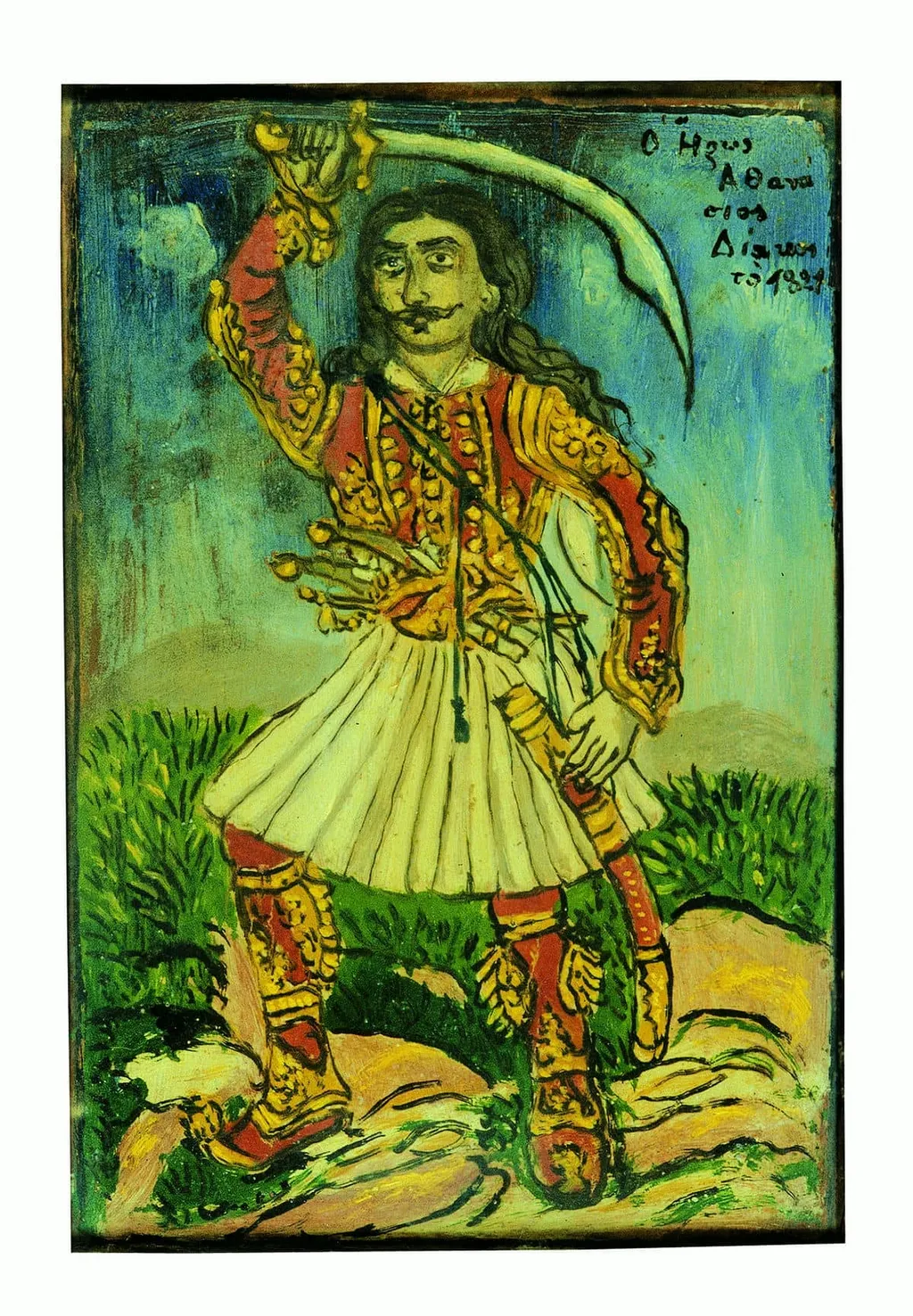
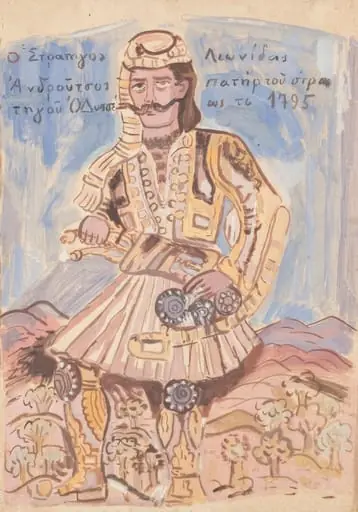
Ο Ήρως Αθανάσιος Διάκος το 1821 is a print by Theofilos (Hadjimichail). It dates from 1912 and is held in the collection of the Metropolitan Organisation of Museums of Visual Arts of Thessaloniki – MOMus.
About this work
This print shows a Greek warrior in a red and blue uniform holding a sword over a fallen Ottoman flag.
This print shows a Greek warrior in a red and blue uniform holding a sword over a fallen Ottoman flag. His pose is dramatic, one foot on the flag’s pole, the other on a dead horse.
Theofilos painted this in the early 1900s. He mixed church art with bold, folk-style colors. This hero, Athanasios Diakos, died fighting in 1821.
If this style grabs you, check out another work by Theofilos (Hadjimichail) (1870 or 1871 - 1934).
Overview
Theofilos, a self-taught Greek painter active in the early 20th century, created this image of Athanasios Diakos as part of a broader effort to visualize national memory through art. Working outside academic traditions, he drew from folk imagery, religious icons, and printed sources to construct emotionally direct scenes. His approach prioritized symbolic power over naturalism, using vivid color and flattened space to convey historical resonance rather than spatial accuracy.
Subject & Meaning
The painting depicts Athanasios Diakos, a Greek revolutionary leader killed in battle in 1821, standing triumphantly over a fallen Ottoman flag and a dead horse. His stance—boot planted on the flag’s pole—symbolizes defiance and victory in death. The scene is not a literal record but a ritualized tribute, blending martyrdom with national pride. Diakos, remembered for his resistance, becomes an emblem of sacrifice for the cause of independence.
Technique & Style
Theofilos rejected Renaissance perspective and academic realism, favoring bold, flat planes and saturated hues drawn from Byzantine icons and popular prints. Details are selected for emotional impact, not anatomical precision: the warrior’s uniform, the torn flag, the horse’s stillness—all serve narrative clarity. Brushwork is direct, contours are strong, and color functions symbolically, with red and blue dominating to evoke both blood and national identity.
History & Provenance
Painted in the early 1900s, this image emerged during a period of renewed interest in the 1821 Revolution as Greece consolidated its national identity. Theofilos, who lived from 1870 to 1934, worked in relative isolation from European art centers, relying on local visual culture. His works were widely reproduced as prints and postcards, making them accessible to the public and embedding them in collective memory.
Context
In the decades after Greek independence, artists and educators sought to cultivate a shared historical consciousness. Theofilos’s paintings filled this role by translating oral traditions and printed accounts into accessible visual forms. His fusion of ecclesiastical iconography with revolutionary themes mirrored a broader cultural project: linking the spiritual authority of the Orthodox Church with the secular heroism of the revolution.
Legacy
Theofilos’s style influenced later generations of Greek folk and naif painters, establishing a visual language for national mythmaking that prioritized emotional truth over technical refinement. His depictions of Diakos and other revolutionaries remain in public spaces and textbooks, sustaining a visual connection between modern Greece and its 19th-century struggles. His work endures not as high art, but as cultural artifact shaped by popular sentiment.
Artist & collection
Artist
Theophilus is a male given name with a range of alternative spellings. Its origin is the Greek word Θεόφιλος from θεός and φιλία can be translated as "Love of God" or "Friend of God", i.e., it is a theophoric name,…
Museum
Metropolitan Organisation of Museums of Visual Arts of Thessaloniki – MOMus
Continue through works from the same source collection.