Artwork
A Heroic Male Nude
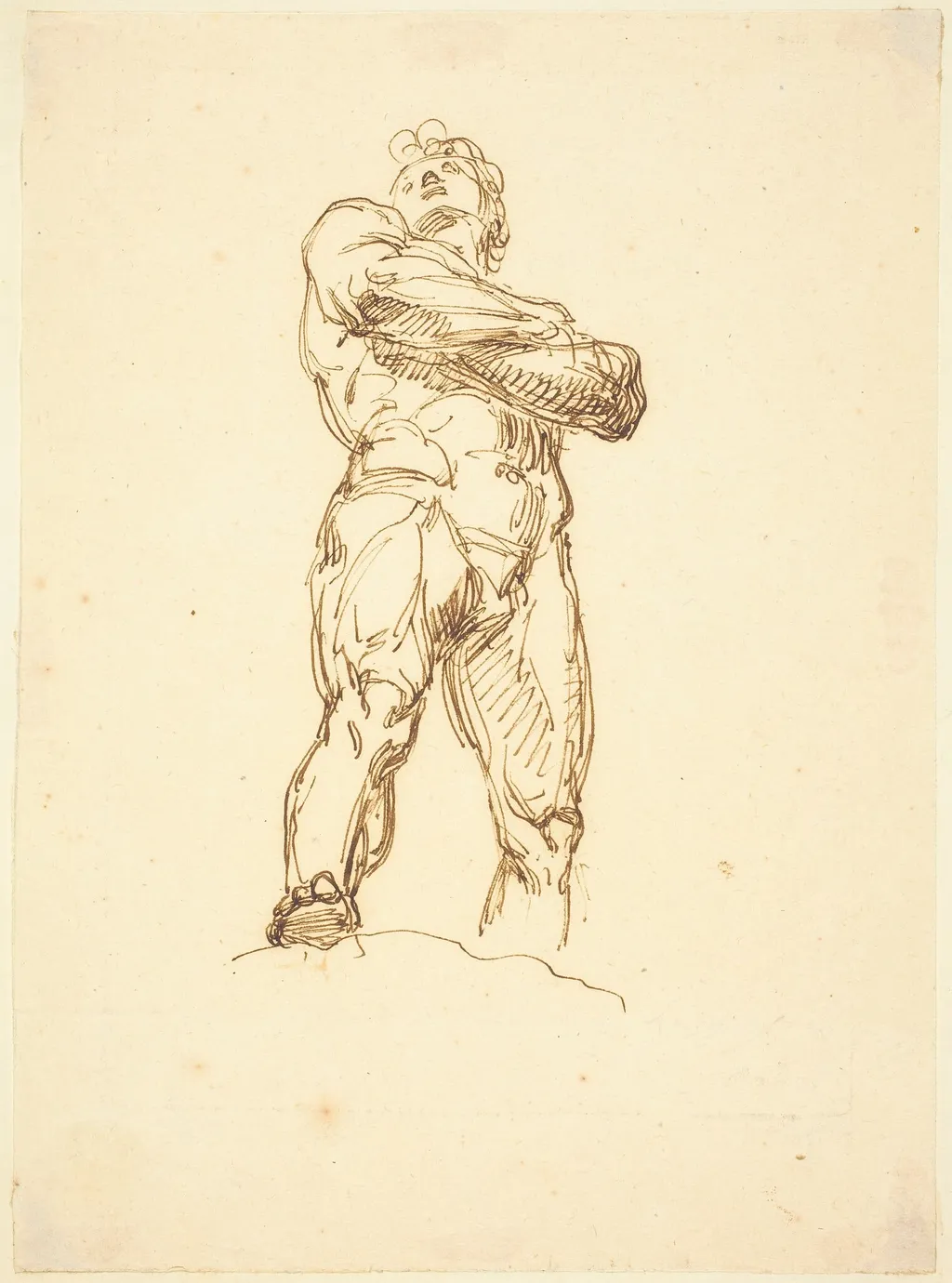
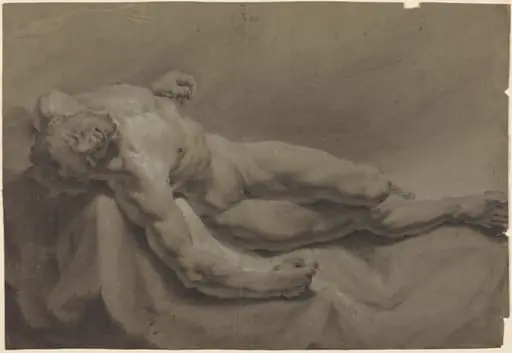
A Heroic Male Nude is an ink drawing by the Romanticist artist Bertel Thorvaldsen. It dates from 1807 and is held in the collection of the National Gallery of Art.
About this work
Overview
The piece functions as a preparatory study rather than a finished composition, illustrating the artist’s interest in the anatomical study of the male form.
Created in 1807 by Danish sculptor Bertel Thorvaldsen, this work is a pen and brown‑ink drawing on laid paper. Though titled as a study of a heroic male nude, it exists solely as a two‑dimensional sketch, measuring roughly the size of a standard sheet. The piece functions as a preparatory study rather than a finished composition, illustrating the artist’s interest in the anatomical study of the male form.
Subject & Meaning
The drawing presents a muscular figure viewed from behind, torso twisted forward and one arm lifted as if in the midst of an action. By omitting facial features and any surrounding context, Thorvaldsen directs attention to the body's structural vigor and the implied narrative of heroic exertion. The pose suggests a moment of strain or preparation, echoing classical ideals of physical perfection.
Technique & Style
Executed with swift, confident strokes of brown ink, the artist emphasizes contour and volume through line rather than detailed modeling. Darker hatching appears beneath the raised arm and along the spine, creating a subtle sense of depth. The laid paper’s faint texture interacts with the ink, allowing the drawing’s gestural quality to convey both movement and the underlying anatomy typical of academic studies for sculpture.
History & Provenance
The sketch was produced as part of Thorvaldsen’s preparatory work for larger sculptural projects, a common practice among neoclassical artists who used drawings to resolve composition before carving. While the original commission or intended final work is not documented, the drawing has remained in the artist’s estate and later entered museum collections through 19th‑century acquisitions, where it serves as evidence of his sculptural process.
Artist & collection


![Male Nude [recto], by Michelangelo](https://artifactworldgallery.com/img/michelangelo--male-nude-recto--8c3354d89884753a-w320.webp)
![Male Nude [verso], by Michelangelo](https://artifactworldgallery.com/img/michelangelo--male-nude-verso--d48a81b2ad2bdbb8-w320.webp)
![Male Nude Holding a Mirror [recto], by Albrecht Dürer](https://artifactworldgallery.com/img/albrecht-durer--male-nude-holding-a-mirror-recto--6c2ca7c869cbcffa-w320.webp)
![Nude Man Seen from Behind [verso], by Jacopo Palma il Giovane](https://artifactworldgallery.com/img/jacopo-palma-il-giovane--nude-man-seen-from-behind-verso--2de266ff199c839b-w320.webp)