Artwork
Untitled
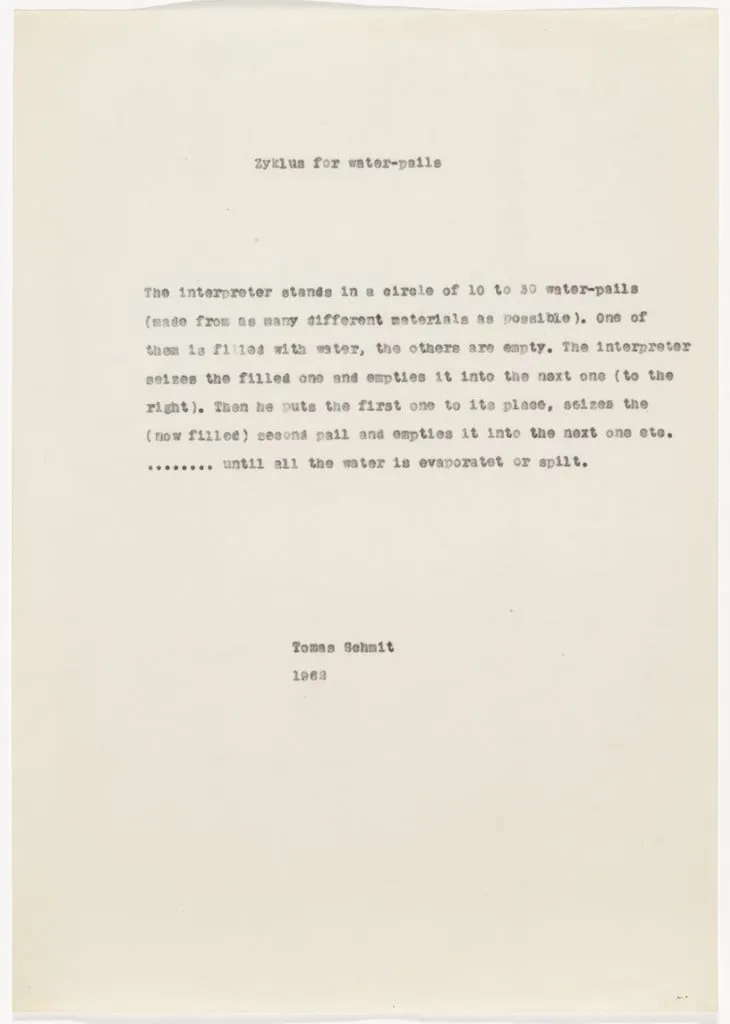
Untitled is a drawing by Tomas Schmit. It dates from 1962 and is held in the collection of the Museum of Modern Art.
About this work
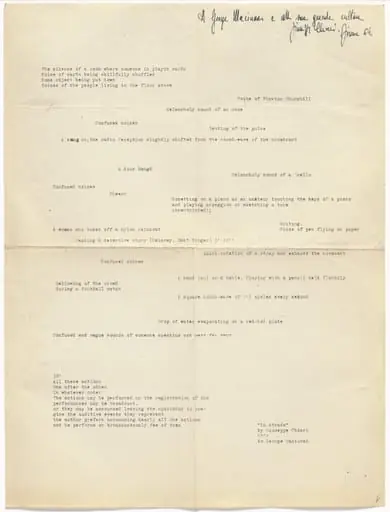
The words are centered and describe a performance: someone pouring water between empty and filled buckets in a circle until it all disappears.
This image shows a sheet of paper with black typewritten text. The words are centered and describe a performance: someone pouring water between empty and filled buckets in a circle until it all disappears. The text looks handwritten at the bottom, with "Tomas Schmit" and "1962" added in print.
The piece isn’t a painting but a set of instructions for an art action. The artist used a typewriter with carbon paper, making the text look faint in places.
Look up Tomas Schmit to see more of his work.
Overview
Created in 1962, this work by Tomas Schmit is a typewritten instruction on paper, produced using carbon paper to generate multiple impressions. Unlike traditional drawings or paintings, it functions as a textual score for a performative act. The medium’s faint, uneven text reflects the mechanical limitations of the typewriter and the physical process of carbon duplication, emphasizing process over polished presentation.
Subject & Meaning
The text describes a simple, repetitive action: pouring water between an empty and a full bucket in a circular motion until the water vanishes. This ritualistic instruction evokes themes of futility, impermanence, and cyclical labor. The absence of visual imagery shifts focus to the act itself, inviting the viewer to imagine the performance rather than observe a finished object.
Technique & Style
Schmit employed a typewriter and carbon paper to produce the text, resulting in layered, partially faded impressions. The faintness of some characters and the slight misalignments suggest manual, unrefined execution. The handwritten signature and date at the bottom contrast with the mechanical text, introducing a personal, almost archival quality to the otherwise impersonal medium.
History & Provenance
The work entered the collection of The Museum of Modern Art, where it is preserved as part of a broader interest in conceptual and performance-based practices from the early 1960s. Its preservation as a physical artifact underscores its role as a document of an unrealized or ephemeral act, aligning it with contemporaneous experimental art movements in Europe and the United States.
Context
Produced during a period when artists increasingly rejected traditional media in favor of instructions, scores, and actions, Schmit’s work reflects the influence of Fluxus and early conceptual art. It shares affinities with works by artists like Yoko Ono and George Brecht, who used text to activate the viewer’s imagination and reframe everyday gestures as art.
Legacy
This piece contributes to the redefinition of art as an idea rather than a fixed object. Its minimalism and reliance on language anticipated later developments in conceptual art, where the instruction became a primary medium. Schmit’s use of mundane tools and ordinary actions helped dismantle hierarchies between art and life, influencing generations of artists working with performative and textual forms.
Artist & collection
Artist
Tomas Schmit was an artist and author associated with the Fluxus movement of the early 1960s and created during the subsequent 40 years a multi-layered work that comprises drawings, editions, theoretical texts and artists books.