Artwork
Promenade (Promenoir)
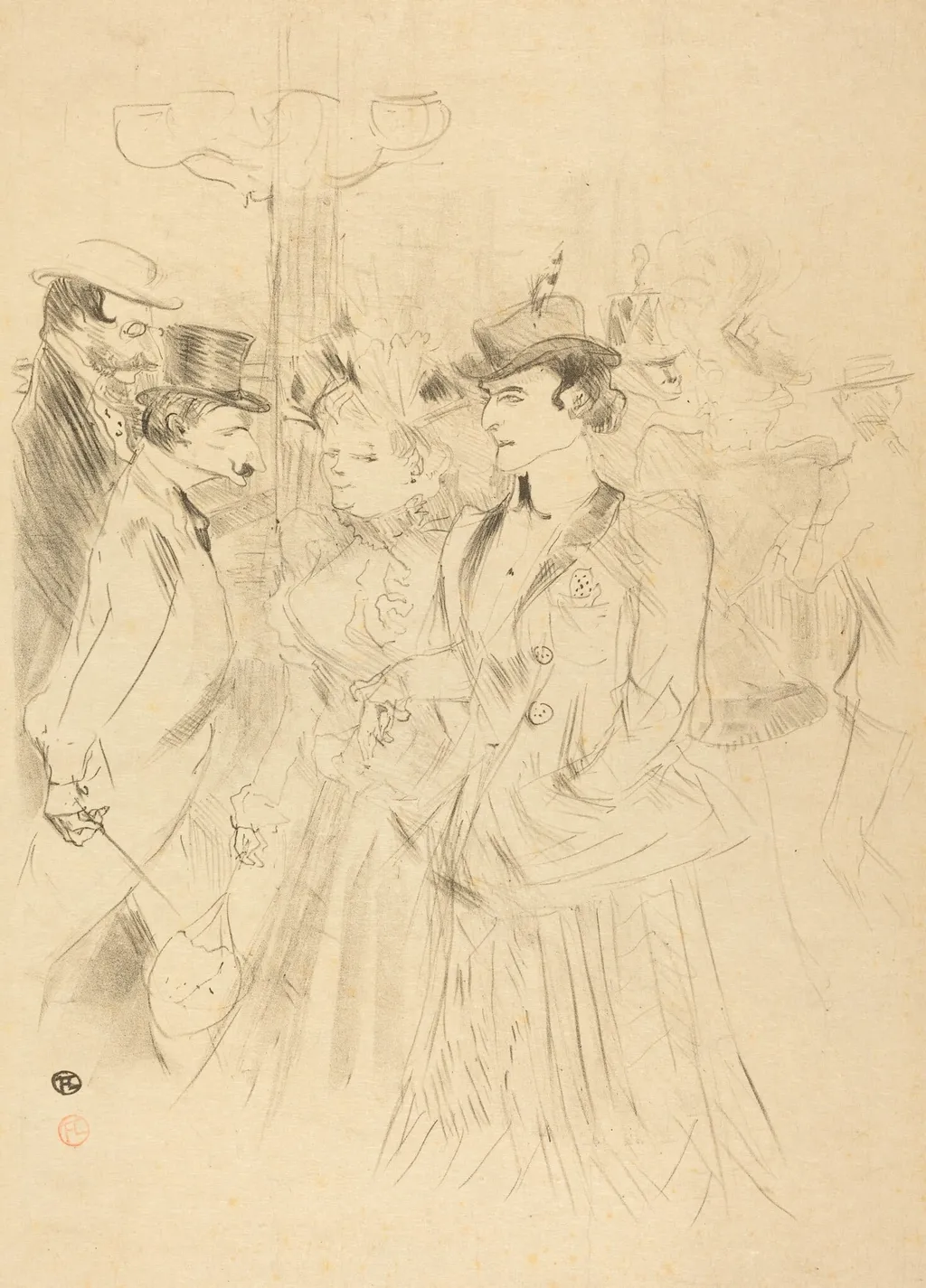
Promenade (Promenoir) is an ink print by the Impressionist artist Henri de Toulouse-Lautrec. It dates from 1899 and is held in the collection of the National Gallery of Art.
About this work
Overview
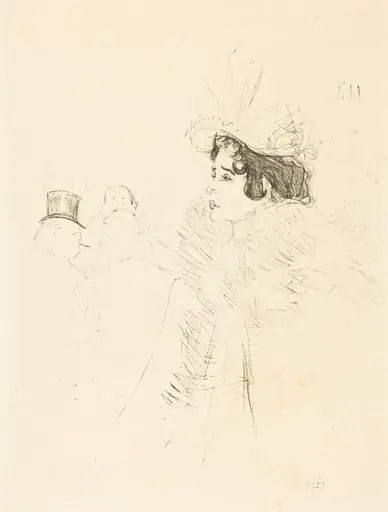
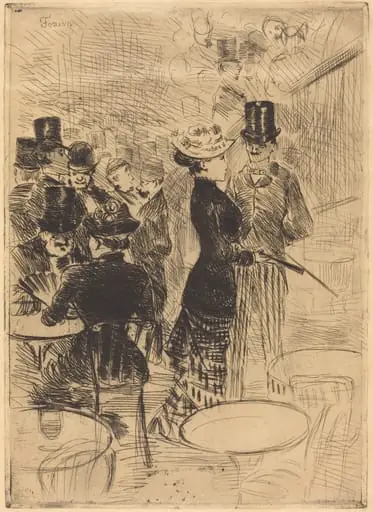
Promenade (Promenoir) is a lithograph created by Henri de Toulouse-Lautrec in 1899 on Japan paper, rendered entirely in black. The work captures a fleeting moment of three individuals walking together.
Subject & Meaning
At the center of the composition is a woman, distinguishable by a long coat, hat, and a flower on her chest, flanked by two men in suits and hats. The men's faces are minimally defined, contrasting with the woman's more detailed appearance, potentially highlighting her as the subject of interest or focus within the social dynamic.
Technique & Style
The lithograph exhibits loose, quick lines, evoking a sense of rapid capture, akin to a spontaneous snapshot. This stylistic choice may reflect Toulouse-Lautrec's ability to convey the immediacy of a moment through his printmaking technique.
History & Provenance
Created in 1899, Promenade (Promenoir) is characteristic of Toulouse-Lautrec's late 19th-century Parisian nightlife themes, though its specific provenance and exhibition history are not detailed here.
Context
The attire and setting place the work firmly in late 19th-century Paris, a period and place Toulouse-Lautrec was known to document through his art, often exploring the social and cultural nuances of the time.
Legacy
As part of Toulouse-Lautrec's oeuvre, Promenade (Promenoir) contributes to the broader legacy of capturing Parisian life in the late 1800s through lithography, a medium he helped popularize for artistic expression beyond commercial use.
Artist & collection
Artist
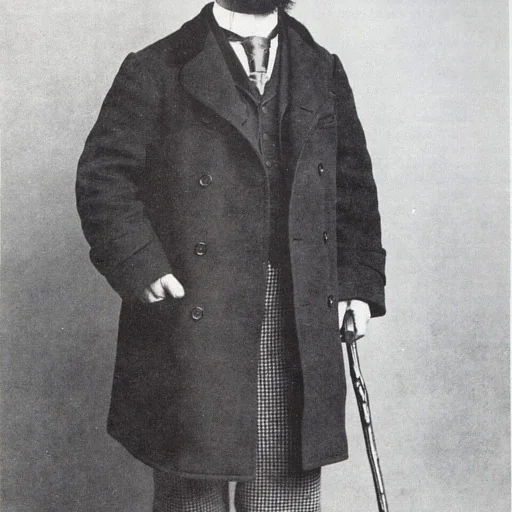
Comte Henri Marie Raymond de Toulouse-Lautrec-Montfa (24 November 1864 – 9 September 1901), known as Toulouse-Lautrec (French: ), was a French painter, printmaker, draughtsman, caricaturist, and illustrator.

 Miss May Belfort in the Irish and American Bar, rue Royale (Miss Belfort Belfort au Irish and American Bar, Rue Royale)
 Why Not?...Once Is Not a Habit (Pourquoi pas?...Une fois n'est pas coutume)
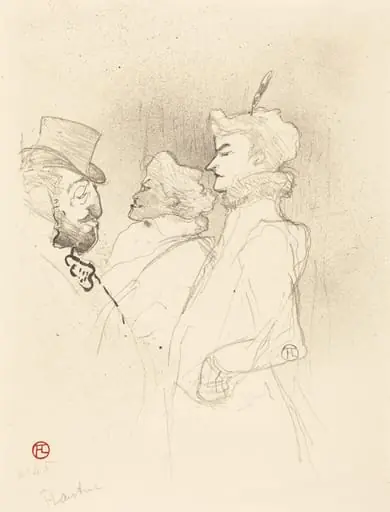 Why Not?...Once Is Not a Habit (Pourquoi pas?...Une fois n'est pas coutume)
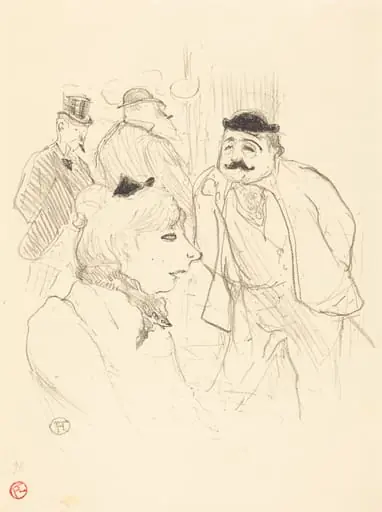 La Tige (Moulin-Rouge)
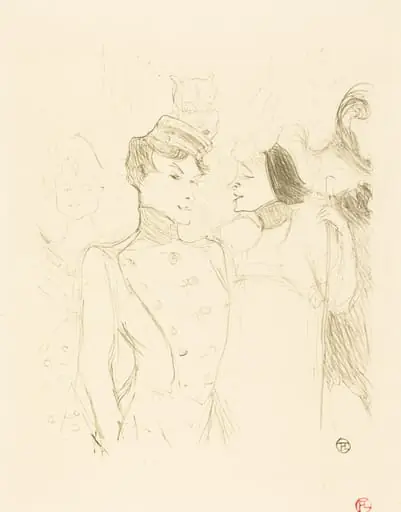 Lender and Lavalliere (Lender et Lavallière)
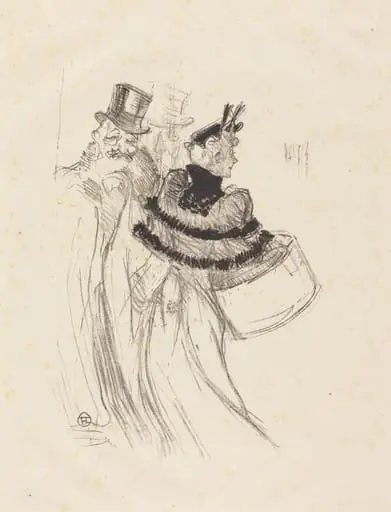 The Old Gentlemen (Les vieux messieurs)
 Le bar des Folies-Bergère (The Bar at the Folies-Bergère)
 Rosmersholm; Le Gage
 Cléo de Mérode
 The Folies-Bergère
 Lender and Auguez in "La chanson de fortunio" (Lender et Auguez dans "La chanson de fortunio")
 The Forfeit (La gage)