Artwork
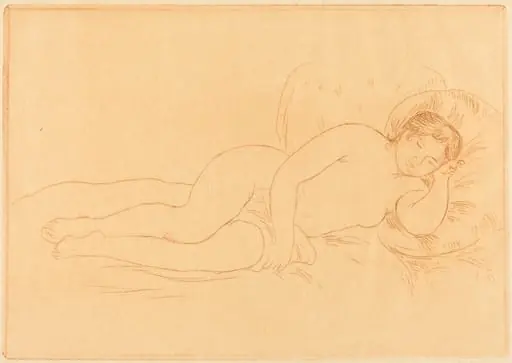
Sleep (Le sommeil)
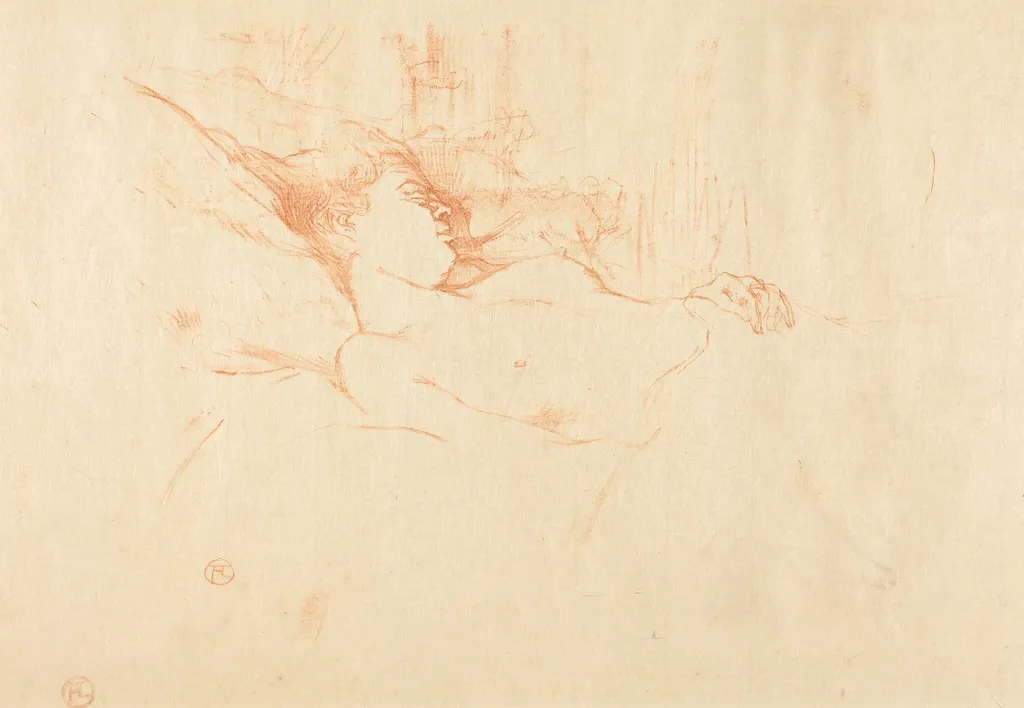
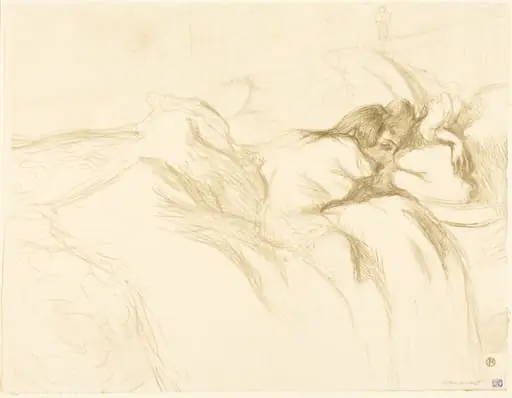
Sleep (Le sommeil) is an ink print by the Impressionist artist Henri de Toulouse-Lautrec. It dates from 1896 and is held in the collection of the National Gallery of Art.
About this work
Overview
Sleep (Le sommeil) is a 1896 lithograph by Henri de Toulouse‑Lautrec, executed in red ink on Japanese paper. The work presents a solitary nude figure reclining in a half‑asleep pose, the arm dangling over the edge of the sheet. Its limited palette and swift line work give the impression of a rapid study rather than a finished composition.
Subject & Meaning
The image captures a moment of private repose, focusing on the vulnerability of a reclining body. By choosing a nude in a state of drowsiness, Toulouse‑Lautrec continues his interest in the overlooked or marginal figures of Parisian life, offering a quiet counterpoint to his more bustling scenes of cabarets and street life.
Technique & Style
Created with a single red ink pass on Japanese paper, the lithograph relies on the fluidity of the medium to produce loose, gestural lines. The stark contrast between the warm red and the pale paper emphasizes the immediacy of the drawing, suggesting a sketch made for reference or experimentation rather than a polished final piece.
History & Provenance
Toulouse‑Lautrec produced the print during a prolific period in the mid‑1890s when he was actively documenting Parisian nightlife and its participants. While the work was not intended as a commercial edition, it reflects his practice of making quick studies on inexpensive materials, a habit that informed many of his larger, more detailed compositions.
Artist & collection
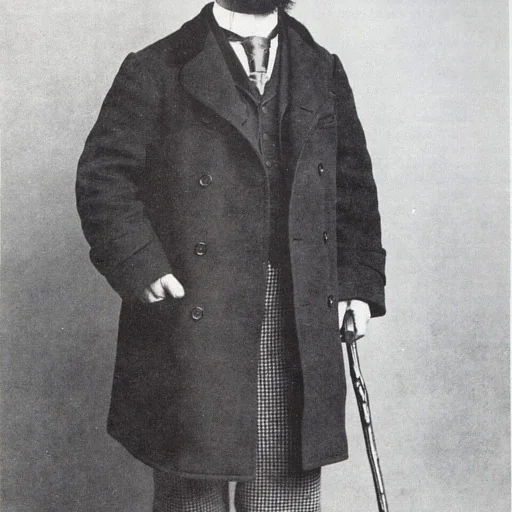
Artist
Comte Henri Marie Raymond de Toulouse-Lautrec-Montfa (24 November 1864 – 9 September 1901), known as Toulouse-Lautrec (French: ), was a French painter, printmaker, draughtsman, caricaturist, and illustrator.