Artwork
Krishna's Butter Ball, Mahabalipuram
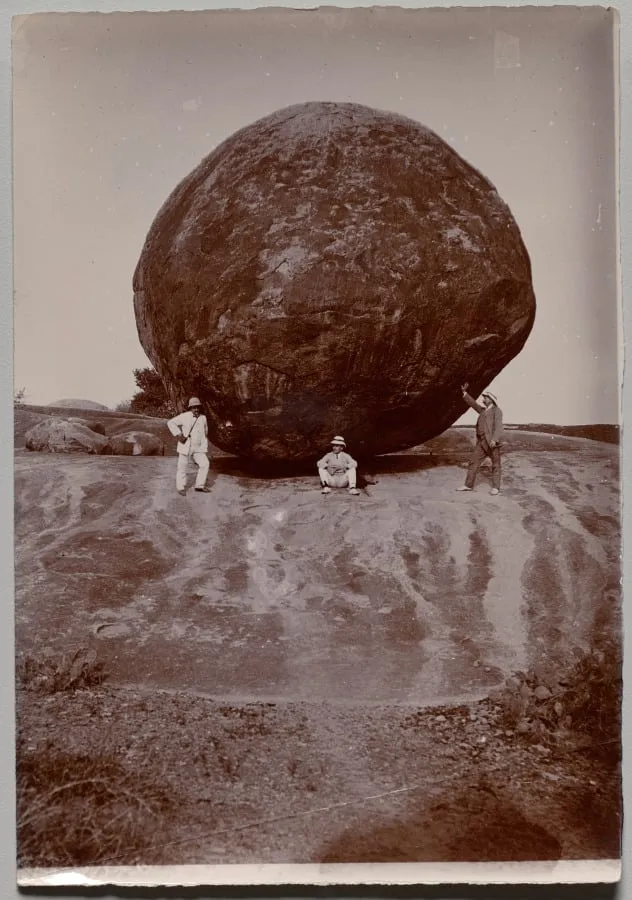
Krishna's Butter Ball, Mahabalipuram is a photography by Unidentified Photographer. It dates from 1904 and is held in the collection of the Cleveland Museum of Art.
About this work
You see a big round rock balanced on a tiny slope, with a few people in old-fashioned clothes standing around it.
You see a big round rock balanced on a tiny slope, with a few people in old-fashioned clothes standing around it.
This rock is called Krishna’s Butter Ball. It’s been sitting in the same spot for over a thousand years, part of an ancient temple site. The name comes from a story about the god Krishna, who could lift something this heavy as easily as butter. The photo was taken when tourists first started visiting the site.
If you like this mix of nature and myth, look up *early 20th century* photos of India’s landmarks.
Overview
Krishna’s Butter Ball is a massive, near‑perfect spherical boulder perched on a shallow incline at the historic coastal complex of Mahabalipuram in southeastern India. The stone has remained in this precarious balance for more than a millennium, forming part of a landscape dominated by early‑7th‑century rock‑cut temples and sculptural groups that were hewn from the same shoreline cliffs.
Subject & Meaning
Local tradition links the boulder to the Hindu deity Krishna, recalling a legend in which the child god could lift a weight as light as butter. The juxtaposition of a heavy stone held seemingly effortlessly by a divine figure reinforces the narrative of Krishna’s supernatural strength and serves as a tangible focal point for devotional storytelling.
Technique & Style
The formation is a natural geological occurrence rather than a human‑carved monument, yet its placement within a sacred precinct gives it an aesthetic resonance akin to the meticulously sculpted monoliths nearby. The photograph captures the stone’s smooth curvature against a modest slope, emphasizing its precarious equilibrium and the contrast between natural form and human‑made architecture.
History & Provenance
During the colonial period, Mahabalipuram attracted European travelers who documented the site in photographs that were dispatched to Britain for publication. These early images, taken as tourists began to explore the ruins, present the boulder surrounded by visitors in period attire, illustrating the emergence of the location as a site of both scholarly interest and exotic tourism.
Context
The boulder sits within a UNESCO‑listed ensemble of monuments that exemplify Pallava architecture, a dynasty responsible for the region’s prolific rock‑cut temples dating to the early 600s CE. While the surrounding structures were deliberately carved, the Butter Ball’s inclusion in the sacred landscape reflects a broader Indian practice of integrating striking natural features into religious settings.
Artist & collection
Artist

 Captain Bailward's camel (verso, left)
 Portfolio XVII, Plates 580- 615
 Battery, Malakoff
 Portfolio XVI, Plate 573: Acoma Water Girls
 Two Oxen and Driver
 Untitled
 The Sphinx
 Portfolio XVI, Plate 570: Acoma Roadway
 Khyber Side of Sarkai Hill
 The Stork Alights
 Dolmen, Cap del Puetch, Ariège, France
 View of Hills near Mahabaleshwar