Artwork
A Caravan halting and refreshing itself
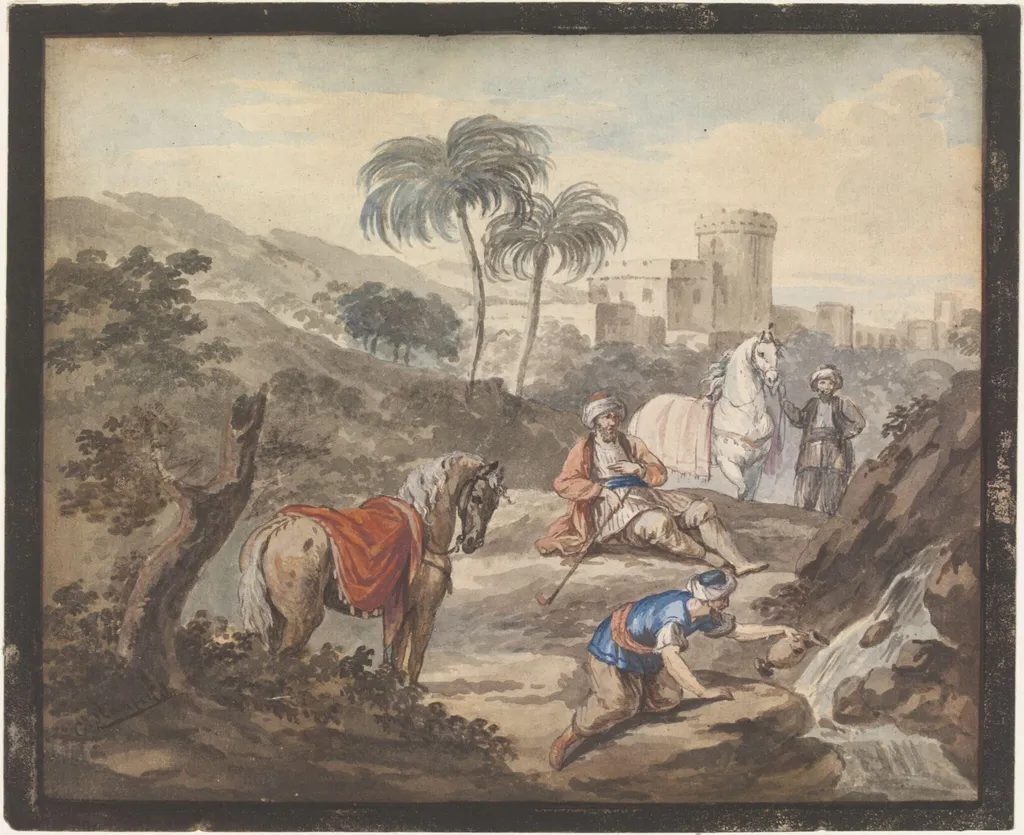
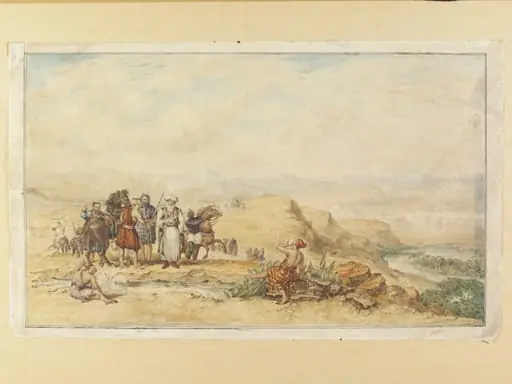
A Caravan halting and refreshing itself is a watercolor work on paper by the Rococo painting artist Unknown. It dates from 1768 and is held in the collection of the Victoria and Albert Museum. This watercolour presents a caravan group pausing beside a rocky slope.
About this work
Overview
This watercolour presents a caravan group pausing beside a rocky slope. A rider is seated on a horse, another figure kneels near a modest fire, while a third stands beside a white horse. In the distance, palm trees frame a distant tower and a waterfall cascades to the right, creating a tranquil yet active tableau rendered in muted earth tones with occasional red and blue accents.
Subject & Meaning
The composition captures a moment of rest during a journey, emphasizing the interplay between human activity and the surrounding landscape. The figures, engaged in simple tasks, suggest themes of hospitality and the transient nature of travel, while the distant architectural element hints at a destination beyond the immediate scene.
Technique & Style
Executed in watercolour, the work employs a delicate wash of earthy pigments, allowing soft transitions between sky, rock, and foliage. Highlights of red and blue are applied with greater opacity, drawing attention to specific details such as the fire and the riders' attire, while the overall palette remains restrained, characteristic of 18th‑century British landscape drawing.
History & Provenance
The image derives from a detail in the lower right corner of William Hamilton’s design for a painted panel intended for the Saloon at Kedleston Hall. Though not a literal copy, the watercolour adapts Hamilton’s compositional framework, and it can be compared with a related study catalogued as SD.524, indicating a series of preparatory works linked to the larger decorative scheme.
Context
The piece reflects the 18th‑century interest in exotic travel scenes, a motif popular among British patrons commissioning decorative panels for country houses. By integrating elements such as palm trees and a distant tower, the work aligns with contemporary tastes for picturesque, narrative landscapes that conveyed both refinement and a sense of adventure.
Artist & collection

 Domestic Scene
 Giacomo and Cardinal Marco, investing Andrea, Abbot of San Zeno, with his Benefice
 The Nymph of Fontainebleau
 Portrait of a Woman
 Madonna and Child with Saints in the Enclosed Garden
 Venus and Minerva
 Family Group of Four on Sofa
 Wall painting from Room H of the Villa of P. Fannius Synistor at Boscoreale
 Flock of Goats
 Huntsmen Resting
 The Flight into Egypt
 View of the Tiber in the Campagna
 Landscape with Bridge
 Landscape with Peasants before an Inn
 Balaam and the Ass
 Travelers Approaching a Bridge
 The Two Hinnies
 The Pharisees Complain to Our Lord
 Heroic Landscape with Fisherman, Cows, and Horsemen
 Halt at an Oasis