Artwork
A Mughal Prince, Perhaps Danyal, Holding a Sprig of Flowers
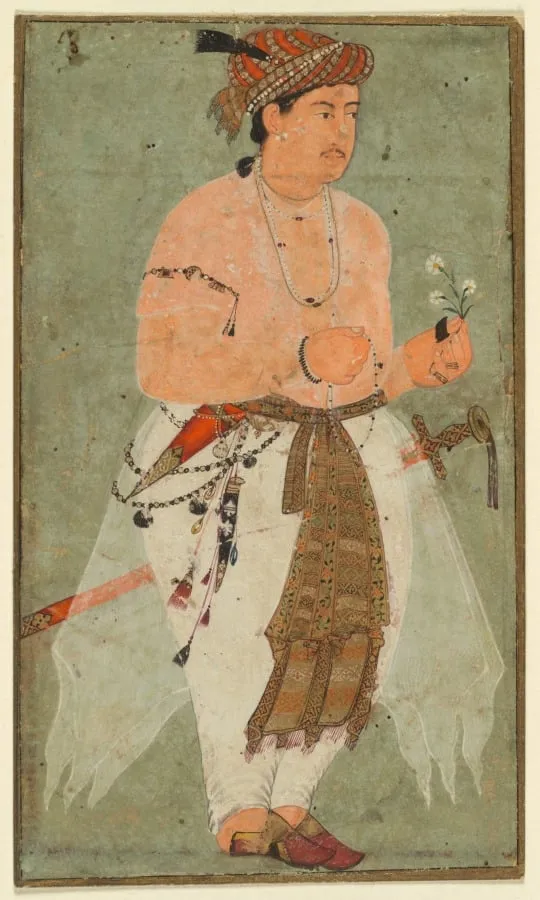
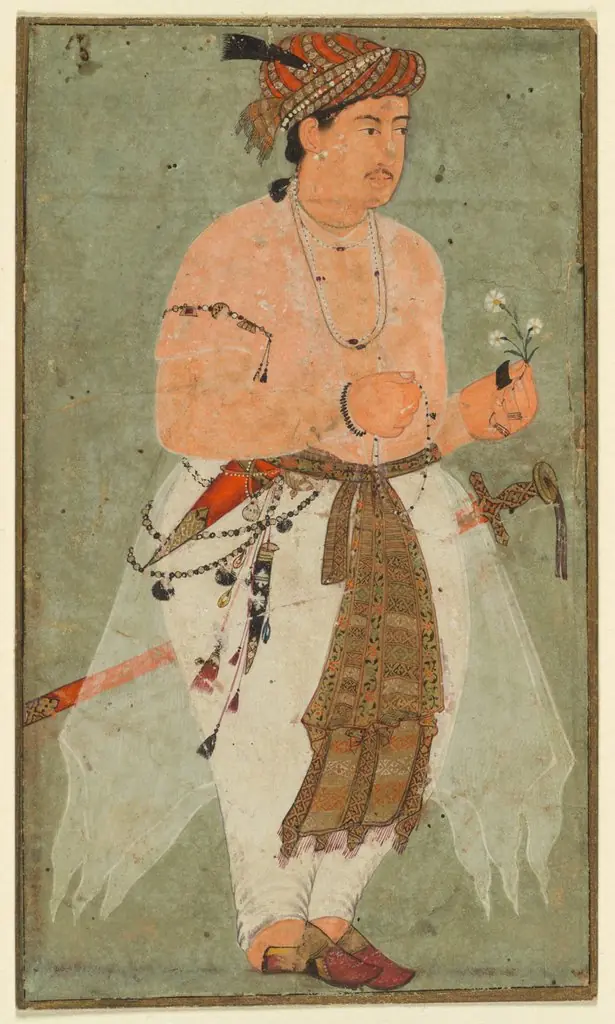
A Mughal Prince, Perhaps Danyal, Holding a Sprig of Flowers is an unspecified painting by the Mughal Painting artist Unknown. It dates from 1585 and is held in the collection of the Cleveland Museum of Art. This early Mughal portrait depicts a young prince in profile, dressed in an ornate robe adorned with jeweled embroidery.
About this work
The painting was made when Mughal art mixed Persian and Indian styles, showing rulers as both warriors and scholars.
A young prince stands in profile, holding a white flower in one hand and prayer beads in the other. He wears a jewel-trimmed robe, a thumb ring, and a small dagger at his waist.
This is likely Prince Danyal, Emperor Akbar’s youngest son. The flower and beads hint at his nickname—"Nosegay of Fortune’s Spring"—while the ring marks him as an archer. The painting was made when Mughal art mixed Persian and Indian styles, showing rulers as both warriors and scholars.
To see more like this, look up *court of akbar (reigned 1556–1605)*.
Overview
This early Mughal portrait depicts a young prince in profile, dressed in an ornate robe adorned with jeweled embroidery. He holds a white flower in one hand and prayer beads in the other, while a thumb ring on his right hand signals his training as an archer. A dagger rests at his waist, and his posture conveys quiet composure. The painting captures him in adolescence, likely during the reign of his father, Emperor Akbar, when Mughal court art was synthesizing Persian elegance with Indian sensibilities.
Subject & Meaning
The prince is traditionally identified as Danyal, Akbar’s youngest son, known by the poetic epithet 'Nosegay of Fortune’s Spring.' The white flower and prayer beads suggest a duality of his identity: a warrior marked by the archer’s thumb ring, yet also a figure of refinement and piety. The inclusion of these symbols reflects courtly ideals that blended martial prowess with spiritual and aesthetic grace, aligning his image with the cultivated persona expected of Mughal royalty.
Technique & Style
The painting employs fine brushwork and delicate coloration characteristic of early Mughal miniatures. Layers of translucent pigment create subtle gradations in the fabric and skin tones, while intricate patterns on the robe reflect Persian influences. The profile view, flattened space, and attention to decorative detail are hallmarks of a style still in transition, merging Timurid traditions with emerging Indian naturalism, without full Western perspective.
History & Provenance
Created during Akbar’s reign (1556–1605), the portrait likely originated in the imperial atelier in Fatehpur Sikri or Agra. It may have been part of a larger album or illustrated manuscript commissioned for courtly circulation. Though its exact provenance before modern collections is undocumented, its stylistic features align with other known works from Akbar’s artistic workshops, which systematically recorded royal figures and court life.
Context
In mid-16th century India, the Mughal court cultivated an image of rulers as both warriors and patrons of culture. Danyal’s portrayal reflects this ideal: his weapons signify military duty, while the flower and beads evoke poetic and religious virtues. This synthesis was deliberate, reinforcing the emperor’s vision of sovereignty as a balance of strength, intellect, and spiritual depth, a theme central to Akbar’s broader political and cultural project.
Legacy
This portrait exemplifies the formative phase of Mughal portraiture, before the later emphasis on individualized realism under Jahangir. It preserves a moment when royal identity was conveyed through symbolic objects rather than psychological depth. As such, it serves as a key reference for understanding how Mughal rulers used visual culture to articulate legitimacy, lineage, and the complex interplay of power and piety in early imperial India.
Artist & collection

 Domestic Scene
 Giacomo and Cardinal Marco, investing Andrea, Abbot of San Zeno, with his Benefice
 The Nymph of Fontainebleau
 Portrait of a Woman
 Madonna and Child with Saints in the Enclosed Garden
 Venus and Minerva
 Family Group of Four on Sofa
 Wall painting from Room H of the Villa of P. Fannius Synistor at Boscoreale