Artwork
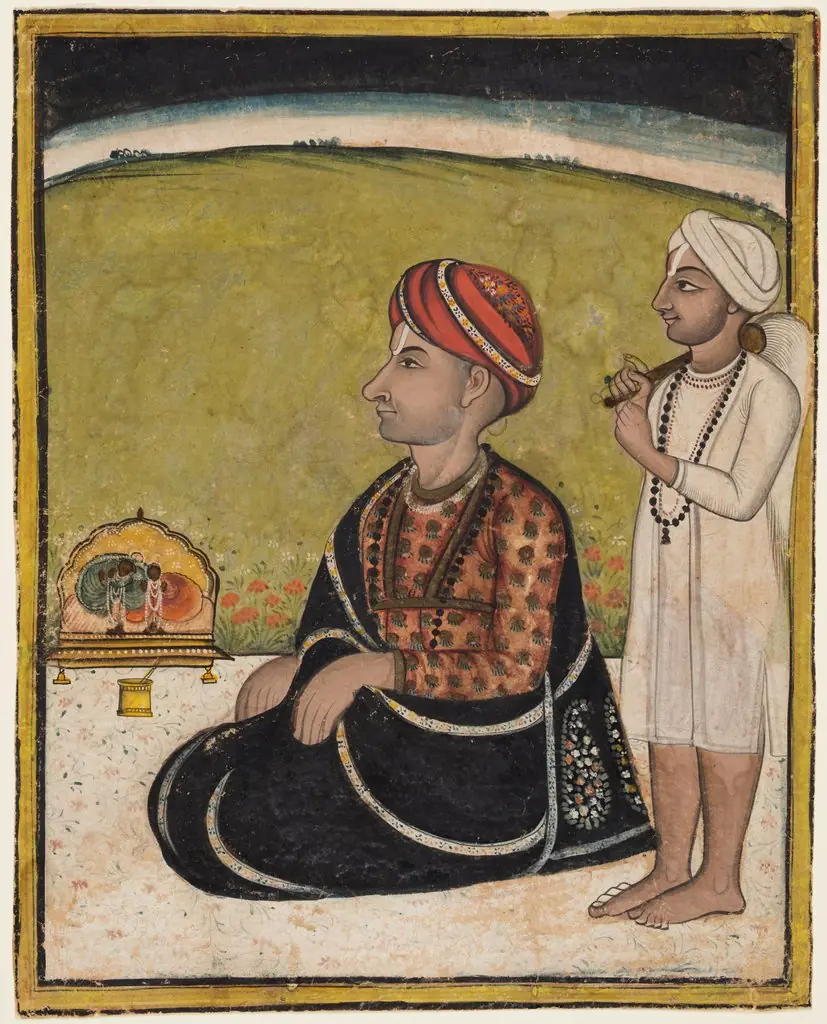
A Ruler Seated on a Terrace Worshipping at a Shrine of Radha and Krishna
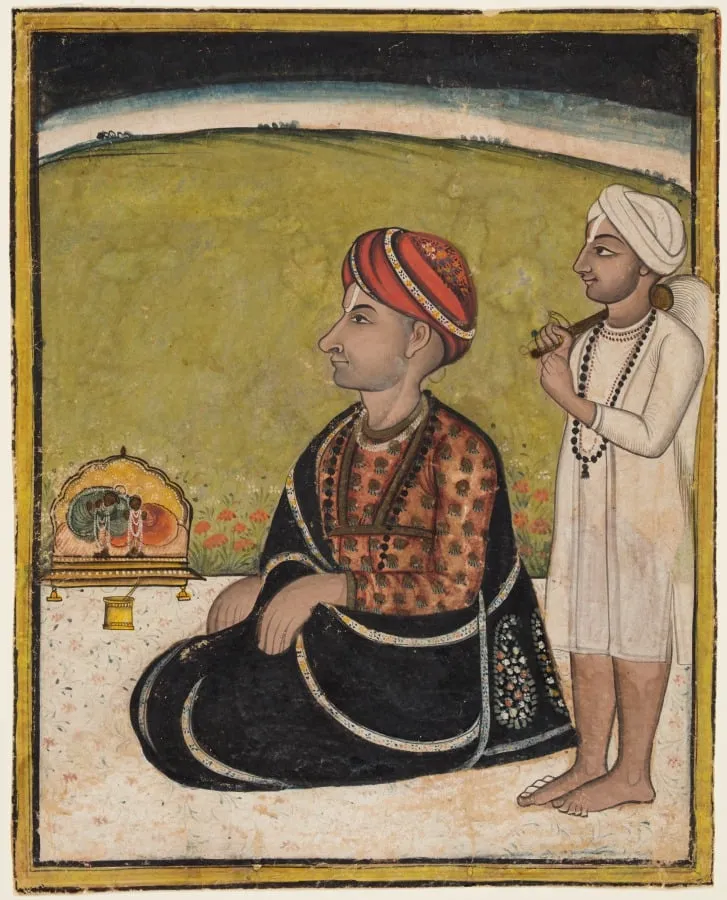
A Ruler Seated on a Terrace Worshipping at a Shrine of Radha and Krishna is an unspecified painting by the Mughal Painting artist Unknown. It dates from 1800 and is held in the collection of the Cleveland Museum of Art. This painting, likely from central India around 1800, depicts a nobleman in quiet devotion before a shrine dedicated to Radha and Krishna.
About this work
The painting comes from Central India around 1800, but we don’t know who the nobleman is, even though his face looks real.
A nobleman in a red turban and embroidered shawl kneels on a terrace, hands pressed together before a small shrine. Krishna and Radha, Hindu gods of love, smile down from the shrine. An attendant stands behind him, holding a fly whisk—a symbol of royalty.
The painting comes from Central India around 1800, but we don’t know who the nobleman is, even though his face looks real. The dark sky and soft horizon suggest evening, adding a quiet mood to the scene.
To see more art like this, look up *central india, madhya pradesh*.
Overview
This painting, likely from central India around 1800, depicts a nobleman in quiet devotion before a shrine dedicated to Radha and Krishna. Dressed in a red turban and a black woolen shawl adorned with floral embroidery, he kneels on a terrace as dusk settles. An attendant behind him holds a fly whisk, a marker of his elevated status. The scene is intimate, devoid of grandeur, emphasizing personal piety over spectacle.
Subject & Meaning
The nobleman’s act of worship centers on Radha and Krishna, deities symbolizing divine love and spiritual union. His bowed posture and clasped hands reflect humility before the divine. The presence of the fly whisk underscores his royal identity, suggesting that even those in power seek spiritual grounding. The quiet evening setting reinforces the contemplative nature of the moment, framing devotion as a private, personal ritual.
Technique & Style
The artist employs fine brushwork to render intricate embroidery on the noble’s garments and delicate facial features that suggest individuality. The dark, muted sky contrasts with the soft glow of the horizon, creating a serene twilight atmosphere. The shrine and figures are rendered with precision, while the background remains minimal, directing focus to the central act of worship and the emotional stillness of the scene.
History & Provenance
The painting originates from a regional court in central India, possibly in what is now Madhya Pradesh, during the early 19th century. Though the nobleman’s identity remains unknown, his attire and the presence of an attendant indicate a high-ranking patron. Such works were often commissioned for private devotion rather than public display, reflecting the devotional practices of local aristocracy during a period of shifting political power.
Context
In early 19th-century central India, Hindu devotional traditions flourished amid the decline of Mughal influence and the rise of regional courts. Paintings like this reflect a cultural emphasis on personal bhakti, or devotion, often centered on Krishna’s legends. The blending of royal iconography with religious imagery reveals how spiritual practice was woven into the daily life and self-image of the nobility.
Legacy
This work exemplifies the quiet, intimate style of central Indian miniature painting, distinct from the more ornate courts of Rajasthan or the Punjab hills. Its focus on individual devotion and subtle naturalism influenced later regional traditions. Though the nobleman’s name is lost, the painting endures as a testament to the enduring role of personal worship in the artistic and spiritual life of India’s princely states.
Artist & collection

 Domestic Scene
 Giacomo and Cardinal Marco, investing Andrea, Abbot of San Zeno, with his Benefice
 The Nymph of Fontainebleau
 Portrait of a Woman
 Madonna and Child with Saints in the Enclosed Garden
 Venus and Minerva
 Family Group of Four on Sofa
 Wall painting from Room H of the Villa of P. Fannius Synistor at Boscoreale
 Emperor Alamgir II
 Raja Anand Dev
 Mian Dalbir Chand
 Posthumous portrait of Emperor Jahangir under a canopy (recto)
 Posthumous portrait of Emperor Jahangir under a canopy (recto); Calligraphy (verso)
 Sultan Muhammad Mirza of Samarkand
 Emperor Shah 'Alam
 Rafi-U'ddaula
 Untitled
 Miran Shah Mirza
 Rafi-U'ddarjat
 A Ruler Seated on a Terrace Worshipping at a Shrine of Radha and Krishna