Artwork
A trail scene in a magistrate's court
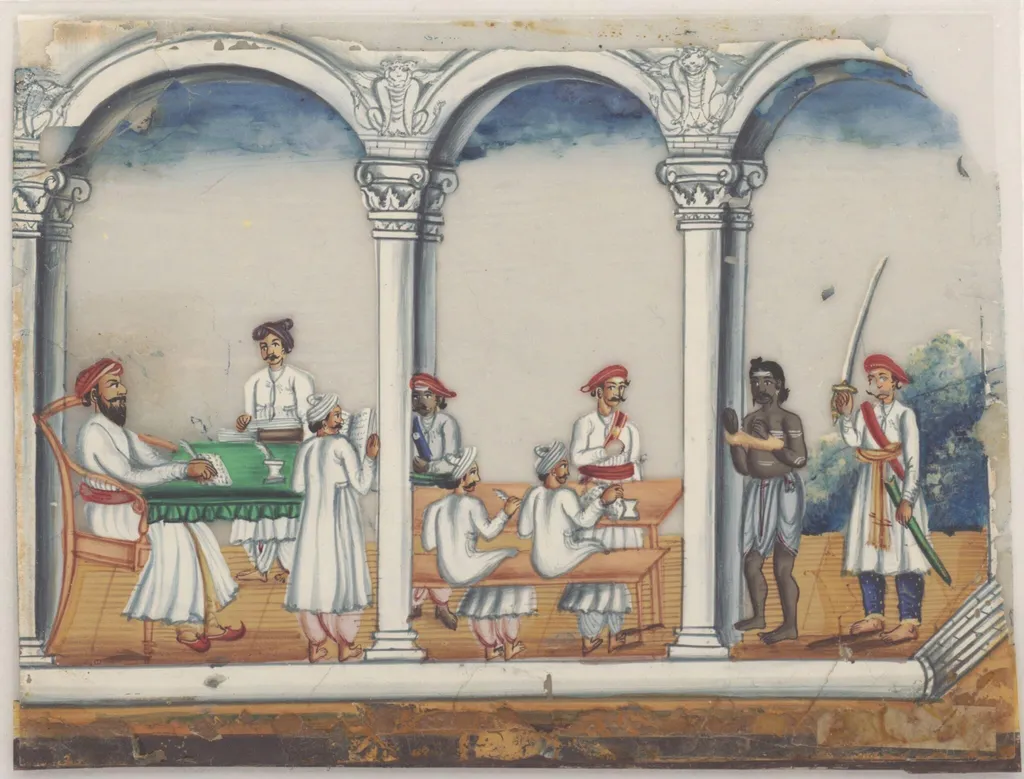
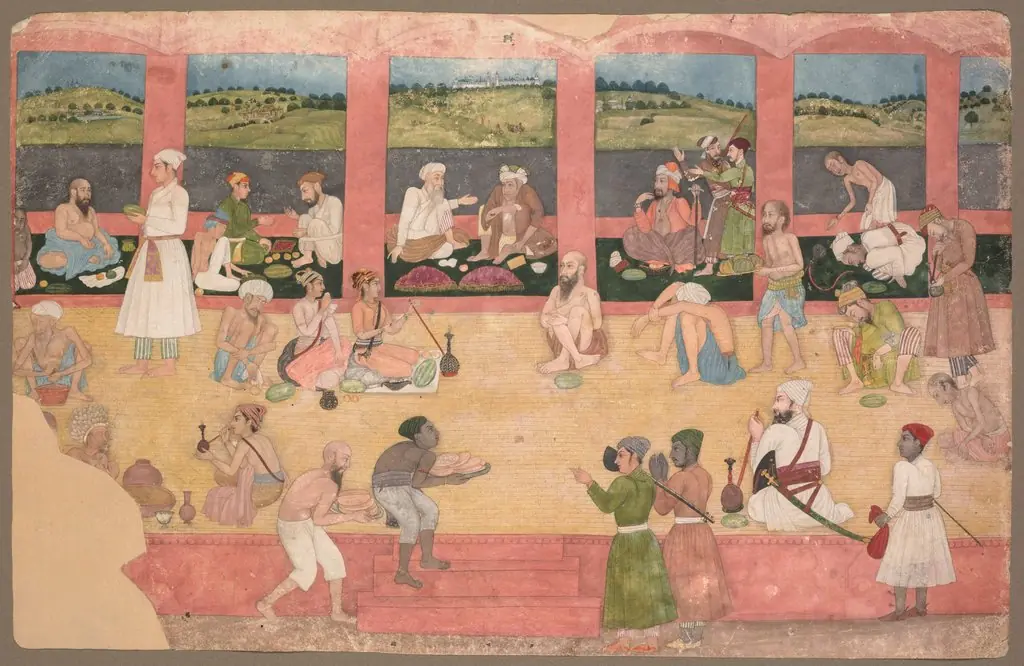
A trail scene in a magistrate's court is a paint painting by the Impressionist artist Unknown. It dates from 1860 and is held in the collection of the Victoria and Albert Museum.
About this work
Overview
This painting captures a judicial proceeding in an open-air courtyard, likely within a Chinese magistrate’s court during the late Ming or early Qing dynasty.
This painting captures a judicial proceeding in an open-air courtyard, likely within a Chinese magistrate’s court during the late Ming or early Qing dynasty. The scene centers on a formal trial, with the judge seated at a desk to the left and the accused standing to the right under the watch of a guard armed with a sword. Architectural arches frame the space, suggesting a structured yet outdoor legal setting, blending civic authority with natural light.
Subject & Meaning
The composition illustrates the formal ritual of justice, emphasizing the magistrate’s role as both arbiter and symbol of imperial order. The accused’s posture and the guard’s presence convey tension, while the judge’s stillness suggests detachment and authority. The scene reflects the bureaucratic nature of local governance, where legal proceedings were public events meant to reinforce social hierarchy and moral accountability.
Technique & Style
The artist employs chiaroscuro to model figures with subtle gradations of light and shadow, enhancing three-dimensionality. Clothing is rendered with careful attention to textile patterns and color contrasts—vibrant hues against the muted stone and wood of the courtyard. Fine brushwork reveals intricate details in embroidery, armor, and architectural elements, demonstrating a mastery of observational realism within a traditional Chinese pictorial framework.
History & Provenance
The painting’s origins are undocumented, but its style and subject align with 17th-century Chinese courtly or bureaucratic art, possibly commissioned by an official or produced for a government office. It may have served as a visual record of judicial practice or as a moralizing image. Its survival suggests it was preserved within a private or institutional collection, though its early ownership remains unknown.
Context
During the Ming and Qing dynasties, magistrates presided over local courts in open courtyards, where trials were often public affairs. These spaces reinforced the visibility of state authority. Art depicting such scenes was rare, making this work a valuable glimpse into the intersection of law, ritual, and daily life, contrasting with more common themes like landscape or portraiture.
Legacy
As one of the few surviving visual records of a magistrate’s court in action, the painting offers insight into the aesthetics and mechanics of pre-modern Chinese justice. It contributes to scholarly understanding of how legal authority was visually represented, influencing later studies of bureaucratic culture and the role of imagery in governance.
Artist & collection

 Domestic Scene
 Giacomo and Cardinal Marco, investing Andrea, Abbot of San Zeno, with his Benefice
 The Nymph of Fontainebleau
 Portrait of a Woman
 Madonna and Child with Saints in the Enclosed Garden
 Venus and Minerva
 Family Group of Four on Sofa
 Wall painting from Room H of the Villa of P. Fannius Synistor at Boscoreale