Artwork
Opium Smokers Served Fruit and Bread
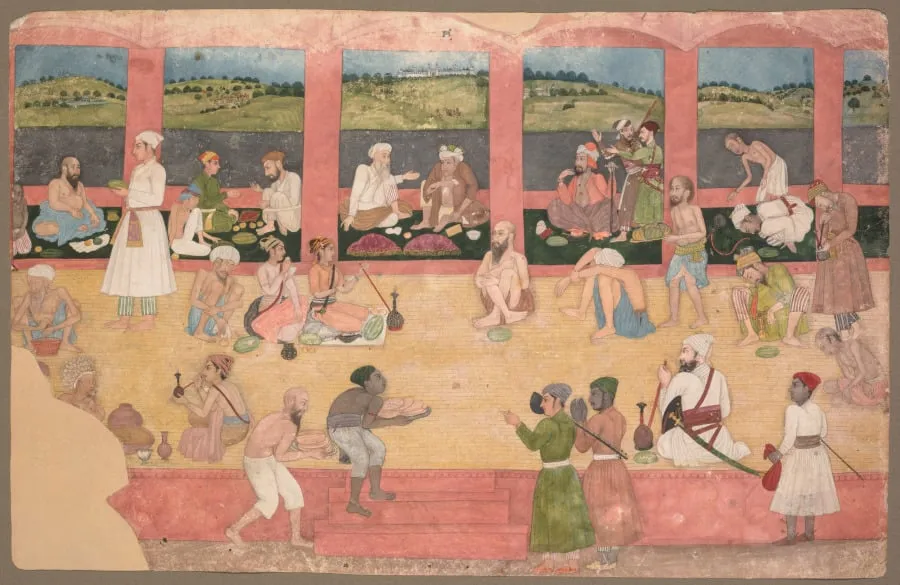
Opium Smokers Served Fruit and Bread is an unspecified painting by the Baroque artist Unknown. It dates from 1750 and is held in the collection of the Cleveland Museum of Art. The painting depicts a bustling terrace built of red sandstone, its floor covered with a straw mat.
About this work
A woman in peach sits quietly while men in blue robes—likely Sufi mystics—mix with clerics and aristocrats.
You see a crowded terrace where nobles and holy men lounge on straw mats, smoking opium and eating fruit.
Some are deep in talk, others look dazed or sleepy. A woman in peach sits quietly while men in blue robes—likely Sufi mystics—mix with clerics and aristocrats. The scene feels both relaxed and strange, like a party where not everyone is fully present.
For more like this, look up the subject: *Mughal dynasty (1526-1756)*.
Overview
The painting depicts a bustling terrace built of red sandstone, its floor covered with a straw mat. Over thirty figures—ranging from Sufi mystics in blue to white‑robed clerics and Mughal aristocrats—are gathered, many appearing under the influence of opium or cannabis. Fruit such as watermelons and apples, together with flatbread, are being handed out, creating a scene of convivial indulgence mixed with languor.
Subject & Meaning
Central to the composition is a female ascetic in a peach‑colored robe, seated calmly amid the revelry. The juxtaposition of holy men and nobles partaking in intoxicants highlights a cultural tolerance for altered states within certain spiritual and courtly circles of the Mughal period. The distribution of food underscores hospitality, while the varied expressions—conversation, drowsiness, and intoxication—suggest a meditation on the boundaries between devotion and pleasure.
Technique & Style
Rendered in a detailed, narrative style typical of Mughal court painting, the work employs precise linear drawing and a rich palette of earth tones contrasted with vivid blues and whites. The architecture is rendered with careful attention to perspective, while the figures are individualized through subtle facial expressions and gestures. Fine brushwork captures the texture of the straw mat, the sheen of fruit, and the smoke curling from opium pipes.
History & Provenance
The canvas originates from the Mughal dynasty (1526‑1756), a period noted for its synthesis of Persian artistic traditions with Indian themes. Although the exact patron is unknown, the inclusion of both religious and secular elites suggests a courtly commission intended to document or comment on contemporary social practices. The painting entered a private collection in the early 20th century before being acquired by a museum specializing in South Asian art.
Artist & collection

 Domestic Scene
 Giacomo and Cardinal Marco, investing Andrea, Abbot of San Zeno, with his Benefice
 The Nymph of Fontainebleau
 Portrait of a Woman
 Madonna and Child with Saints in the Enclosed Garden
 Venus and Minerva
 Family Group of Four on Sofa
 Wall painting from Room H of the Villa of P. Fannius Synistor at Boscoreale
 Traveling Warriors Stopping at a Farm
 Traveling Warriors Stopping at a Farm
 A feast for Babur hosted by his half-brother Jahangir Mirza in Ghazni in May 1505, from a Babur-nama (Memoirs of Babur)
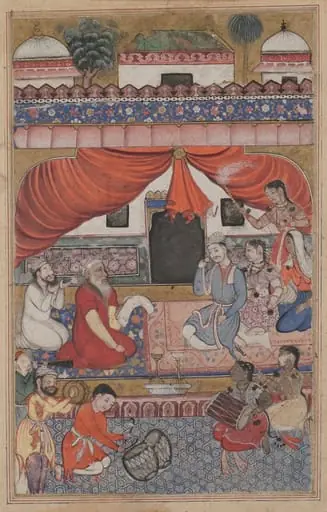 Preparation for the marriage of Mahmuda to the Young Vizier, from a Tuti-nama (Tales of a Parrot): Thirty-third Night
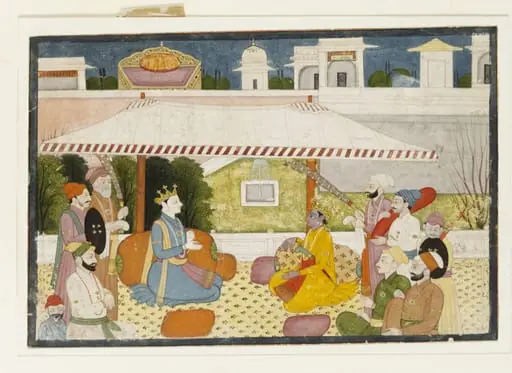 Krishna and Balarama
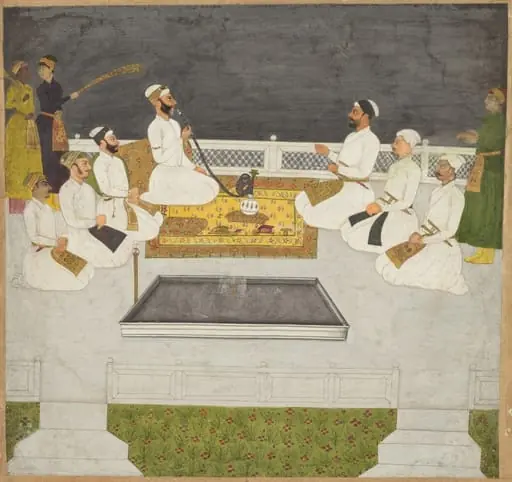 Husain Ali Khan Entertaining His Brothers (The Sayyid Brothers)
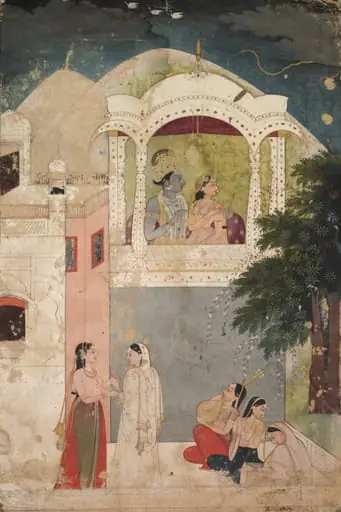 Radha and Krishna seated on a balcony
 Untitled
 A Man Dips His Hand into a Cauldron as Ladies of the Harem Stand in Amazement: A Page from a Manuscript of Religious History
 Alivardi Khan and Siraj ud-Daula