Artwork
Abhisandita Nayika
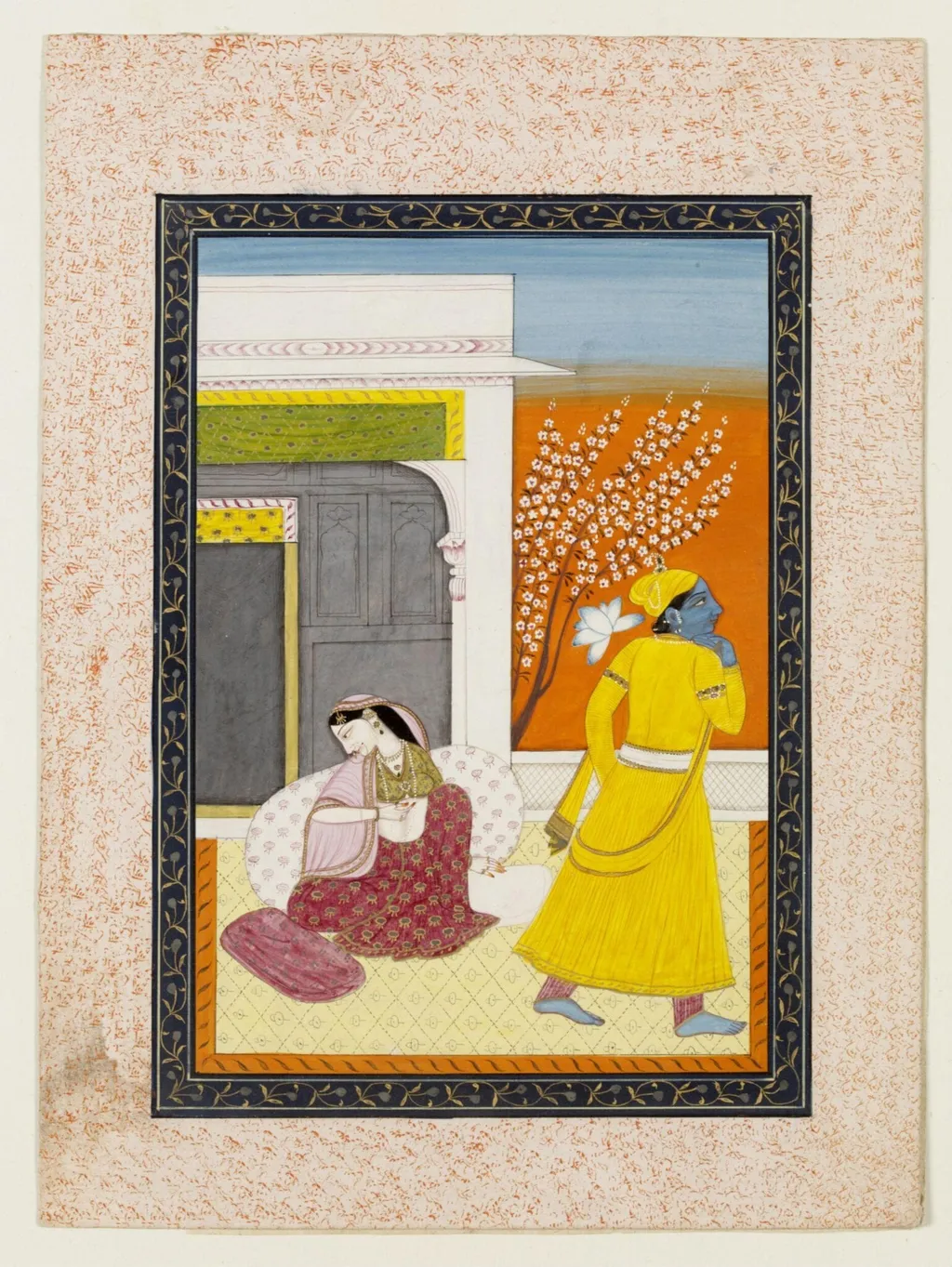
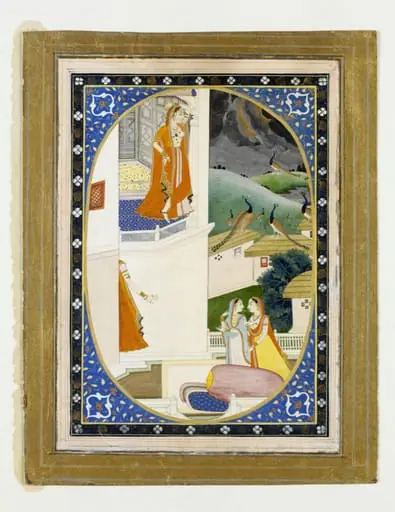
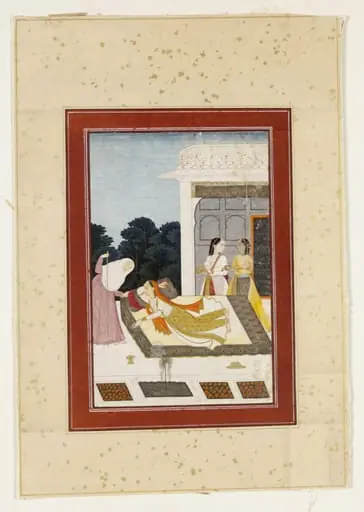
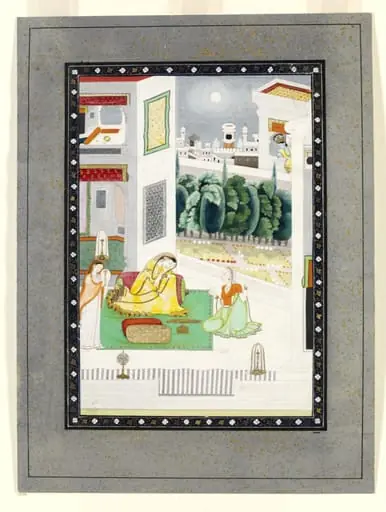
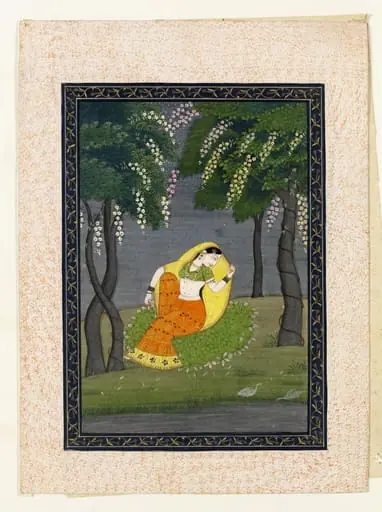
Abhisandita Nayika is a paint painting by the Impressionist artist Unknown. It dates from 1870 and is held in the collection of the Victoria and Albert Museum. This opaque watercolour on paper portrays a moment of emotional distance between two figures, drawn from the Nayaka Nayika tradition.
About this work
Overview
This opaque watercolour on paper portrays a moment of emotional distance between two figures, drawn from the Nayaka Nayika tradition. The woman, seated indoors, faces away from the man who stands just outside the threshold. The composition uses flat planes of vivid pigment—red, pink, yellow, and blue—against a plain background, emphasizing symbolic gesture over naturalistic detail.
Subject & Meaning
The scene illustrates the abhisandita nayika, a heroine estranged from her lover, Krishna. She remains seated, fan in hand, while he departs, holding a lotus—a symbol of divine love and unfulfilled longing. His blue skin identifies him as Krishna in Hindu iconography. Her turned gaze and his forward stride convey a quiet tension, reflecting the emotional rupture central to this poetic archetype.
Technique & Style
Figures are rendered with simplified forms, and the background is reduced to a flat orange plane with a narrow band of blue sky.
Executed in opaque watercolour, the painting favors bold outlines and unmodulated hues over fine detail. Figures are rendered with simplified forms, and the background is reduced to a flat orange plane with a narrow band of blue sky. The patterned floor rug adds subtle texture, while the flowering tree is stylized, reinforcing the work’s decorative and symbolic intent rather than illusionistic depth.
History & Provenance
This painting originates from the Pahari school, likely produced in the early 18th century in the Himalayan foothills. It belongs to a series illustrating the eight nayikas from Sanskrit poetic texts, popular among Rajput courts. The Victoria and Albert Museum holds similar works, suggesting it was part of a larger collection commissioned by a regional ruler or noble patron.
Context
The Nayaka Nayika theme emerged from medieval Indian poetry, where love was categorized into emotional states. Artists translated these literary archetypes into visual form for courtly audiences. This painting reflects a fusion of devotional Hindu imagery with secular poetic traditions, serving both aesthetic and didactic purposes in elite cultural circles.
Legacy
Works like this helped preserve and disseminate the Nayika tradition beyond literature into visual culture. Their simplified forms and symbolic clarity influenced later Indian miniature painting and continue to inform contemporary interpretations of classical Indian aesthetics. They remain key references for understanding how emotion was encoded in pre-modern South Asian art.
Artist & collection

 Domestic Scene
 Giacomo and Cardinal Marco, investing Andrea, Abbot of San Zeno, with his Benefice
 The Nymph of Fontainebleau
 Portrait of a Woman
 Madonna and Child with Saints in the Enclosed Garden
 Venus and Minerva
 Family Group of Four on Sofa
 Wall painting from Room H of the Villa of P. Fannius Synistor at Boscoreale