Artwork
Akbar II
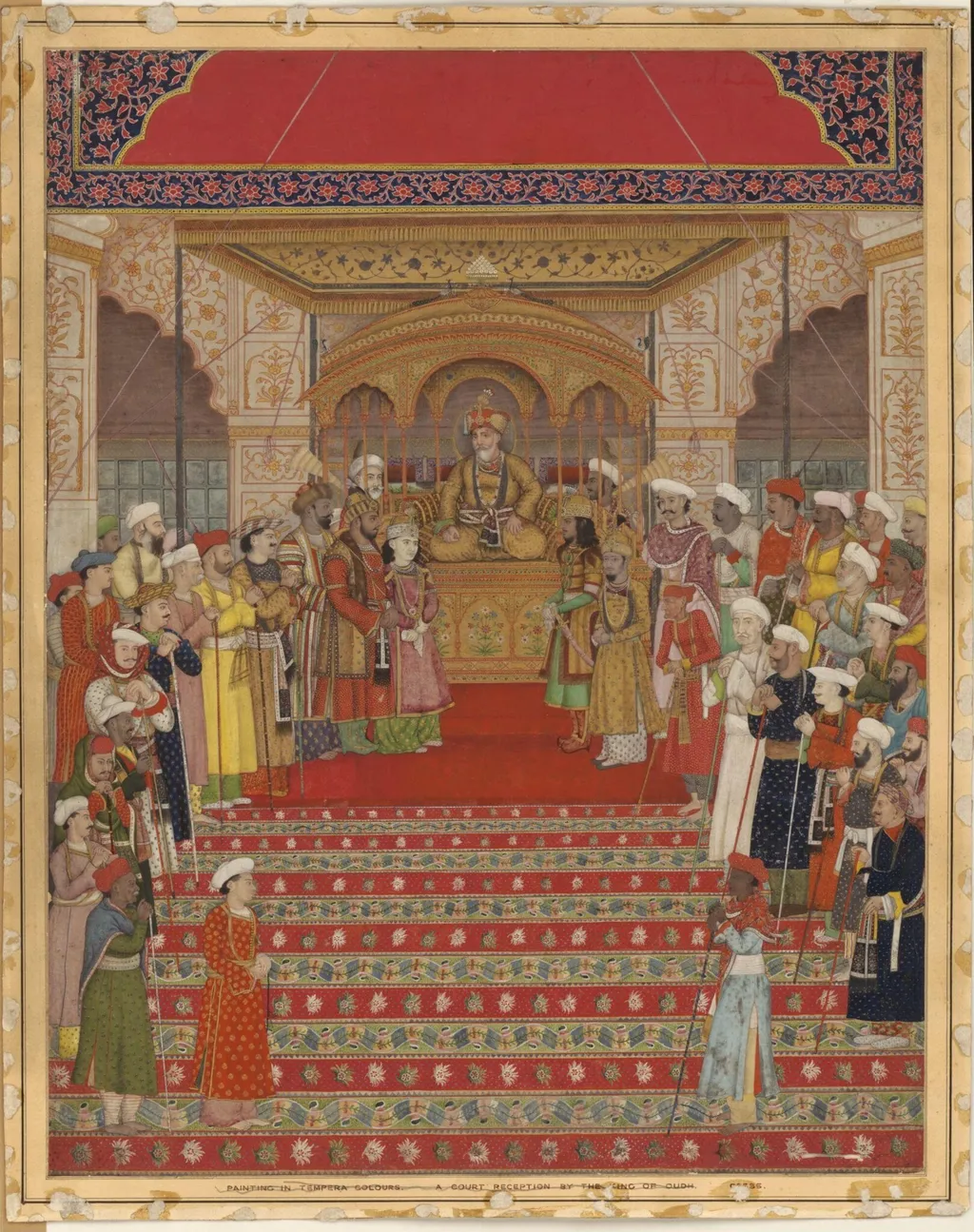
Akbar II is a paint painting by the Romanticist artist Unknown. It dates from 1830 and is held in the collection of the Victoria and Albert Museum.
About this work
Overview
The scene reflects the ceremonial traditions of the late Mughal court, even as imperial power waned under British influence.
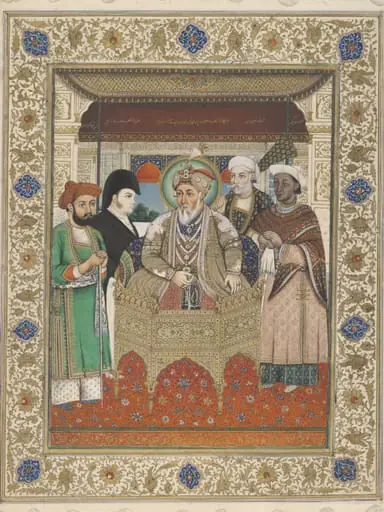
This opaque watercolor and gold painting on paper, dated around 1830, portrays Akbar Shah II, the Mughal emperor, during a formal court session in the Diwan-i Khas of Delhi’s Red Fort. The composition presents a hierarchical gathering of royalty and nobility, rendered with meticulous detail and a restrained palette of rich reds, golds, and deep greens. The scene reflects the ceremonial traditions of the late Mughal court, even as imperial power waned under British influence.
Subject & Meaning
Akbar II is depicted seated on an elevated throne, holding a document that suggests the receipt or issuance of official orders. Surrounding him are members of the royal family and high-ranking courtiers, arranged by rank and proximity. The orderly arrangement underscores the emperor’s authority and the ritualized nature of Mughal governance. The presence of multiple princes reinforces dynastic continuity, even as the empire’s political reach diminished.
Technique & Style
Executed in opaque watercolor with gold leaf accents, the painting employs fine brushwork to render intricate textiles, architectural details, and facial features. The use of layered pigments creates depth, while the flat, patterned backgrounds and stepped platform suggest a stylized space rather than naturalistic perspective. Figures are rendered with individualized expressions and costumes, reflecting the conventions of late Mughal portraiture and courtly illustration.
History & Provenance
Created during Akbar II’s reign (1806–1837), the painting likely originated in the imperial atelier in Delhi, where artists continued traditional Mughal styles despite declining patronage. It may have been commissioned to commemorate a formal audience or to reinforce the emperor’s legitimacy. The work entered Western collections in the 19th century, possibly through British officials or collectors, and is now held in institutions such as the Victoria and Albert Museum.
Context
By the 1830s, the Mughal Empire had lost most territorial control to the British East India Company, yet the emperor retained ceremonial status. This painting preserves the visual language of Mughal sovereignty—elaborate dress, architectural grandeur, and ritualized hierarchy—despite the erosion of real political power. It stands as a cultural artifact of a court clinging to tradition amid colonial encroachment.
Legacy
The painting exemplifies the persistence of Mughal artistic conventions into the 19th century, serving as a bridge between imperial traditions and early colonial documentation. It informs modern understanding of how indigenous elites maintained symbolic authority through visual culture. Today, it remains a key reference in studies of late Mughal art and the intersection of power, representation, and decline.
Artist & collection

 Domestic Scene
 Giacomo and Cardinal Marco, investing Andrea, Abbot of San Zeno, with his Benefice
 The Nymph of Fontainebleau
 Portrait of a Woman
 Madonna and Child with Saints in the Enclosed Garden
 Venus and Minerva
 Family Group of Four on Sofa
 Wall painting from Room H of the Villa of P. Fannius Synistor at Boscoreale