Artwork
An Illuminated Folio from the Royal Manuscript of the Farhang-i Jahangiri (verso)
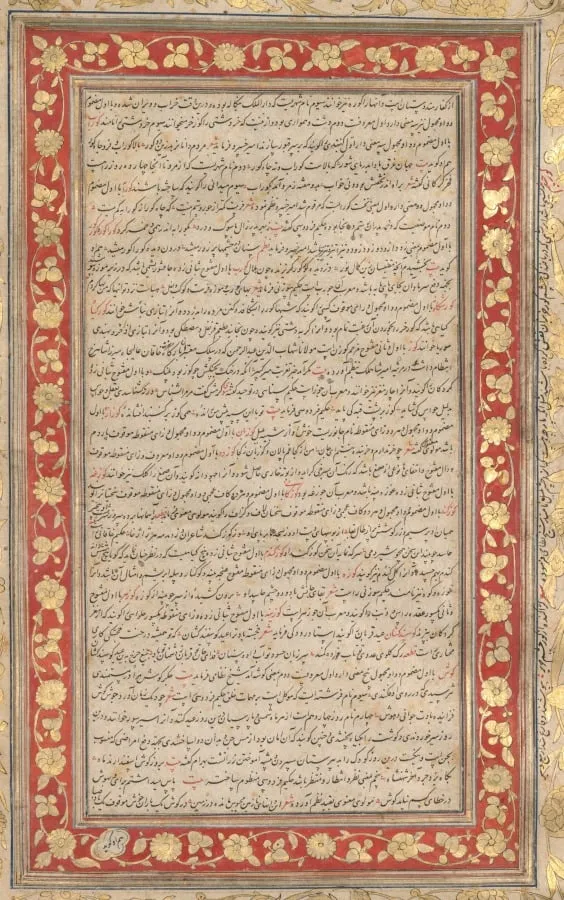
An Illuminated Folio from the Royal Manuscript of the Farhang-i Jahangiri (verso) is an unspecified painting by the Baroque artist Unknown. It dates from 1608 and is held in the collection of the Cleveland Museum of Art.
About this work
You see a page from a royal dictionary, filled with neat Persian script and a small painting of a man in a turban holding a book.
You see a page from a royal dictionary, filled with neat Persian script and a small painting of a man in a turban holding a book.
This isn’t just any dictionary—it took 12 years to write and was made for Emperor Jahangir, who ruled Mughal India. The tiny painting shows the scholar who wrote it, surrounded by words he collected. Each page was probably painted by different artists, so no single name is attached.
To see more pages like this, look up court of Jahangir (1605–1627).
Overview
This illuminated folio belongs to the royal manuscript of the Farhang‑i Jahangiri, a comprehensive Persian dictionary commissioned during the reign of Emperor Jahangir (1605–1627). The page combines finely executed Persian calligraphy with a miniature portrait of a turbaned scholar holding a book, exemplifying the Mughal court’s dedication to scholarly patronage.
Subject & Meaning
The miniature depicts the compiler of the dictionary, Mir Jamal al‑Din Husayn Inju, portrayed as a learned figure amidst the surrounding text. His representation underscores the intellectual labor involved in assembling over nine thousand lexical entries, each illustrated with poetic citations, and highlights the reverence afforded to scholars in Mughal cultural circles.
Technique & Style
The folio features precise Nastaliq script rendered in black ink, typical of Persian manuscript tradition, while the miniature employs delicate watercolor and gold leaf. The figure’s turban and attire reflect Mughal court fashion, and the composition balances textual density with a modest visual focal point, a hallmark of early 17th‑century Persian‑Mughal illumination.
History & Provenance
Compiled over twelve years by Inju, who was born in Shiraz but spent much of his career in Agra, the dictionary was presented to Emperor Jahangir as a tribute to his patronage of the arts and letters. The manuscript remained within the imperial library, and individual pages were likely painted by various court artists, leaving no single attribution.
Context
The Farhang‑i Jahangiri emerged at a time when the Mughal empire fostered a synthesis of Persian literary culture and Indian artistic practices. Its production reflects the broader imperial agenda of consolidating linguistic knowledge and showcasing the emperor’s support for scholarly endeavors, aligning with similar projects undertaken in Jahangir’s court.
Artist & collection

 Domestic Scene
 Giacomo and Cardinal Marco, investing Andrea, Abbot of San Zeno, with his Benefice
 The Nymph of Fontainebleau
 Portrait of a Woman
 Madonna and Child with Saints in the Enclosed Garden
 Venus and Minerva
 Family Group of Four on Sofa
 Wall painting from Room H of the Villa of P. Fannius Synistor at Boscoreale
 Baz Bahadur
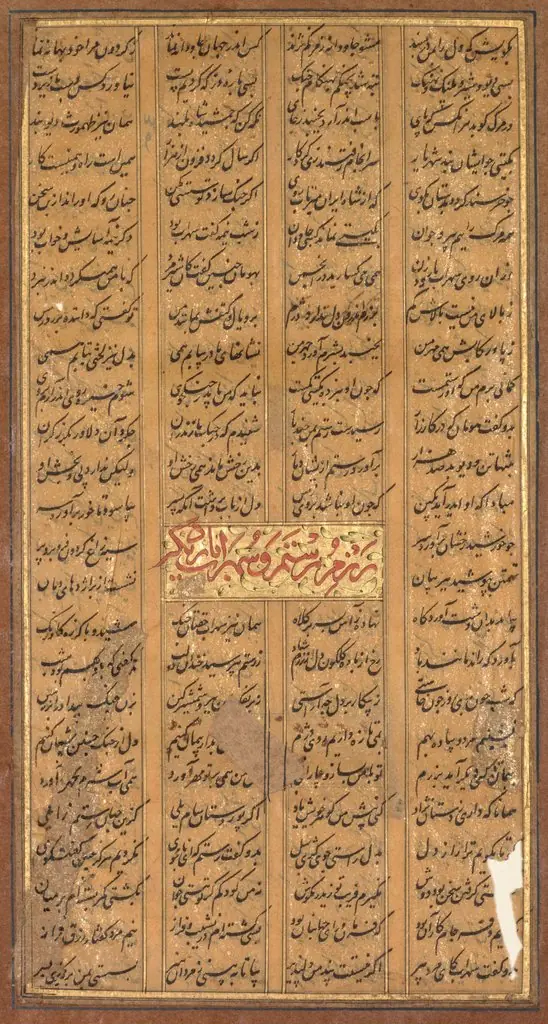
 Text of Rustam and Suhrab, from the Shah-nama of Firdausi (Persian, c. 934–1020) (recto)
 Text of Rustam and Suhrab, from the Shah-nama of Firdausi (Persian, c. 934–1020) (recto)
 Adham Khan and Akbar
 Page from Tales of a Parrot (Tuti-nama): text page (blank)
 Text of Rustam and Suhrab, from the Shah-nama of Firdausi (Persian, c. 934–1020) (verso)
 Landscape with a lotus pool, from a Tuti-nama (Tales of a Parrot), Eighth Night