Artwork
Architectural Sketch (verso)
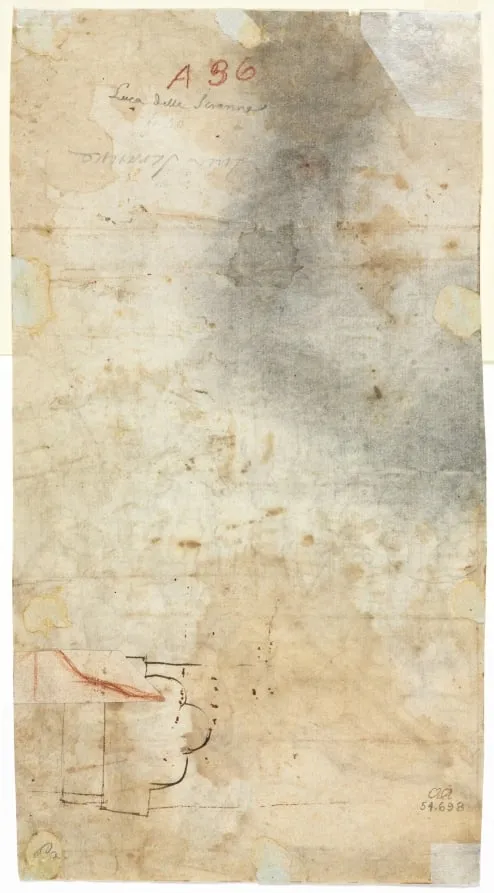
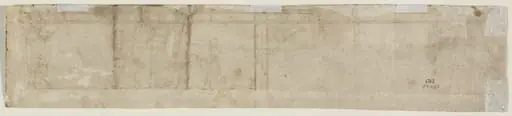
Architectural Sketch (verso) is a drawing by the Renaissance artist Unknown. It dates from 1504 and is held in the collection of the Cleveland Museum of Art. The work is a modest architectural drawing executed on a sheet of paper that shows signs of age and handling.
About this work
Overview
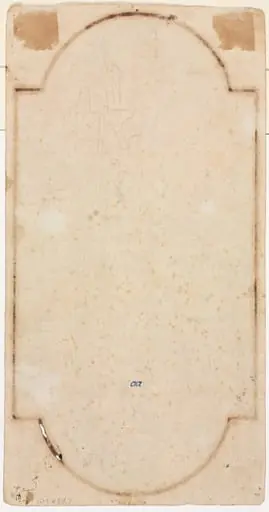
The work is a modest architectural drawing executed on a sheet of paper that shows signs of age and handling. The surface is uneven, with torn edges, brown discolorations reminiscent of coffee stains, and a dark, blurred spot near the upper margin. The drawing appears on the verso side of the sheet, suggesting it was used as a secondary surface for quick notation.
Subject & Meaning
The composition records a fragment of a building, focusing on a corner that includes a modest archway and a series of linear elements that may represent steps or a ledge. The sketch captures the essential geometry of the structure without decorative detail, indicating its purpose as a visual reference rather than a finished illustration.
Technique & Style
Rendered with a rapid, gestural hand, the drawing employs loose lines and minimal shading to convey form. The artist’s approach is characteristic of preliminary studies, prioritising speed and clarity over finish. The faint, uneven strokes suggest the use of a simple pen or charcoal on paper, applied in a single, unrefined session.
History & Provenance
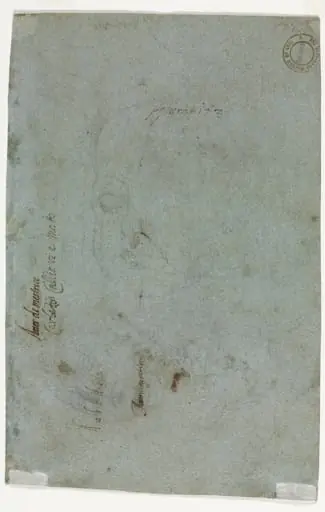
A brief inscription at the top reads "A 36" alongside the name "Luca della Robbia," though the lettering is partially obscured. This notation links the sketch to the workshop of the renowned Florentine sculptor, implying it may have been a study for a project associated with his circle. The paper’s condition points to long-term storage, possibly within an archival collection.
Context
During the Renaissance, artists and architects frequently produced such sketches to explore spatial relationships and to plan decorative programs. The inclusion of an archway aligns with the period’s interest in classical motifs, while the informal nature of the drawing reflects the practical, on‑site documentation common among workshop assistants.
Legacy
Although the drawing lacks the polish of a finished work, it offers insight into the preparatory practices of the Luca della Robbia workshop. As a tangible fragment of the creative process, it contributes to a broader understanding of how Renaissance artisans translated architectural ideas into three‑dimensional execution.
Artist & collection

 Domestic Scene
 Giacomo and Cardinal Marco, investing Andrea, Abbot of San Zeno, with his Benefice
 The Nymph of Fontainebleau
 Portrait of a Woman
 Madonna and Child with Saints in the Enclosed Garden
 Venus and Minerva
 Family Group of Four on Sofa
 Wall painting from Room H of the Villa of P. Fannius Synistor at Boscoreale