Artwork
Bernardino Corio
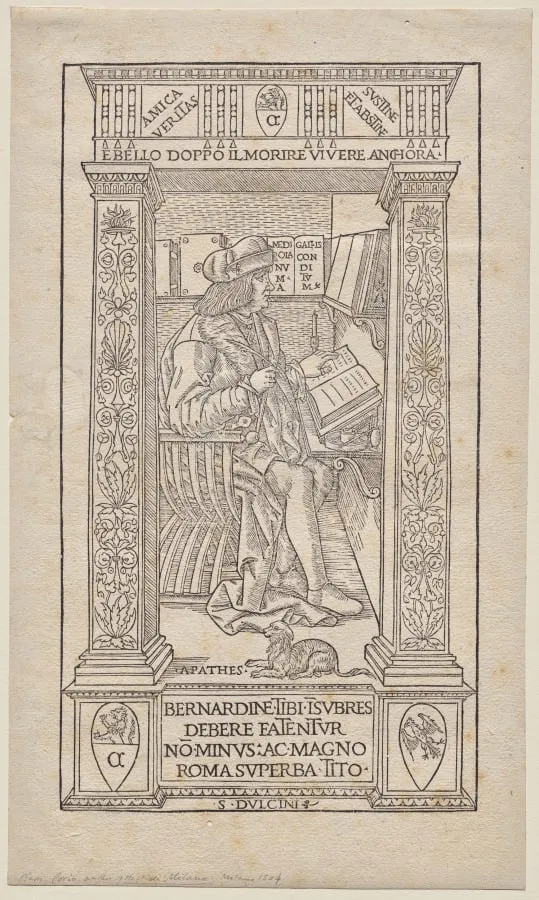
Bernardino Corio is a print by the Renaissance artist Unknown. It dates from 1503 and is held in the collection of the Cleveland Museum of Art.
About this work
The background has shelves filled with more books, and the whole scene is framed by fancy columns and Latin words.
This print shows a man sitting in a carved wooden frame that looks like a bookshelf. He’s holding an open book in one hand and a scroll in the other, with a dog curled at his feet. The background has shelves filled with more books, and the whole scene is framed by fancy columns and Latin words.
The man’s name is written below: *Bernardino Corio*. The print looks like it was made in 1503, but the artist isn’t known.
If you like this style, look up Renaissance.
Overview
This print, dated 1503, depicts Bernardino Corio, a Milanese historian, seated within an architectural frame resembling a bookshelf. He holds an open book and a scroll, while a dog rests at his feet. The background is lined with volumes, and the composition is bordered by ornate columns and Latin inscriptions. Though the artist remains unidentified, the work reflects Renaissance ideals of scholarship and humanist culture.
Subject & Meaning
Bernardino Corio, a respected chronicler of Milan’s history, is portrayed as a learned man immersed in textual authority. The open book and scroll suggest active engagement with written knowledge, while the dog symbolizes loyalty or vigilance. The surrounding shelves imply a life devoted to scholarship, reinforcing his identity as a keeper and transmitter of historical record.
Technique & Style
The print employs fine linear detail to render wood grain, book spines, and architectural elements with precision. The use of perspective and classical columns aligns with Renaissance conventions, emphasizing order and intellectual harmony. Latin inscriptions frame the scene, enhancing its scholarly tone. The composition is tightly controlled, balancing realism with symbolic arrangement.
History & Provenance
Created in 1503, the print likely served as a portrait for Corio’s contemporaries or as a commemorative piece for his writings. Its survival suggests it was valued within intellectual circles in northern Italy. No record of its original commission or early owners exists, and its maker remains anonymous, though its style points to a Lombard printmaker active in the early 16th century.
Context
In early 16th-century Milan, humanist scholarship flourished under the Sforza court. Corio’s historical works were widely read, and visual representations of scholars were becoming common as symbols of civic pride. This print fits a broader trend of portraying intellectuals within book-filled, architecturally refined settings, reflecting the era’s reverence for learning and textual tradition.
Legacy
Though not widely reproduced, the print stands as a quiet example of how Renaissance culture visualized the scholar’s role. It contributes to the visual vocabulary of learned men in early modern Europe, influencing later portraiture that linked intellect with domesticated, book-lined environments. Its anonymity underscores how individual artists often remained hidden behind the prestige of their subjects.
Artist & collection

 Domestic Scene
 Giacomo and Cardinal Marco, investing Andrea, Abbot of San Zeno, with his Benefice
 The Nymph of Fontainebleau
 Portrait of a Woman
 Madonna and Child with Saints in the Enclosed Garden
 Venus and Minerva
 Family Group of Four on Sofa
 Wall painting from Room H of the Villa of P. Fannius Synistor at Boscoreale
 Saint John in a Landscape
 Erasmus of Rotterdam
 Saint Bartholomew
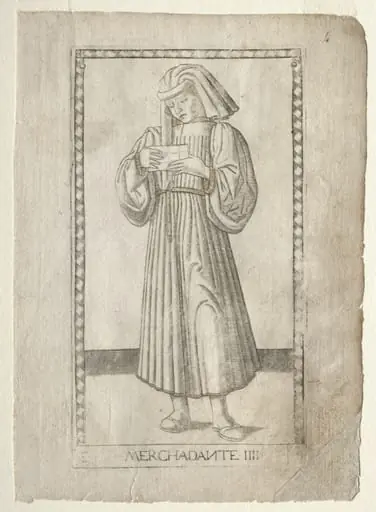 The Merchant (from the Tarocchi, series E: Conditions of Man, #4)
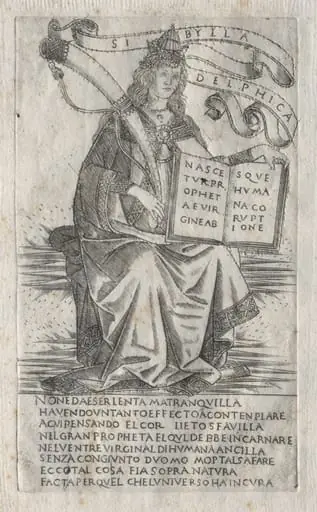 The Sibyls: The Delphian Sibyl
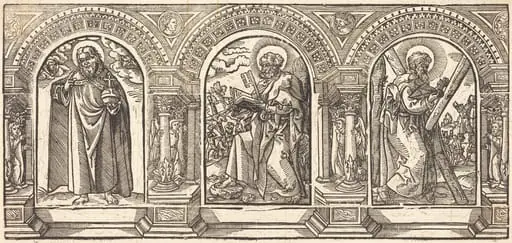 Christ and His Disciples II
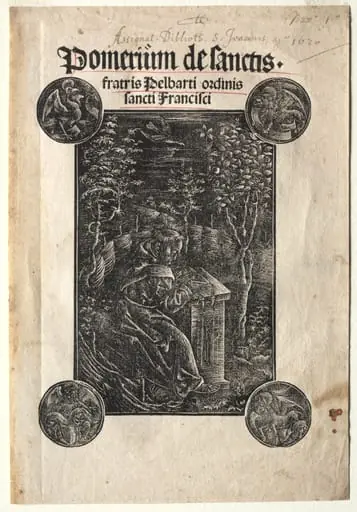 Pelbart of Temesvar Studying in a Garden
 The Emblem
 Saint George (?)
 Desiderius Erasmus of Rotterdam
 Saint Augustine
 The Apostle Matthew