Artwork
Bhima and Duhshashana
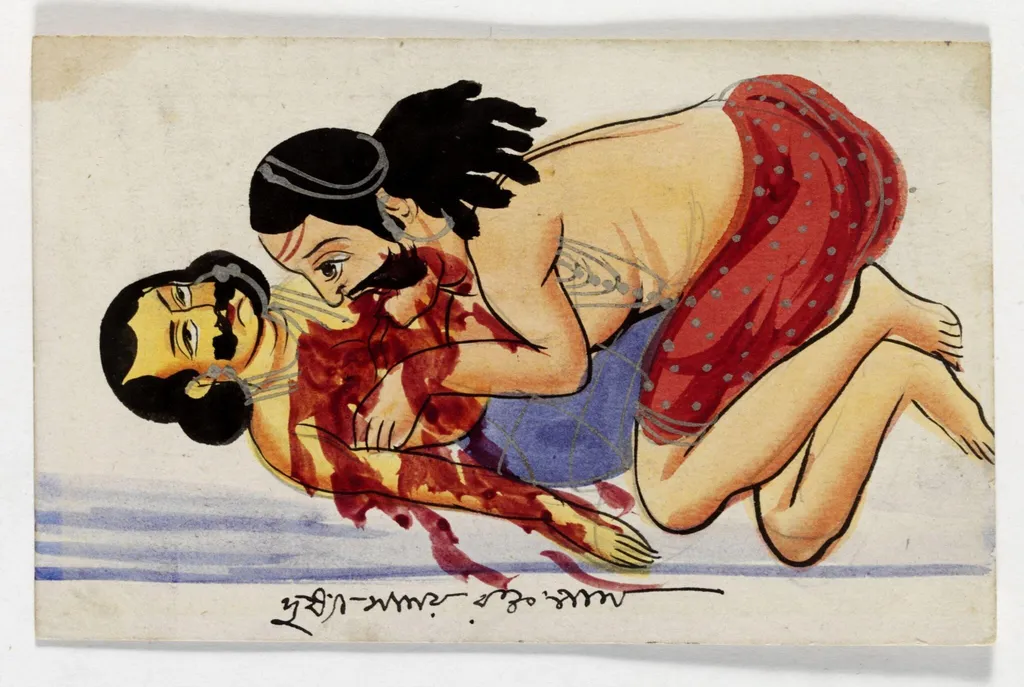
Bhima and Duhshashana is a paint painting by the Impressionist artist Unknown. It dates from 1890 and is held in the collection of the Victoria and Albert Museum.
About this work
Overview
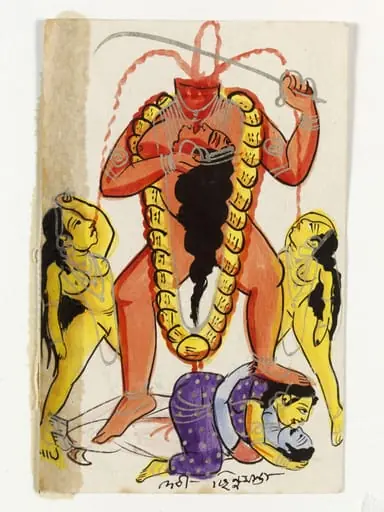
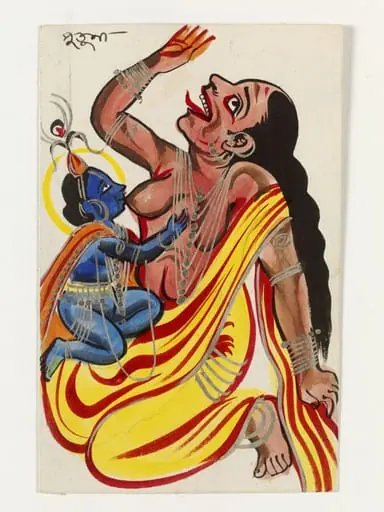
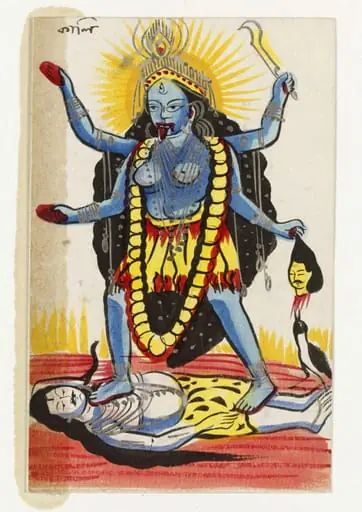
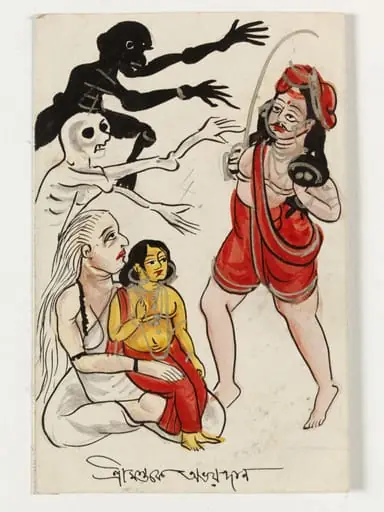
This watercolor and tin alloy painting on cardboard illustrates a violent episode from the Mahabharata, depicting Bhima consuming the blood of Duhshashana.
This watercolor and tin alloy painting on cardboard illustrates a violent episode from the Mahabharata, depicting Bhima consuming the blood of Duhshashana. Executed in bold, flat hues and energetic brushwork, the composition captures a moment of raw physical confrontation. The use of inexpensive materials and rapid, gestural strokes aligns it with the Kalighat tradition of 19th-century Bengal, where mythological scenes were rendered for popular audiences.
Subject & Meaning
The scene portrays Bhima fulfilling his oath to avenge Draupadi’s humiliation by killing Duhshashana and drinking his blood. The intimate, violent embrace underscores the personal nature of the retribution. Facial expressions convey rage and agony, emphasizing moral consequence over heroism. The act is not glorified but presented as a visceral climax to a long-standing feud rooted in honor and justice.
Technique & Style
The painting employs watercolor and tin alloy on cardboard, using unmodulated areas of red, blue, and yellow with minimal shading. Brushstrokes are swift and loose, outlining forms with minimal detail, suggesting movement rather than realism. The figures are flattened against a blank background, focusing attention on their entangled bodies. This stylistic economy reflects Kalighat’s adaptation of folk aesthetics for mass reproduction.
History & Provenance
Created in mid-19th century Bengal, likely near Kalighat temple in Kolkata, the work was produced for pilgrims and local buyers seeking affordable religious imagery. Artists in this tradition often worked in family workshops, producing scenes from Hindu epics as devotional souvenirs. The use of cardboard and tin alloy indicates a pragmatic approach to materials, suited to high-volume production and portability.
Context
This painting emerged during a period of cultural transition in colonial India, when traditional iconography was being reinterpreted for urban markets. Kalighat artists responded to changing audiences by simplifying forms and amplifying emotional intensity. Mythological subjects like Bhima’s vengeance resonated with contemporary ideas of justice and retribution, bridging ancient narrative with modern urban sensibilities.
Legacy
Works like this helped shape the visual language of Indian popular art, influencing later commercial prints and folk traditions. Though once dismissed as mere souvenirs, Kalighat paintings are now recognized for their expressive power and cultural insight. This piece exemplifies how sacred stories were made accessible through immediacy of form, preserving myth in the rhythm of everyday life.
Artist & collection

 Domestic Scene
 Giacomo and Cardinal Marco, investing Andrea, Abbot of San Zeno, with his Benefice
 The Nymph of Fontainebleau
 Portrait of a Woman
 Madonna and Child with Saints in the Enclosed Garden
 Venus and Minerva
 Family Group of Four on Sofa
 Wall painting from Room H of the Villa of P. Fannius Synistor at Boscoreale