Artwork
Cănceu
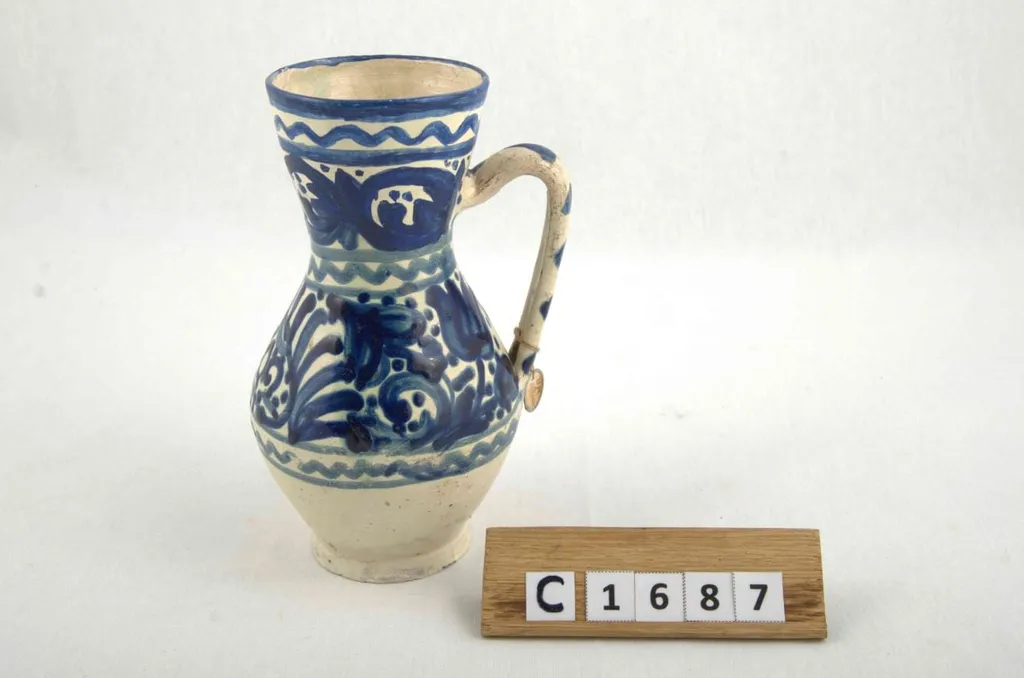
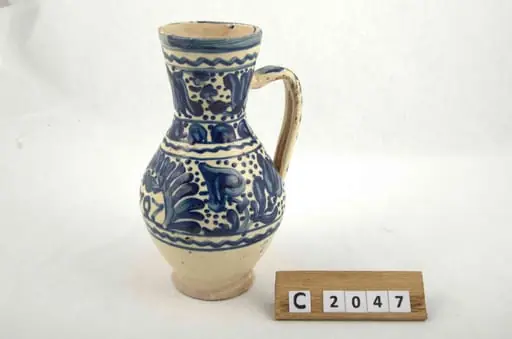
Cănceu is a photography by the Romanticist artist Unknown. It dates from 1802 and is held in the collection of the ASTRA National Museum Complex. A small white ceramic jug, labeled C1687, features a simple blue decorative pattern.
About this work
Overview
A small white ceramic jug, labeled C1687, features a simple blue decorative pattern. Its form is functional: wide mouth, narrow base, and a single handle. The design consists of abstract wavy lines and a central floral motif. Placed on a plain background with a wooden marker, the object appears as a specimen rather than a display piece, suggesting archival or cataloguing context.
Subject & Meaning
The jug’s decoration lacks narrative or symbolic depth, focusing instead on repetitive, stylized forms. The flower-like shape may reflect regional ceramic traditions, but no clear iconography or cultural story is evident. The accompanying label C1687 implies identification within a collection, prioritizing cataloging over interpretive meaning.
Technique & Style
The vessel is hand-thrown ceramic, glazed white with hand-painted blue pigment. The lines are uneven, suggesting artisanal rather than industrial production. The floral motif is simplified, with loose, organic contours typical of folk or utilitarian pottery. Brushwork is direct and unrefined, emphasizing function over ornamentation.
History & Provenance
The wooden sign marked C1687 indicates this object was part of a numbered collection, likely from the 19th or early 20th century. No origin or maker is recorded. Its preservation suggests it was retained for study or documentation, possibly from a regional pottery tradition in Eastern Europe, though specific provenance remains unverified.
Context
This piece aligns with common European folk ceramics of the 18th–19th centuries, where household vessels were decorated with locally derived motifs. Its minimal design contrasts with elaborate porcelain traditions, reflecting everyday use. The presence of a catalog label implies institutional interest, possibly from a museum or ethnographic survey.
Legacy
As a modest, unlabeled artifact, the jug contributes little to broader art historical discourse. Its value lies in its representation of vernacular craft—unadorned, functional, and unattributed. It survives as a quiet record of material culture, preserved not for fame but for its place in a systematic inventory.
Artist & collection

 Domestic Scene
 Giacomo and Cardinal Marco, investing Andrea, Abbot of San Zeno, with his Benefice
 The Nymph of Fontainebleau
 Portrait of a Woman
 Madonna and Child with Saints in the Enclosed Garden
 Venus and Minerva
 Family Group of Four on Sofa
 Wall painting from Room H of the Villa of P. Fannius Synistor at Boscoreale