Artwork
Drawing of a pavilion
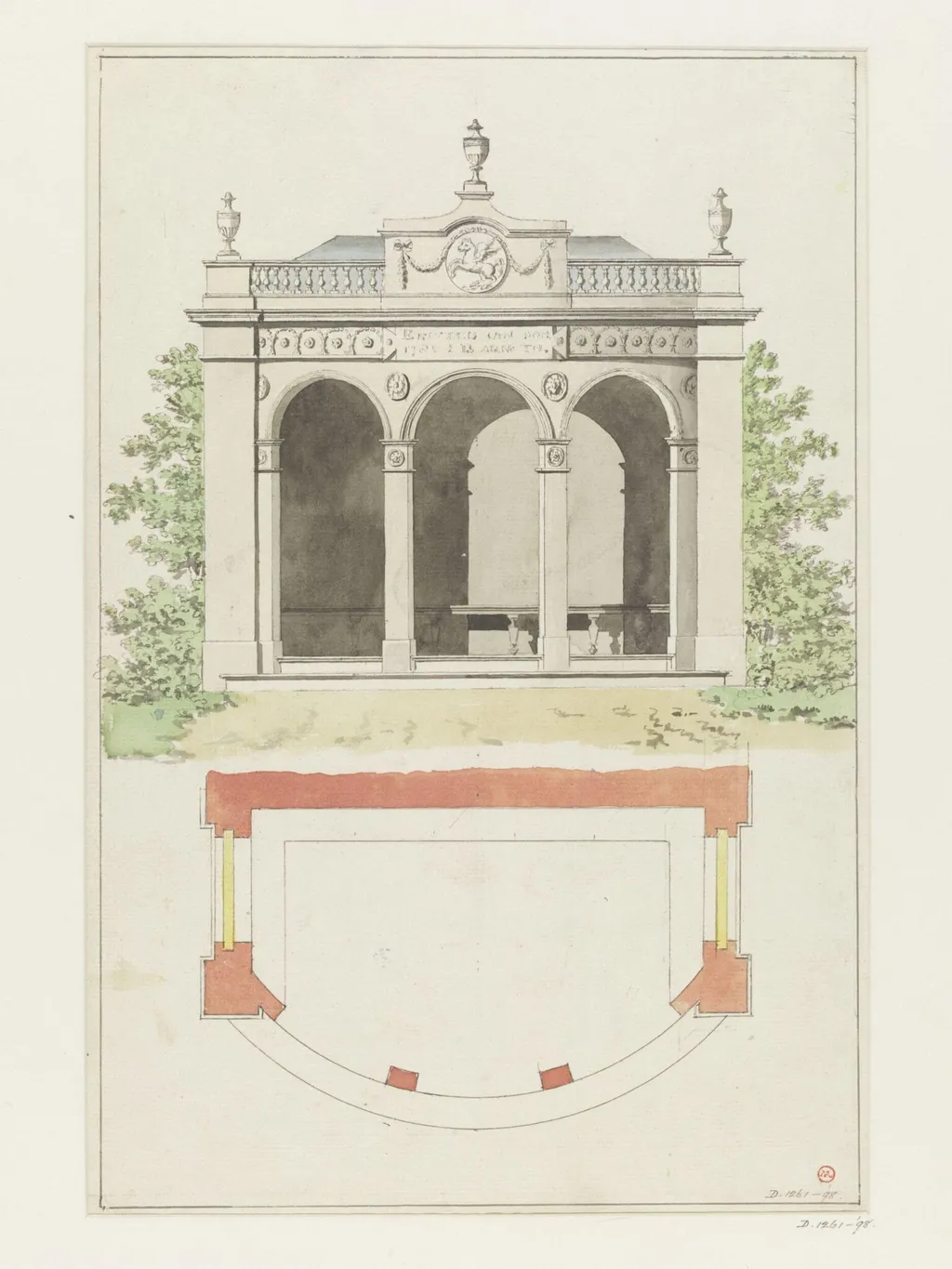
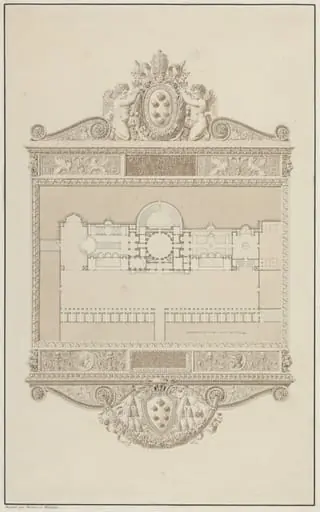
Drawing of a pavilion is a drawing by Unknown. It dates from 1750 and is held in the collection of the Victoria and Albert Museum. This pencil, ink, and watercolor drawing on paper presents a garden pavilion with architectural precision and atmospheric detail.
About this work
Overview
The structure is rendered in three-quarter view, emphasizing its ornamental front facade, while a complementary semicircular floor plan is positioned beneath.
This pencil, ink, and watercolor drawing on paper presents a garden pavilion with architectural precision and atmospheric detail. The structure is rendered in three-quarter view, emphasizing its ornamental front facade, while a complementary semicircular floor plan is positioned beneath. Delicate washes suggest foliage and sky, contrasting with the sharp linework of the stonework and decorative elements.
Subject & Meaning
The pavilion appears designed as a garden folly, intended for contemplation or light performance. Its three arched openings frame views rather than enclose space, suggesting an open-air setting. Central decorative motifs—a Pegasus relief and trophies—hint at classical or allegorical themes, possibly referencing poetry, muse, or aristocratic leisure, common in 18th-century landscape design.
Technique & Style
The artist employs precise ink lines to define architectural forms, while soft watercolor washes model the surrounding trees and sky, creating depth without heaviness. The floor plan below is rendered in muted tones, aligning with the elevation to serve as a functional companion. The use of color is restrained: red for the roof, yellow for columns, reinforcing clarity over ornamentation.
History & Provenance
The drawing likely originates from the late 17th or early 18th century, a period when garden architecture was documented extensively by designers and patrons. Its inclusion in the Victoria and Albert Museum’s collection suggests it was part of a larger archive of architectural studies, possibly used for construction or as a record of a designed landscape now lost.
Context
Such drawings were common among architects and landowners who commissioned garden structures as expressions of taste and refinement. The pavilion’s scale and decoration align with European traditions of ornamental garden features, particularly in England and France, where classical motifs were adapted for private estates as symbols of cultural sophistication.
Legacy
This drawing survives as a record of a transient architectural form, preserving details of a structure that may no longer exist. It reflects the practice of documenting design intent through layered representation—elevation and plan together—offering insight into how such spaces were conceived, visualized, and realized in the early modern period.
Artist & collection

 Domestic Scene
 Giacomo and Cardinal Marco, investing Andrea, Abbot of San Zeno, with his Benefice
 The Nymph of Fontainebleau
 Portrait of a Woman
 Madonna and Child with Saints in the Enclosed Garden
 Venus and Minerva
 Family Group of Four on Sofa
 Wall painting from Room H of the Villa of P. Fannius Synistor at Boscoreale
 Design for a Baldaquin
 Drawing of fountain in Draper's Gardens
 Arcade Decoration
 Longitudinal section through Pantheon portico
 Pencil drawing of a fountain and entryway
 Design for a Catafalque
 Repton for Ackermann's Repository
 Untitled
 Design for a City Gate in Trier
 Elevations of the interior walls of the Hall, Combe Bank.
 Untitled
 Villa Madama a Rome