Artwork
Drona
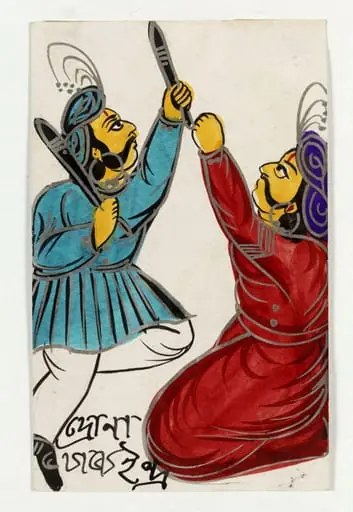
Drona is a paint painting by the Impressionist artist Unknown. It dates from 1890 and is held in the collection of the Victoria and Albert Museum.
About this work
Overview
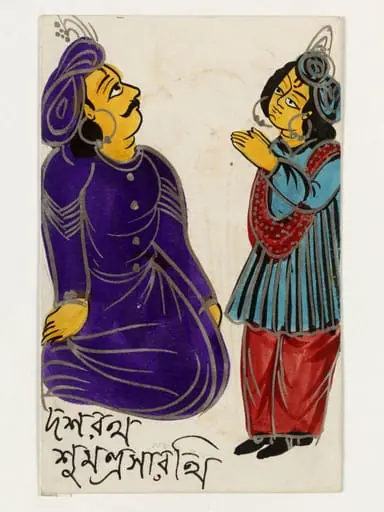
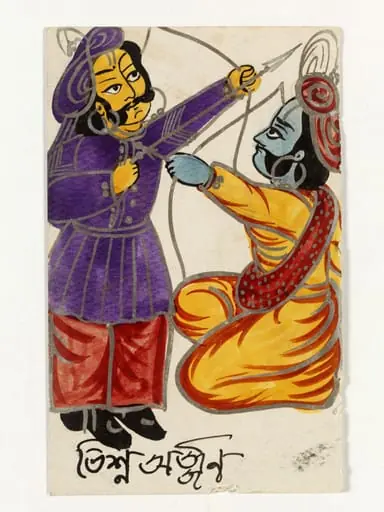
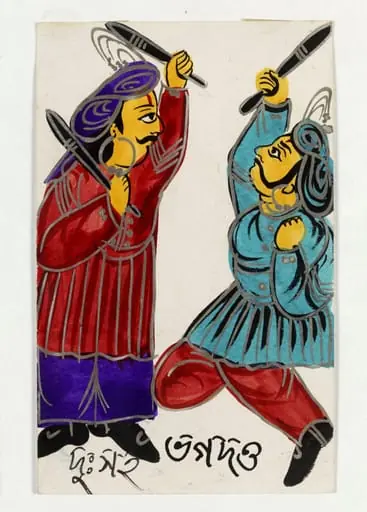
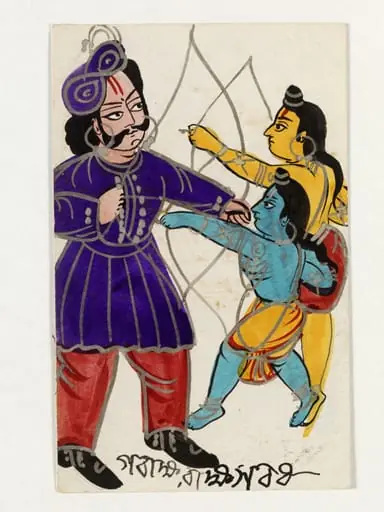
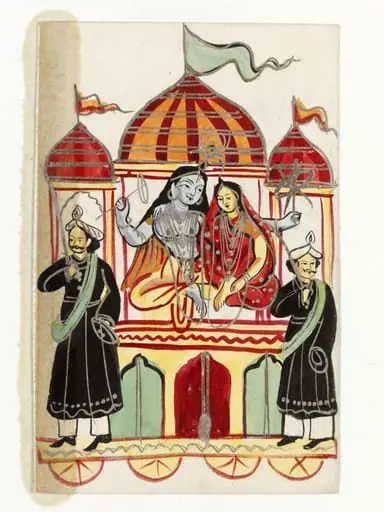
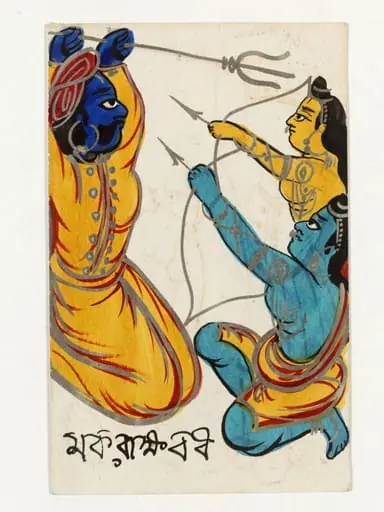
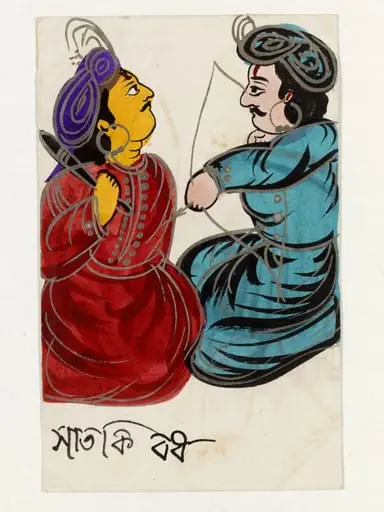
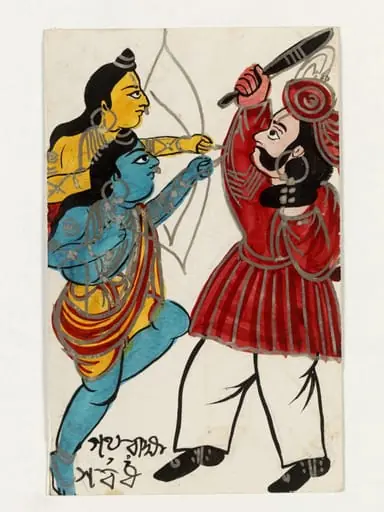
Created in 1890, this watercolour and tin alloy painting on paper is titled *Drona* and originates from the Kalighat tradition in Calcutta.
Created in 1890, this watercolour and tin alloy painting on paper is titled *Drona* and originates from the Kalighat tradition in Calcutta. Though its exact narrative is unconfirmed, it likely references a moment from the *Ramayana*, possibly involving Arjuna and Aswatthaman. The work’s quiet composition and unlabelled figures reflect the Kalighat artists’ practice of capturing mythic scenes with minimal context, appealing to both devotional and commercial audiences.
Subject & Meaning
The painting presents two figures in silent confrontation within an empty interior, suggesting a pivotal moment of tension—perhaps the aftermath of Drona’s death or Aswatthaman’s pursuit of vengeance. No inscriptions or traditional iconography identify the characters, leaving interpretation open. The absence of narrative clutter emphasizes emotional stillness over dramatic action, aligning with Kalighat’s tendency to distill complex stories into single, potent moments.
Technique & Style
The work employs soft, fluid brushwork for the figures’ forms, contrasted with precise details in the architecture and light. Tin alloy is used sparingly to add subtle metallic sheen, likely to highlight fabric or armor. The room’s high ceiling and slanted sunlight are rendered with observational clarity, blending folk simplification with emerging naturalism. This hybrid approach reflects Kalighat artists’ adaptation to urban tastes without abandoning regional aesthetics.
History & Provenance
Produced in late 19th-century Calcutta, the painting emerged from a community of artists who migrated from rural Bengal to serve pilgrims and colonial buyers near the Kalighat temple. Though unsigned, its materials and style are consistent with other works from this period held in institutions like the Victoria and Albert Museum. Its survival suggests it was valued as both devotional object and artistic commodity.
Context
Kalighat paintings responded to rapid urbanization and British colonial presence by reimagining Hindu epics for new audiences. Artists abandoned elaborate temple styles for quicker, cheaper works on paper, often sold as souvenirs. This piece’s minimalism and focus on psychological tension reflect a shift toward intimate storytelling, where mythic drama is conveyed through posture and light rather than crowded scenes.
Legacy
The painting exemplifies how Kalighat artists negotiated tradition and modernity, preserving mythic themes while adopting new materials and compositional strategies. Its understated power influenced later Indian modernists who sought to root contemporary expression in indigenous visual languages. Though once dismissed as folk art, such works are now recognized for their quiet innovation and cultural resilience.
Artist & collection

 Domestic Scene
 Giacomo and Cardinal Marco, investing Andrea, Abbot of San Zeno, with his Benefice
 The Nymph of Fontainebleau
 Portrait of a Woman
 Madonna and Child with Saints in the Enclosed Garden
 Venus and Minerva
 Family Group of Four on Sofa
 Wall painting from Room H of the Villa of P. Fannius Synistor at Boscoreale