Artwork
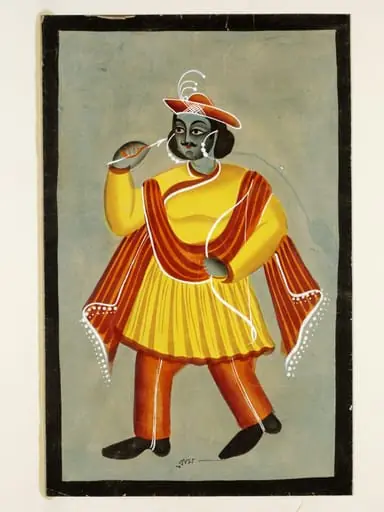
English Babu (Native Indian Clerk) Holding a Hookah
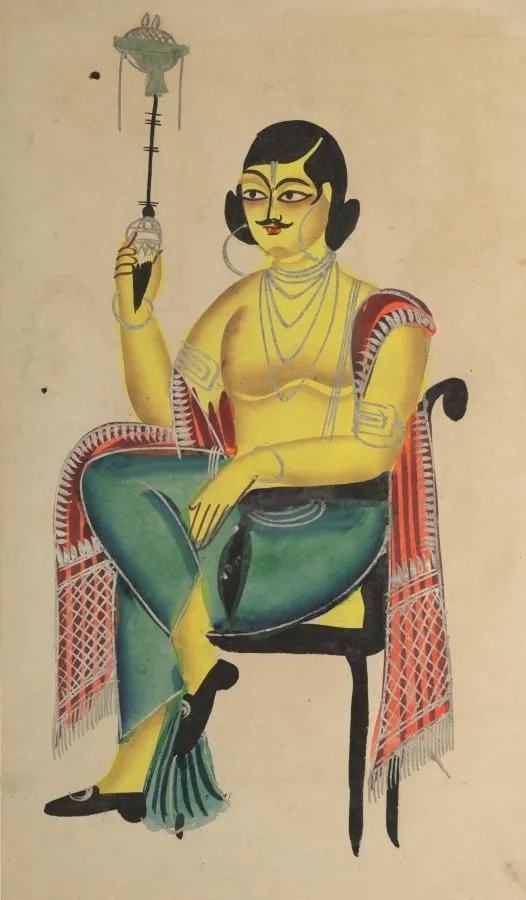
English Babu (Native Indian Clerk) Holding a Hookah is an unspecified painting by the Patna School of Painting artist Unknown. It dates from 1890 and is held in the collection of the Cleveland Museum of Art.
About this work
Overview
This Kalighat painting from Kolkata depicts a native Indian clerk, or 'babu', in a satirical light, highlighting the cultural dissonance of adopting British mannerisms in 19th-century India.
Subject & Meaning
The subject, a Bengali clerk, is portrayed as a comical figure, blending British and Indian attire and habits (e.g., Prince Albert hairstyle, European shoes, hookah) in an awkward manner, critiquing the perceived vanity and pretentiousness of the emerging Indian middle class that emulated their colonial rulers.
Technique & Style
Characterized by the bold, quick, and accessible style of Kalighat paintings, this work features vivid, expressive lines and a straightforward composition, typical of the genre's aim to produce relatable, humorous art for a broad audience.
History & Provenance
Created in Kolkata during the Kalighat painting era, the artwork remains anonymous, as was common for artists of this tradition, who prioritized swift production for local sales over individual recognition.
Context
Emerging from the cultural intersection of British colonial rule and Indian daily life, this painting reflects the societal tensions and humorous observations of the time, as captured by Kalighat artists for the masses.
Legacy
As part of the Kalighat tradition, this work contributes to the historical record of India's colonial era, offering insights into the social dynamics and cultural adaptations of the period, while also representing the genre's influence on subsequent Indian folk and popular art forms.
Artist & collection

 Domestic Scene
 Giacomo and Cardinal Marco, investing Andrea, Abbot of San Zeno, with his Benefice
 The Nymph of Fontainebleau
 Portrait of a Woman
 Madonna and Child with Saints in the Enclosed Garden
 Venus and Minerva
 Family Group of Four on Sofa
 Wall painting from Room H of the Villa of P. Fannius Synistor at Boscoreale
 Man Seated in a European Chair Smoking a Margila Pipe, from a Kalighat album
 Man Seated in a European Chair Smoking a Margila Pipe, from a Kalighat album
 Jailer Receiving the Mahant of Tarakeshwar in Prison
 Untitled
 Hari-Hara (recto), from a Kalighat album
 Pavana
 Karttikeya
 Rama
Rama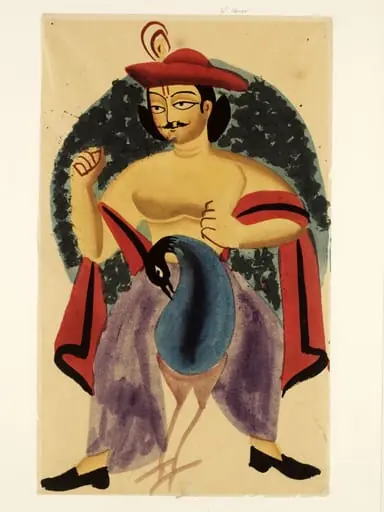 Karttikeya
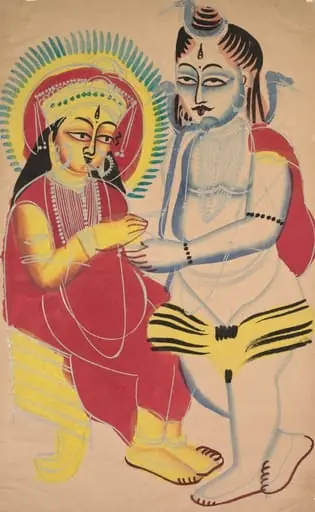 Annapurna and Shiva