Artwork
Farfurie semi-adâncă, acoperită pe suprafața interioară cu un strat de angobă de culoare verde închis, peste care este pictat cu pensula și cu cornul decorul format din motive florale stilizate și motive geometrice: registrul decorativ central, încadrat într-un cerc de culoare maro-închis, conține o tulpină și elemente vegetale formate din linii punctate, două frunze de culoare albă și trei flori, cele două laterale de culoare roșu-cărămiziu, iar cea centrală de culoare albă cu mijlocul roșu. Buza farfuriei este decorată cu un șir de semicercuri cu contur maro, lipite de muchia buzei, umplute cu culorile alb și roșu-cărămiziu și având pe exterior linii mici de culoare maro-închis. Bordura interioară a farfuriei este marcată cu o linie circulară subțire iar muchia buzei cu o dungă de culoare maro-închis. Suprafața ornamentată a farfuriei este acoperită cu un strat de smalț transparent. Cromatica: verde închis, alb, roșu-cărămiziu, maro-închis.
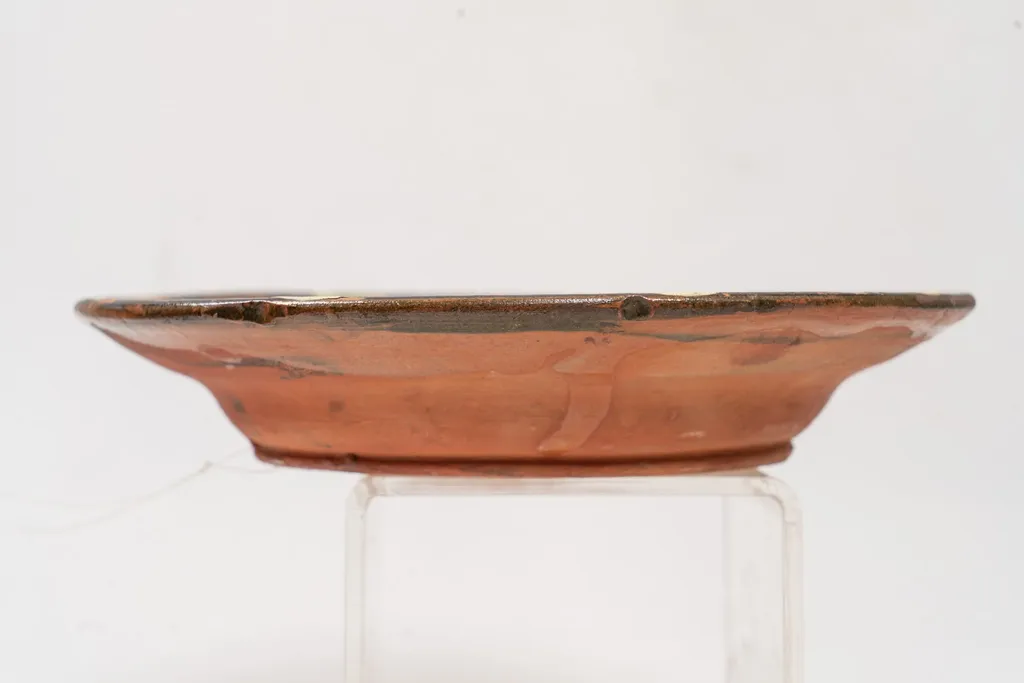
Farfurie semi-adâncă, acoperită pe suprafața interioară cu un strat de angobă de culoare verde închis, peste care este pictat cu pensula și cu cornul decorul format din motive florale stilizate și motive geometrice: registrul decorativ central, încadrat într-un cerc de culoare maro-închis, conține o tulpină și elemente vegetale formate din linii punctate, două frunze de culoare albă și trei flori, cele două laterale de culoare roșu-cărămiziu, iar cea centrală de culoare albă cu mijlocul roșu. Buza farfuriei este decorată cu un șir de semicercuri cu contur maro, lipite de muchia buzei, umplute cu culorile alb și roșu-cărămiziu și având pe exterior linii mici de culoare maro-închis. Bordura interioară a farfuriei este marcată cu o linie circulară subțire iar muchia buzei cu o dungă de culoare maro-închis. Suprafața ornamentată a farfuriei este acoperită cu un strat de smalț transparent. Cromatica: verde închis, alb, roșu-cărămiziu, maro-închis. is a print by Unknown. It dates from 1850 and is held in the collection of the Ethnographical Museum of Transylvania. This ceramic dish is a hand-formed vessel made of coarse clay, coated internally with a dark green slip and sealed with a transparent glaze.
About this work
Overview
This ceramic dish is a hand-formed vessel made of coarse clay, coated internally with a dark green slip and sealed with a transparent glaze.
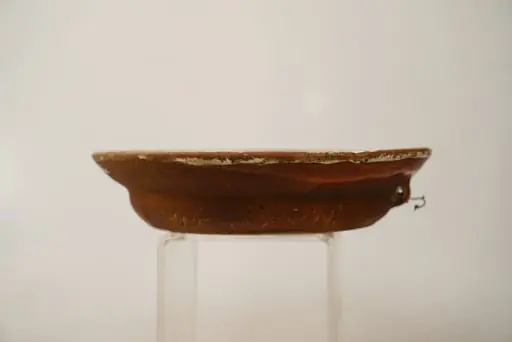
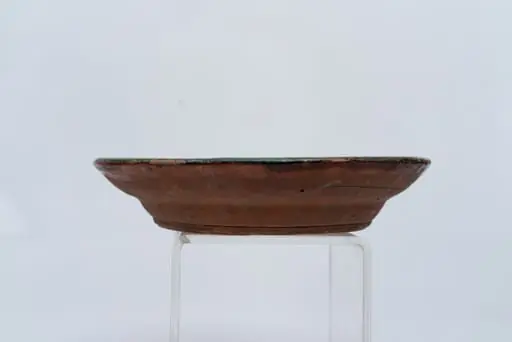
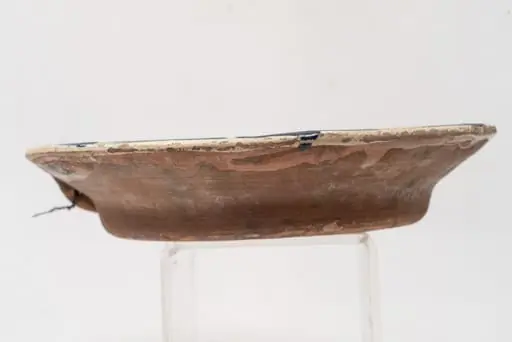
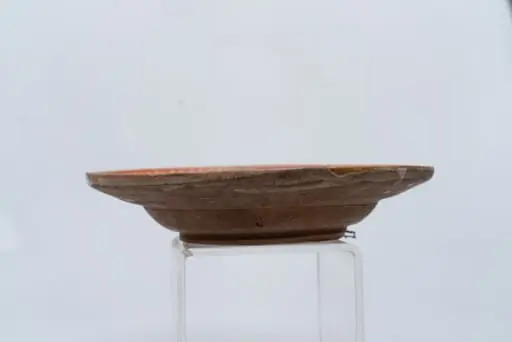
This ceramic dish is a hand-formed vessel made of coarse clay, coated internally with a dark green slip and sealed with a transparent glaze. Its exterior retains the natural reddish-brown tone of the fired clay. The rim features a repetitive pattern of small semicircles filled with white and brick-red pigment, bordered by fine dark brown lines. The overall form is simple, with minimal shaping, emphasizing function and restrained decoration.
Subject & Meaning
The interior decoration centers on stylized floral and geometric motifs arranged in a circular band. A central stem, rendered with dotted lines, supports two white leaves and three flowers: two in brick-red on the sides, one white with a red center. These elements suggest a symbolic representation of vegetation, possibly tied to seasonal cycles or domestic rituals. The symmetry and repetition imply a deliberate, non-naturalistic aesthetic rooted in local tradition.
Technique & Style
The vessel was shaped from unrefined clay and fired before being coated with a dark green slip applied as a base layer. Decorative elements were painted with a brush and possibly a hollowed bone tool, using pigments of white, brick-red, and dark brown. The use of dotted lines to suggest foliage and the strict radial composition reflect a regional style focused on clarity and rhythm rather than realism. The transparent glaze preserved the design while adding a slight sheen.
History & Provenance
The object shows signs of wear along the rim and base, indicating prolonged use. Its construction and decoration align with ceramic traditions from rural Eastern Europe, likely produced in the 18th or 19th century. No documented provenance exists, but similar pieces are held in regional ethnographic collections, suggesting local workshop production rather than industrial manufacture. Its survival points to continued domestic use over generations.
Context
This dish belongs to a broader category of utilitarian pottery common in agrarian communities across the Carpathian region. Its decorative scheme—combining vegetal motifs with geometric borders—echoes folk patterns found on textiles, woodwork, and other household objects. The restrained palette and lack of figural imagery reflect a cultural preference for abstraction and symbolic representation, distinguishing it from more ornate urban ceramics of the same period.
Legacy
Though not widely exhibited, the piece exemplifies a vernacular ceramic tradition that persisted into the modern era. Its design principles—repetition, symmetry, and symbolic flora—continue to inform contemporary craft revivals in Romania and neighboring regions. Museums preserving such objects help document the continuity of rural aesthetics amid industrialization, offering insight into everyday visual culture beyond elite art forms.
Artist & collection

Museum
Ethnographical Museum of Transylvania
Continue through works from the same source collection.
 Domestic Scene
 Giacomo and Cardinal Marco, investing Andrea, Abbot of San Zeno, with his Benefice
 The Nymph of Fontainebleau
 Portrait of a Woman
 Madonna and Child with Saints in the Enclosed Garden
 Venus and Minerva
 Family Group of Four on Sofa
 Wall painting from Room H of the Villa of P. Fannius Synistor at Boscoreale
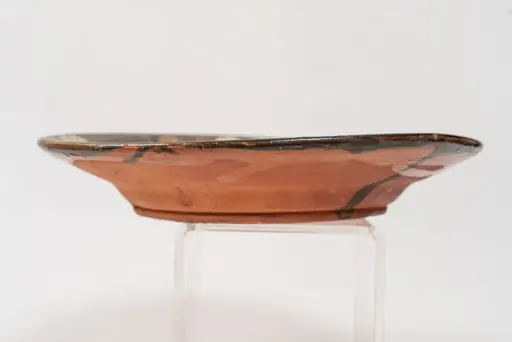 Farfurie semi-adâncă, acoperită pe suprafața interioară cu un strat de angobă de culoare verde închis-maro, peste care este pictat cu pensula și cu cornul decorul format din motive florale stilizate și motive geometrice: registrul decorativ central, încadrat într-un cerc de culoare maro închis, conține o tulpină cu frunze de culoare roșu-cărămiziu și trei flori formate din câte trei puncte albe cu mijloc marcat printr-un punct roșu. În stânga acestei tulpini cu flori este marcat cu culoare roșie anul fabricării piesei, 1961, iar în dreapta ei inițialele meșterului "P.Ș". Buza farfuriei este decorată cu patru flori cu patru petale albe și mijloc roșu, cu tulpină și elemente vegetale de culoare maro și cu câte două frunze de culoare roșie. Între aceste flori se găsesc intercalate patru motive geometrice formate din linii mici paralele de culoare maro închis. Bordura interioară a farfuriei este marcată cu o linie circulară subțire iar muchia buzei cu o dungă de culoare maro. Suprafața ornamentată a farfuriei este acoperită cu un strat de smalț transparent. Cromatica: verde închis-maro, alb, roșu-cărămiziu, maro-închis.
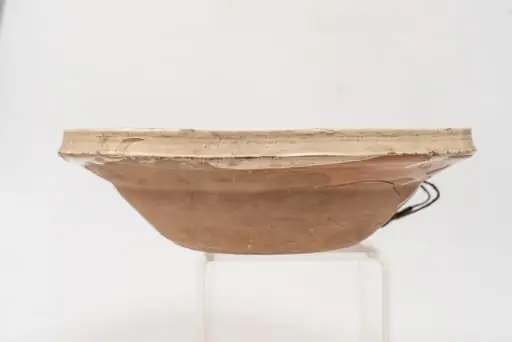 Farfurie adâncă de tip castron, cu corp tronconic, buză evazată și muchia buzei verticală. Piesa este acoperită pe fața interioară și pe exteriorul buzei cu un strat de angobă albă peste care este pictat cu pensula și cu cornul decorul format din motive florale și fitomorfe stilizate: zona centrală a farfuriei este decorată cu o floare cu petale alungite de culoare albastră, mijloc marcat printr-un punct maro, frunze verzi și elemente vegetale de culoare maro-închis. Buza este decorată cu cinci flori de culoare maro cu frunze, aproximativ identice, înscrise între două linii circulare de culoare maro. Suprafața ornamentată a farfuriei este acoperită cu un strat de smalț transparent. Cromatica: alb, maro, verde, albastru, maro-închis.
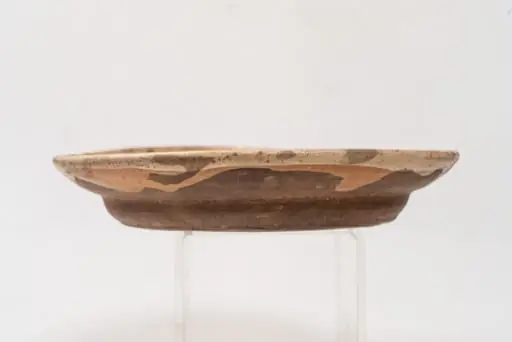 Farfurie semi-adâncă, cu fund larg, buză evazată și muchia buzei ușor ridicată. Piesa este angobată pe fața interioară cu un strat de humă albă, peste care este realizat prin sgrafitare și prin pictare cu pensula decorul format din motive vegetale stilizate: o tulpină cu frunze și elemente vegetale de culoare verde și maro, regăsite pe fundul farfuriei. Buza acesteia este decorată cu un șir de linii ovale sgrafitate, umplute cu culoare (verde și maro). Suprafața ornamentată este acoperită cu un strat de smalț transparent. Cromatica: alb, maro, verde.
 Farfurie semi-adâncă, cu buza evazată și ușor concavă spre interior și cu muchia buzei rotunjită; este acoperită pe suprafața interioară cu un strat de angobă albă peste care este pictat cu cornul și cu pensula decorul format din motive vegetale și florale stilizate (registrul decorativ de pe fundul farfuriei conține o tulpină cu o floare centrală cu petale rotunde, în culorile galben-ocru, maro și verde; două flori laterale de lalea, de culoare maro, și frunze de culoare galben-ocru și verde) și motive decorative geometrice (patru grupuri, inegale ca lungime, formate din linii paralele drepte, de culoare maro, intercalate cu patru grupuri de câte 3 linii maro sub formă de semicercuri, umplute cu culorile galben și verde), dispuse pe buza farfuriei și încadrate de linii paralele sub formă de cerc, de culoare maro. Patru linii mici spiralate, de culoare maro, completează decorul central de pe fundul farfuriei. Piesa este acoperită pe suprafața ornamentată cu un strat de smalț transparent. Cromatica: alb, verde, maro, galben-ocru.
 Farfurie adâncă, cu buză evazată; este angobată pe fața interioară cu un strat de angobă maro, peste care este pictat cu cornul, pensula și cu gaița decorul format din motive geometrice: central pe fundul farfuriei este pictată o linie spiralată rotundă de culoare albă; bordura interioară a farfuriei este decorată cu linii circulare concentrice de culoare albă trase cu gaița și cu puncte verzi, iar buza farfuriei cu o linie ondulată circulară și puncte groase de culoare albă. Muchia buzei este marcată cu o dungă verde. Suprafața ornamentată a farfuriei este acoperită cu un strat de smalț transparent. Cromatica: maro, alb, verde.
 Farfurie de formă semi-adâncă, cu fund larg și buză evazată; este angobată pe fața interioară cu un strat de humă albă, peste care este pictat cu pensula și cu cornul decorul format din motive florale stilizate și din motive geometrice: registrul central de pe fundul farfuriei conține o linie spiralată de culoare maro pe exteriorul căreia sunt pictate opt flori de lalea cu petale în culorile albastru, galben, maro. Buza este decorată cu un șir de linii drepte de culoare verde și albastră. Muchia buzei este marcată cu o dungă albastră și o linie circulară maro, subțire iar bordura interioară a farfuriei este decorată cu trei linii circulare de culoare maro. Cromatica: alb, albastru, verde, galben, maro. Farfuria este acoperită pe fața ornamentată cu un strat de smalț transparent.
 Farfurie adâncă, cu buza evazată și muchia buzei ușor ridicată. Piesa este angobată pe fața interioară cu un strat de angobă albă, peste care este pictat cu pensula și cu cornul decorul format din motive florale stilizate și geometrice: central pe fundul farfuriei sunt pictate cinci flori cu petale mici rotunde, cu contur de culoare siena arsă și mijlocul umplut cu linii hașurate intersectat, de culoare verde. Un romb central, umplut cu linii hașurate intersectat și puncte mici de culoare verde completează decorul din acest registru. Registrul decorativ marginal de pe buza farfuriei, înscris între două linii circulare de culoare siena arsă, este format dintr-o linie circulară buclată de culoare verde, în buclele căreia sunt pictate câte trei puncte maro. Marginea buzei este marcată cu o dungă de culoare siena arsă peste care este pictată o linie ondulată mărunt, albă. Suprafața ornamentată a farfuriei este acoperită cu un strat de smalț transparent. Cromatica: alb, siena arsă, verde, maro.
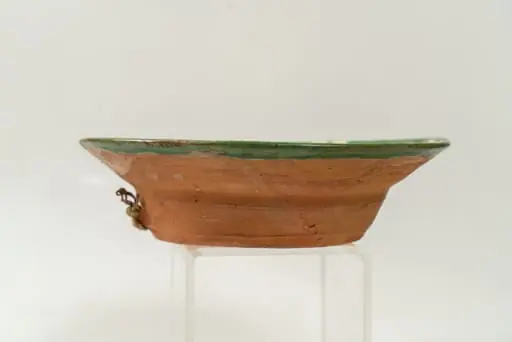 Farfurie adâncă, cu buză lată, evazată; piesa este modelată din lut la roata olarului și acoperită cu un strat de angobă verde pe fața interioară. Decorul este realizat prin pictare cu pensula și se compune din motive florale și vegetale stilizate (un buchet cu trei flori albe și frunze de culoare verde-închis, plasat în zona centrală, pe fundul farfuriei și cinci flori albe pictate pe buza acesteia, intercalate de cinci grupuri de frunze). Cromatica: verde, alb, verde-închis. Fața ornamentată a farfuriei este acoperită cu un strat de smalț transparent.
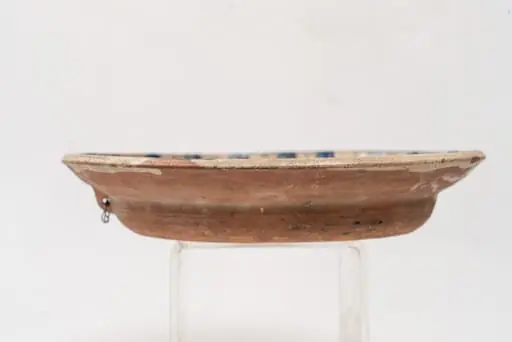 Farfurie de formă semi-adâncă, cu fund larg și buză răsfrântă; este angobată pe fața interioară cu un strat de humă albă, peste care este pictat cu cornul și cu pensula decorul monocromatic, format din motive florale și fitomorfe stilizate și din motive geometrice: registrul central de pe fundul farfuriei conține o linie spiralată ce are pe exterior, de o parte și de alta, câte un semicerc dublu decorat cu linii mici albastre și două motive vegetale. Buza este decorată cu un șir continuu de frunze duble între linii punctate. Muchia buzei este marcată cu o linie de culoare albastră iar bordura interioară a farfuriei cu două linii subțiri circulare. Cromatica: alb, albastru. Farfuria este acoperită pe fața ornamentată cu un strat de smalț transparent.
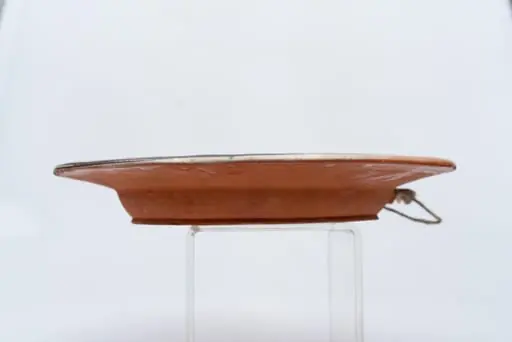 Farfurie semi-adâncă, cu buza dreaptă evazată; este acoperită pe fața interioară cu un strat de angobă albă. Decorul este pictat cu cornul și cu pensula și este format din motive geometrice și figurative stilizate: central pe fundul farfuriei sunt reprezentate, cu contur de culoare maro-închis și în manieră naivă, o siluetă umană (bărbat, purtând pălărie și cizme maro), în stânga căreia se află un animal (greu de identificat cu exactitate, posibil pasăre) iar în dreapta o masă cu două obiecte pe ea. Buza farfuriei este decorată cu o dungă de culoare maro-roșcat, mărginită de câte o linie de culoare maro-închis, peste care s-au pictat puncte maro. Suprafața ornamentată a farfuriei este acoperită cu un strat de smalț transparent. Cromatica: alb, maro-roșcat, maro-închis, verde.