Artwork
Female Tumbler
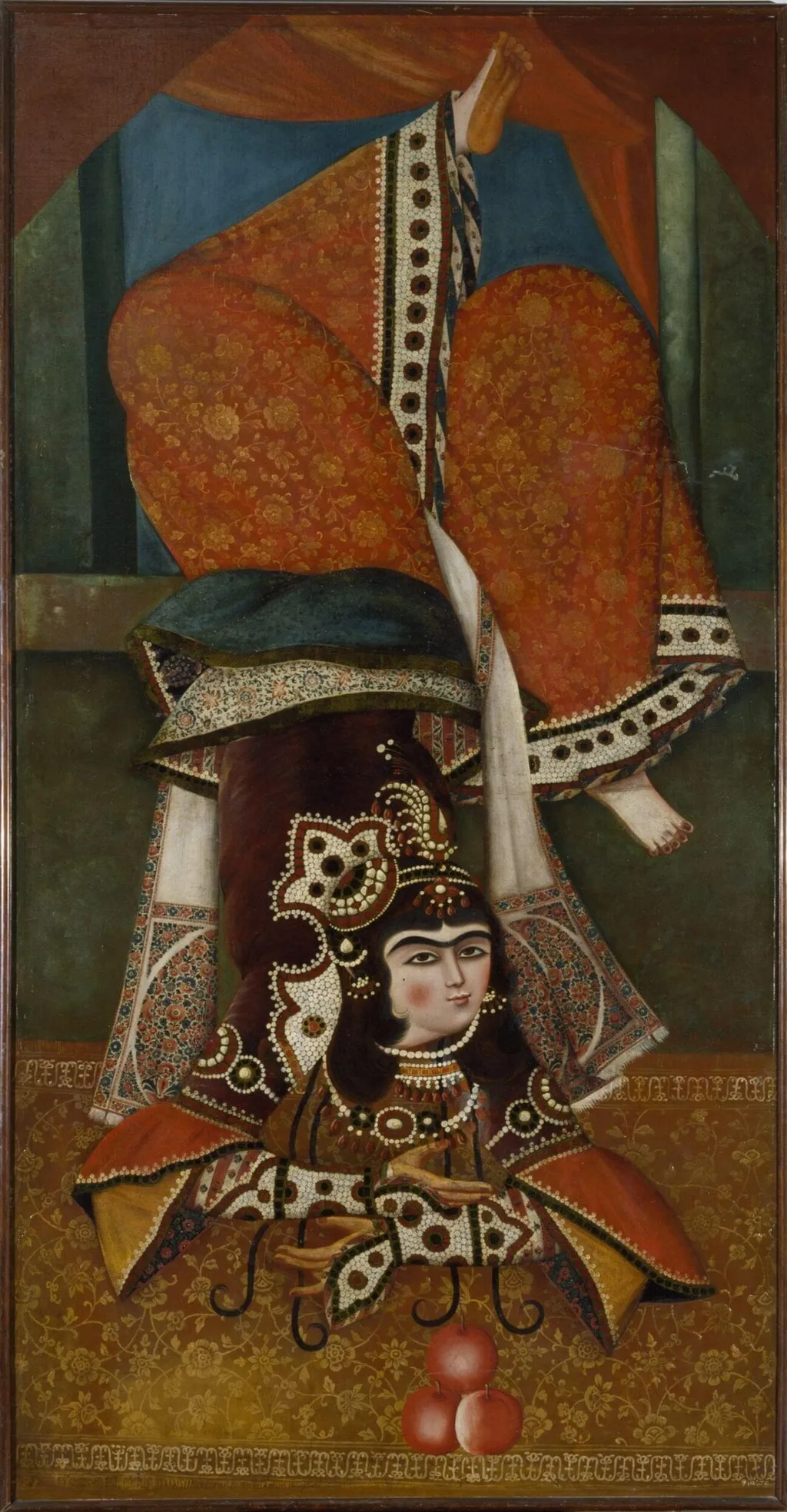
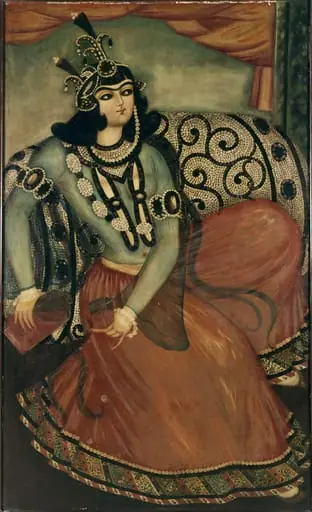
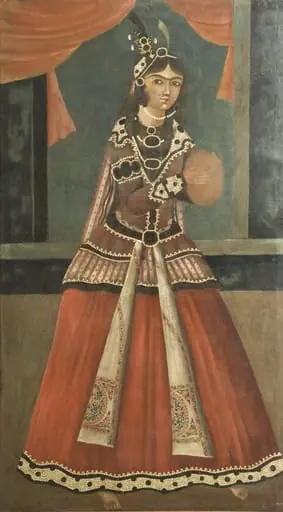
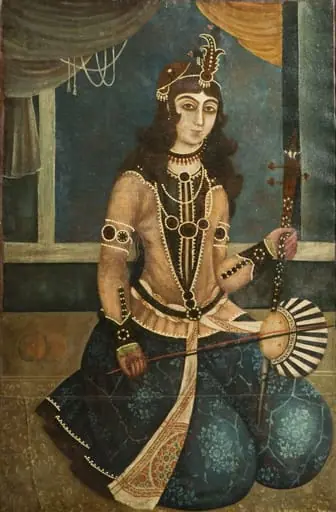
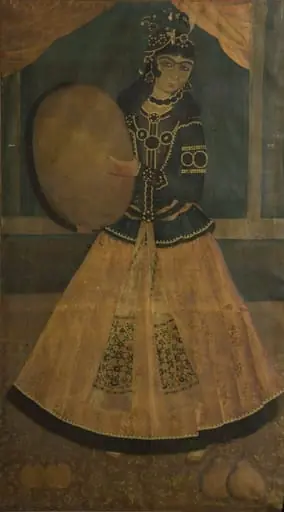
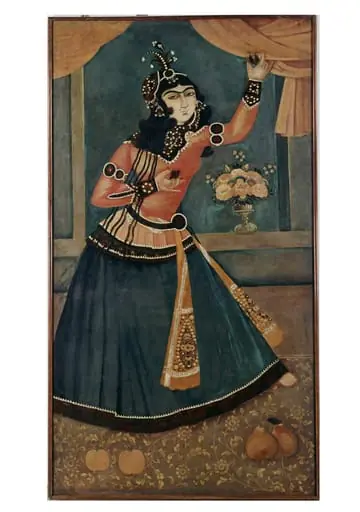
Female Tumbler is an oil painting by the Romanticist artist Unknown. It dates from 1800 and is held in the collection of the Victoria and Albert Museum. This oil painting depicts a woman mid-acrobatic flip, part of a pair created during the early Qajar period.
About this work
Overview
Acquired by the V&A in 1876, it was believed to originate from a royal palace in Tehran, possibly commissioned by Fath 'Ali Shah.
This oil painting depicts a woman mid-acrobatic flip, part of a pair created during the early Qajar period. Acquired by the V&A in 1876, it was believed to originate from a royal palace in Tehran, possibly commissioned by Fath 'Ali Shah. The work reflects a revival of oil painting in Iran after decades of decline, driven by Qajar court patronage and renewed cultural investment following political stabilization in the late 18th century.
Subject & Meaning
The figure is a female tumbler, rendered in isolation against a plain background, suggesting a decorative rather than narrative function. Such images likely formed part of a larger series portraying idealized or fantastical figures from the royal harem, blending courtly fantasy with visual spectacle. The inversion of the body emphasizes physical grace and control, aligning with Qajar-era interests in performance, beauty, and the exoticized representation of women within palace life.
Technique & Style
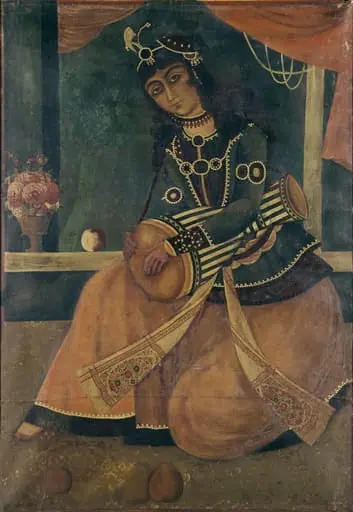
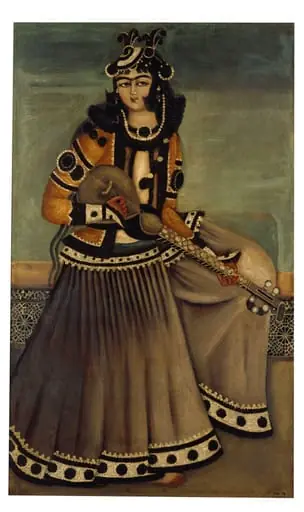
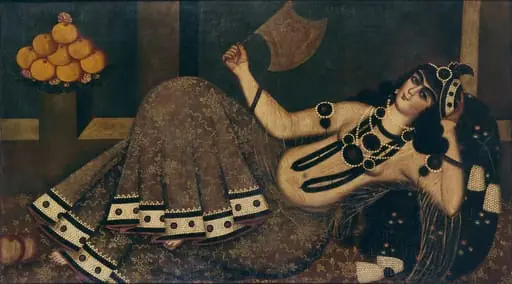
The figure is rendered with flattened forms and minimal modeling, characteristic of early Qajar oil painting. Despite the two-dimensional structure, intricate patterns in clothing and jewelry demonstrate meticulous attention to surface detail. Oil paint was applied with precision, avoiding heavy impasto; instead, the technique favors smooth, even layers to enhance decorative richness over spatial depth, reflecting a fusion of European materials with Persian aesthetic traditions.
History & Provenance
The painting entered the V&A’s collection in 1876 with the attribution 'From the Shah's palace at Tehran.' It likely belonged to a wall-integrated series commissioned by Fath 'Ali Shah, who promoted oil painting as a courtly art form. These works were often produced in large numbers for palace interiors, and many were dispersed after the dynasty’s decline. The survival of this pair is rare, offering insight into a once-widespread but now fragmentary visual program.
Context
Oil painting was introduced to Iran through trade with Europe after 1600 but declined after the Afghan invasions of 1722. Under the Qajar dynasty, especially during Fath 'Ali Shah’s reign, the medium experienced a revival as a tool of royal self-representation. Artists adapted European techniques to local tastes, producing stylized, ornamental portraits that emphasized status and spectacle over realism, often depicting courtly life in idealized, theatrical terms.
Legacy
This painting stands as a testament to the Qajar era’s unique synthesis of foreign materials and indigenous aesthetics. Though such wall paintings were once common in royal residences, few survive intact. Its preservation allows scholars to study how Persian artists negotiated global influences while maintaining distinct visual conventions, contributing to a broader understanding of 19th-century Iranian cultural identity beyond traditional miniature painting.
Artist & collection

 Domestic Scene
 Giacomo and Cardinal Marco, investing Andrea, Abbot of San Zeno, with his Benefice
 The Nymph of Fontainebleau
 Portrait of a Woman
 Madonna and Child with Saints in the Enclosed Garden
 Venus and Minerva
 Family Group of Four on Sofa
 Wall painting from Room H of the Villa of P. Fannius Synistor at Boscoreale