Artwork
St. Sophia, Constantinople
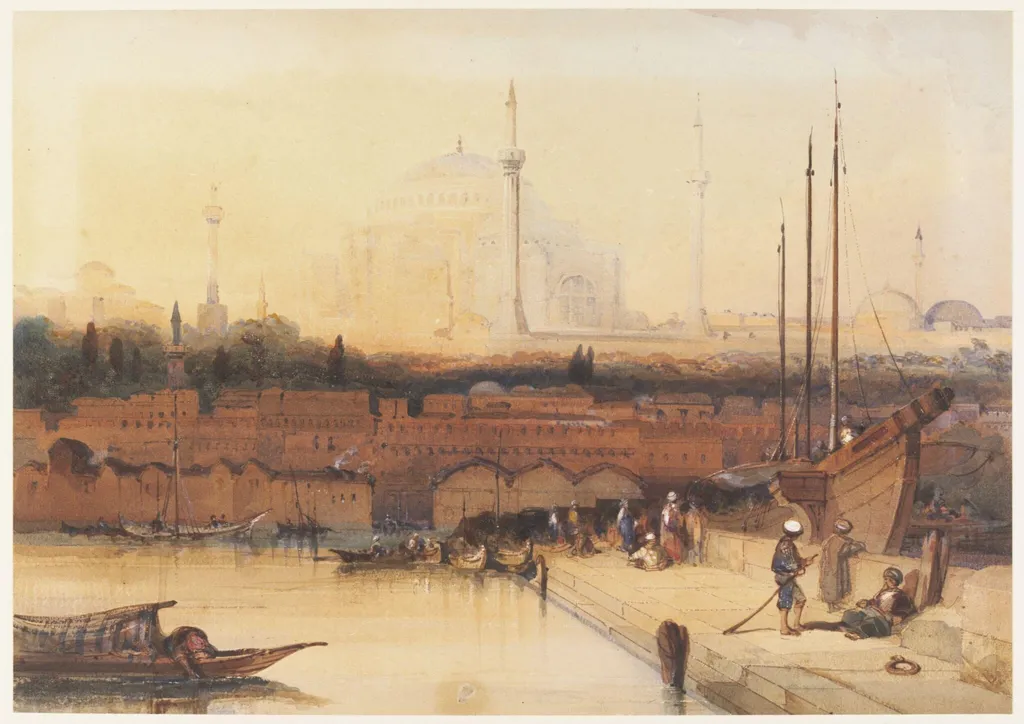
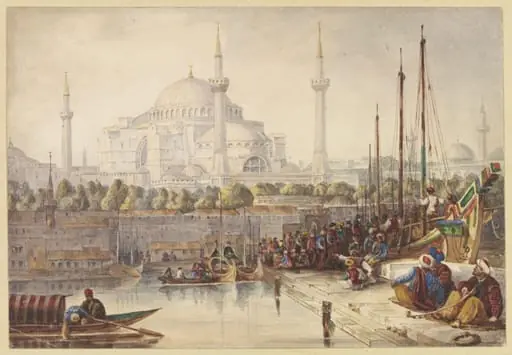
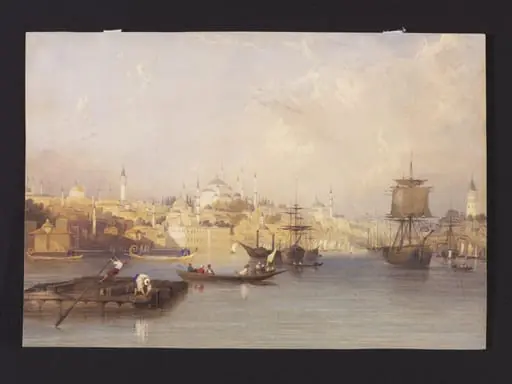
St. Sophia, Constantinople is a watercolor work on paper by the Romanticist artist Unknown. It dates from 1840 and is held in the collection of the Victoria and Albert Museum. A watercolour from 1840, titled *St.
About this work
Overview
Though once credited to David Roberts, research in the Searight Archive confirmed it was executed by an anonymous artist working from an 1833 etching by E.
A watercolour from 1840, titled *St. Sophia, Constantinople*, presents a view of the Hagia Sophia as seen from the Bosphorus shore. Though once credited to David Roberts, research in the Searight Archive confirmed it was executed by an anonymous artist working from an 1833 etching by E. Finden, based on Roberts’s original sketch. The piece entered a public collection after being acquired at Christie’s South Kensington in 1977 under a misattributed provenance.
Subject & Meaning
The scene captures the Hagia Sophia rising above a bustling waterfront, its dome and minarets softened by atmospheric haze. Figures in loose garments move along the shore, while small boats rest at anchor, suggesting the daily rhythms of Constantinople’s harbor. The composition emphasizes quiet coexistence between sacred architecture and ordinary life, framing the monument not as a relic but as a living presence within its urban context.
Technique & Style
The artist employed delicate washes and muted tones to evoke distance and luminosity, allowing the distant domes to recede into a hazy sky. Soft edges and minimal detail in the foreground figures and vessels enhance the sense of spatial depth. The restrained palette and gentle gradations reflect a Romantic sensitivity to light and atmosphere, prioritizing mood over topographical precision.
History & Provenance
The watercolour originated as a reproduction of an etching by E. Finden, derived from David Roberts’s 1833 sketch during his travels in the Ottoman Empire. For decades, it was mistakenly attributed to Roberts himself. Scholarly review of the Searight Archive clarified its true origin in the 1970s, leading to its reclassification. It was sold at Christie’s in 1977 under the incorrect attribution, a common error among 19th-century reproductive works.
Context
In the 1830s–40s, European interest in the Eastern Mediterranean surged, fueled by travel literature and archaeological curiosity. Artists often reproduced views of Constantinople for domestic audiences, blending observation with idealization. This watercolour reflects that trend, translating Roberts’s fieldwork into a more intimate, atmospheric interpretation suited to private collections and the Romantic aesthetic of the time.
Legacy
Though unsigned and initially misattributed, the work contributes to the visual record of how Western audiences perceived Istanbul’s architectural heritage in the early Victorian era. Its reattribution underscores the importance of archival research in correcting historical misconceptions. Today, it stands as an example of how reproductive prints and watercolours mediated cultural knowledge before the age of photography.
Artist & collection

 Domestic Scene
 Giacomo and Cardinal Marco, investing Andrea, Abbot of San Zeno, with his Benefice
 The Nymph of Fontainebleau
 Portrait of a Woman
 Madonna and Child with Saints in the Enclosed Garden
 Venus and Minerva
 Family Group of Four on Sofa
 Wall painting from Room H of the Villa of P. Fannius Synistor at Boscoreale