Artwork
Hari-Hara
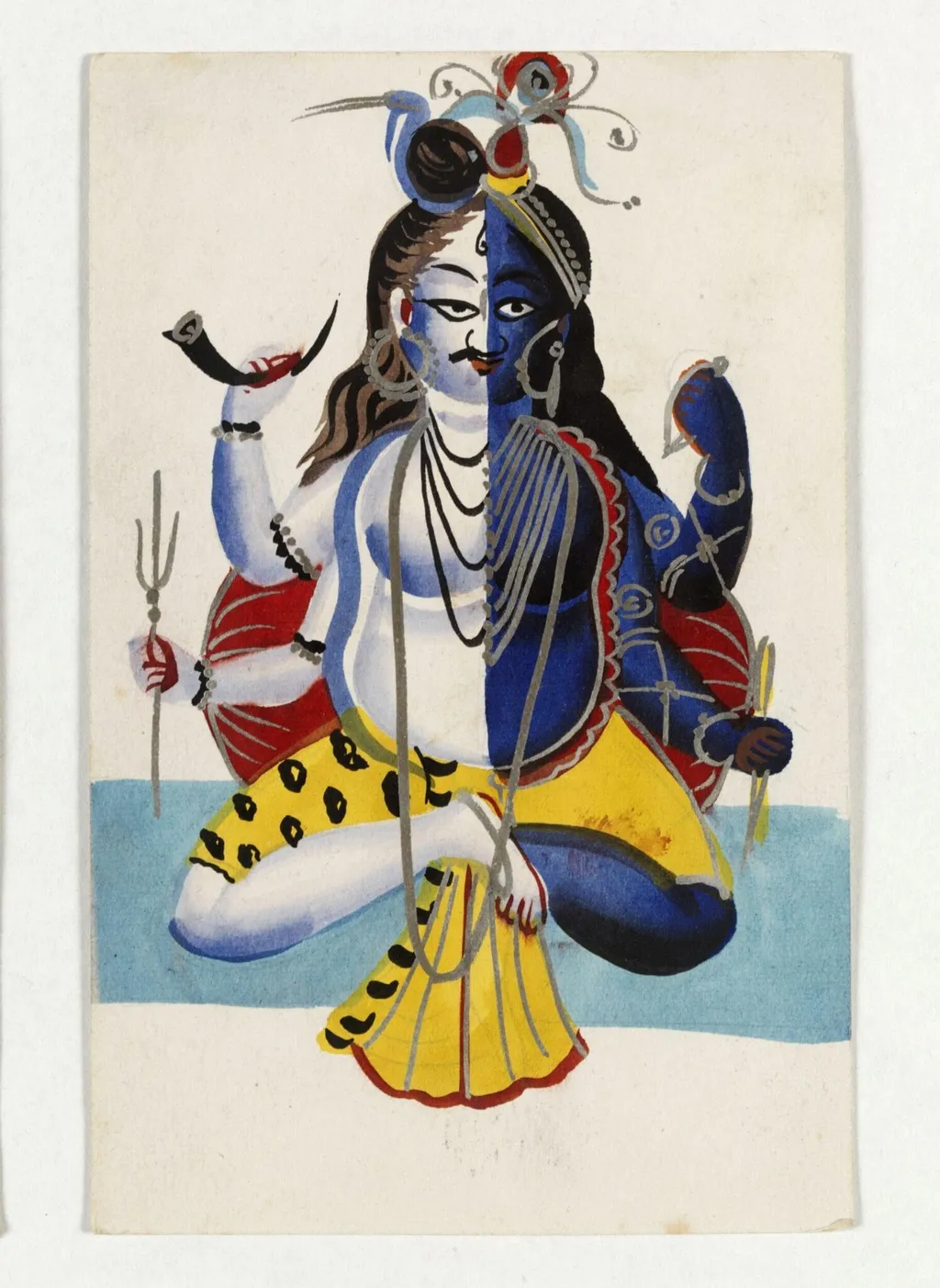
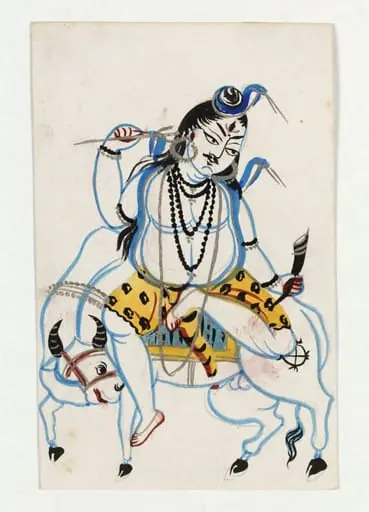
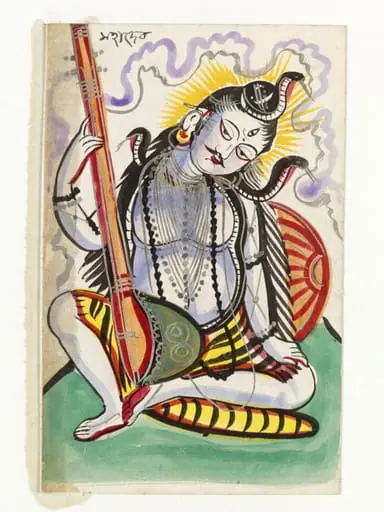
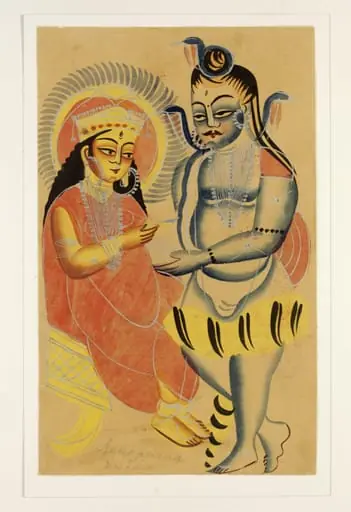
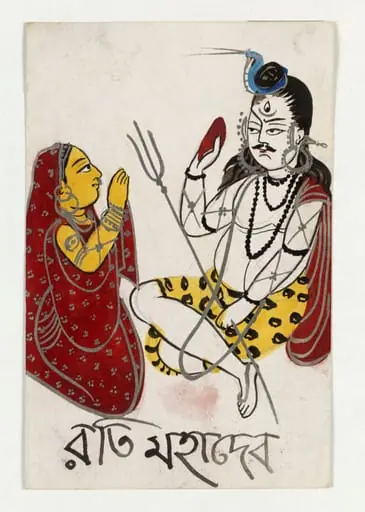
Hari-Hara is a paint painting by the Impressionist artist Unknown. It dates from 1890 and is held in the collection of the Victoria and Albert Museum.
About this work
Overview
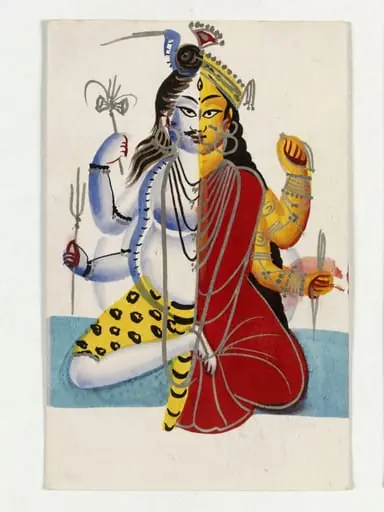
Created in 1890, *Hari-Hara* is a watercolor and tin alloy painting on cardboard that merges the Hindu deities Vishnu and Shiva into a single iconographic form. The work reflects a devotional tradition that unites opposing divine principles—preservation and destruction—into one unified presence. Its materials and scale suggest it was made for private or ritual use rather than public display.
Subject & Meaning
The central figure combines Vishnu’s blue complexion and Shiva’s white skin, symbolizing their cosmic roles as preserver and transformer.
The central figure combines Vishnu’s blue complexion and Shiva’s white skin, symbolizing their cosmic roles as preserver and transformer. The trident and bow in the figure’s hands reference Shiva’s destructive power and Vishnu’s protective weaponry. The dual-faced visage, adorned with jewelry and flowing hair, visually encodes the synthesis of these deities, embodying a non-dual theological concept central to certain Shaiva and Vaishnava traditions.
Technique & Style
The painting employs watercolor with subtle metallic accents from tin alloy, enhancing the luminosity of the deity’s ornaments and garments. Details like the spotted yellow skirt and layered textiles are rendered with careful brushwork, while the flat, off-white background isolates the figure, emphasizing symbolic presence over spatial depth. The style leans toward illustrative realism, rooted in regional Indian painting traditions rather than Western naturalism.
History & Provenance
The work was included in the 1971 exhibition *Tantra* at London’s Hayward Gallery, curated by Philip S. Rawson and the Arts Council of Great Britain. Its prior provenance remains undocumented, but its materials and iconography suggest it originated in northern or western India during the late 19th century, possibly as part of a devotional or manuscript illustration tradition.
Context
In late 19th-century India, religious imagery continued to evolve amid colonial influence and revivals of indigenous aesthetics. *Hari-Hara* reflects a persistent interest in syncretic deities, a practice with roots in medieval tantric and Puranic texts. Though produced during a period of increasing Western artistic influence, the painting maintains traditional iconographic conventions, indicating its function within local spiritual practice.
Legacy
The inclusion of *Hari-Hara* in the 1971 *Tantra* exhibition introduced the work to a Western audience interested in esoteric Hindu traditions. While not widely reproduced, its presence in that landmark show contributed to broader scholarly recognition of Indian devotional art as a complex visual language, distinct from both Western modernism and colonial categorizations.
Artist & collection

 Domestic Scene
 Giacomo and Cardinal Marco, investing Andrea, Abbot of San Zeno, with his Benefice
 The Nymph of Fontainebleau
 Portrait of a Woman
 Madonna and Child with Saints in the Enclosed Garden
 Venus and Minerva
 Family Group of Four on Sofa
 Wall painting from Room H of the Villa of P. Fannius Synistor at Boscoreale