Artwork
Hartlib's Alexander: Alexander Seated on Throne
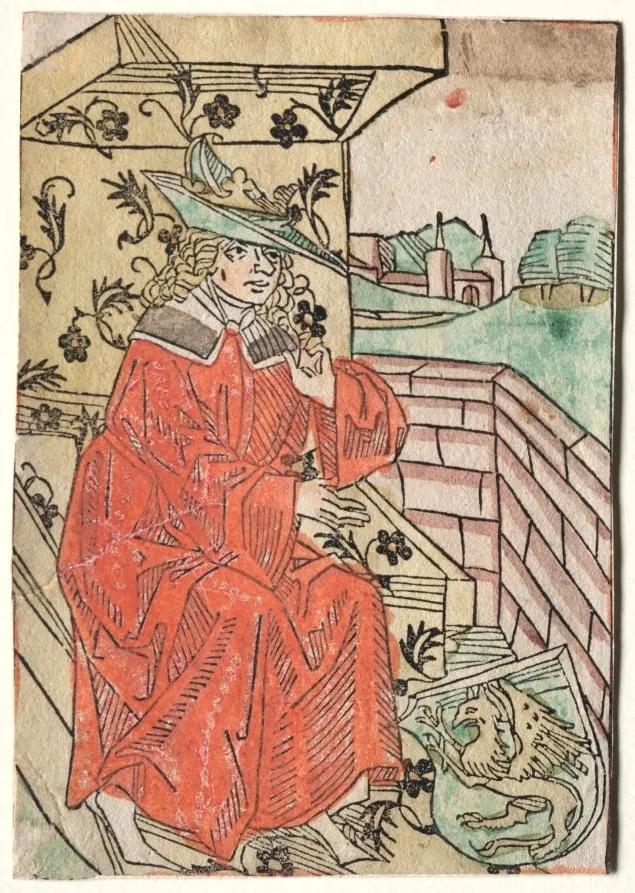
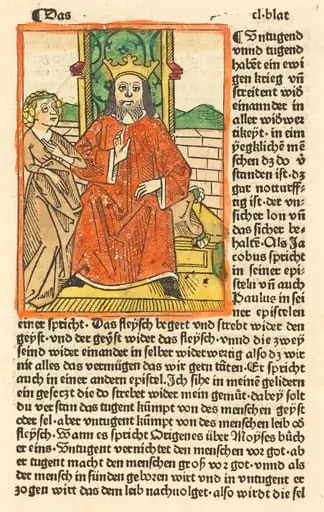
Hartlib's Alexander: Alexander Seated on Throne is a print by the Renaissance artist Unknown. It dates from 1404 and is held in the collection of the Cleveland Museum of Art. This print depicts Alexander the Great seated on a stone balcony, dressed in a vivid red robe that resembles folded armor.
About this work
Overview
The composition is stylized, with flat areas of color and strong outlines characteristic of Renaissance graphic traditions.
This print depicts Alexander the Great seated on a stone balcony, dressed in a vivid red robe that resembles folded armor. The composition is stylized, with flat areas of color and strong outlines characteristic of Renaissance graphic traditions. A lion rests at his feet, while a hybrid face emerges from the shadows below. A distant harbor and simple architecture frame the scene, suggesting a symbolic rather than literal setting.
Subject & Meaning
Alexander is portrayed as a ruler in repose, holding a scroll that may signify wisdom or command. The lion, a traditional emblem of power, reinforces his authority, while the enigmatic half-human figure below hints at hidden forces or the duality of leadership. The rigid posture and symbolic elements suggest an allegorical representation, emphasizing Alexander’s legacy rather than his historical likeness.
Technique & Style
The print employs flat, unmodulated colors and sharp contours, avoiding chiaroscuro or atmospheric perspective. The robe’s patterned texture mimics metallic armor, blending regality with rigidity. Background elements are minimized and stylized, with the harbor rendered as a schematic silhouette. This approach reflects Renaissance printmaking conventions, prioritizing symbolic clarity over naturalistic depth.
History & Provenance
The print is attributed to the circle of Samuel Hartlib, a 17th-century intellectual known for collecting and disseminating scientific and philosophical imagery. Though the exact origin and maker remain uncertain, its style aligns with emblematic prints circulating in Protestant Europe during the mid-1600s, often used to convey moral or political ideas through classical allusion.
Context
During the Renaissance and early modern period, rulers like Alexander were frequently invoked in prints to comment on leadership, knowledge, and power. This image fits within a broader tradition of using classical figures as vehicles for contemporary ideals, particularly among scholars and reformers who sought to link ancient wisdom with emerging scientific and political thought.
Legacy
Though not widely reproduced, the print contributes to a visual language that equated classical antiquity with intellectual authority. Its symbolic economy and stylized form influenced later emblem books and pedagogical imagery, preserving a mode of representation where myth, history, and moral instruction converged in a single, compact composition.
Artist & collection

 Domestic Scene
 Giacomo and Cardinal Marco, investing Andrea, Abbot of San Zeno, with his Benefice
 The Nymph of Fontainebleau
 Portrait of a Woman
 Madonna and Child with Saints in the Enclosed Garden
 Venus and Minerva
 Family Group of Four on Sofa
 Wall painting from Room H of the Villa of P. Fannius Synistor at Boscoreale