Artwork
Icoașanț
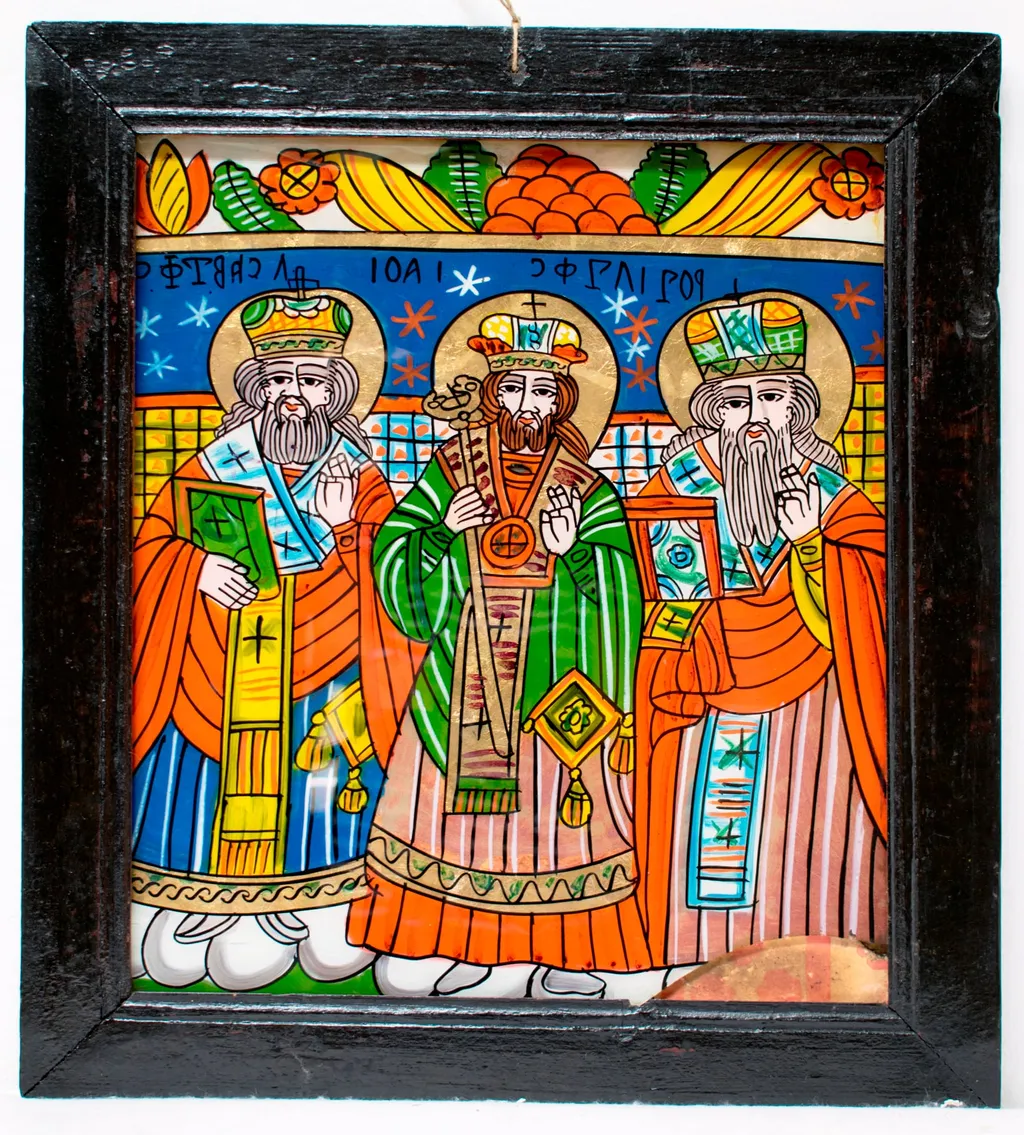
Icoașanț is a drawing by Unknown. It dates from 1850 and is held in the collection of the "Dimitrie Gusti" National Village Museum.
About this work
Overview
The background features abstract blue fields accented with yellow and orange forms, while floral motifs appear at the upper edge.
This artwork depicts three figures dressed in vibrant orange and green robes with gold detailing, each holding a distinct object: a green book, a staff, and a small box. The background features abstract blue fields accented with yellow and orange forms, while floral motifs appear at the upper edge. The composition is framed in dark brown wood, emphasizing its ceremonial tone. The palette and detail suggest a devotional intent, though the artist remains unidentified.
Subject & Meaning
The three figures likely represent religious or spiritual roles, indicated by their symbolic attributes—the book suggesting scripture, the staff authority, and the box a sacred vessel. Their matching attire and aligned posture imply a shared purpose, possibly ritualistic or hierarchical. The absence of facial detail and the stylized setting point toward symbolic representation rather than portraiture, common in devotional traditions where identity is subsumed by function.
Technique & Style
The painting employs bold, flat areas of color with precise linear detail, particularly in the robes’ gold trim and the intricate floral elements. Background shapes are simplified yet rhythmic, creating a decorative harmony. The lack of perspective and emphasis on pattern over naturalism align with non-Western or medieval religious art traditions, where visual symbolism outweighs spatial realism.
History & Provenance
The work’s origin is undocumented, and no record of its creation, commission, or early ownership exists. Its style resembles regional religious art from cultures that valued symbolic color and object-based iconography, though no specific geographic or temporal source has been confirmed. It has remained in private hands, with no public exhibition history noted.
Context
The imagery reflects a broader tradition of sacred figure groups found in liturgical or ceremonial art, where objects denote spiritual roles. Similar compositions appear in illuminated manuscripts and ritual textiles from various cultures, often used in devotional settings. The use of gold and saturated hues suggests an association with the divine, common in art meant for veneration rather than decoration.
Legacy
As an unsigned work, it contributes to a larger corpus of anonymous religious art that prioritizes symbolic clarity over individual authorship. Its preservation highlights the enduring value placed on ritual imagery in communities where visual language conveys theological concepts. Though unattributed, its formal qualities continue to inform studies of non-canonical devotional art.
Artist & collection
Museum
"Dimitrie Gusti" National Village Museum
Continue through works from the same source collection.
 Domestic Scene
 Giacomo and Cardinal Marco, investing Andrea, Abbot of San Zeno, with his Benefice
 The Nymph of Fontainebleau
 Portrait of a Woman
 Madonna and Child with Saints in the Enclosed Garden
 Venus and Minerva
 Family Group of Four on Sofa
 Wall painting from Room H of the Villa of P. Fannius Synistor at Boscoreale
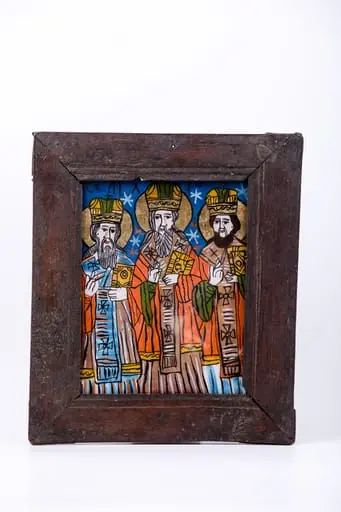 Cei Trei Sfinți Ierarhi Vasile cel Mare, Grigorie de Dumnezeu Cuvântătorul și Ioan Gură-de-Aur slujesc și săvârșesc Sfânta Liturghie împreună. Sunt înveșmântați în veșminte liturgice: sacos crem-albastru-alb-crem, felon roșu vermillon, epitrahil albastru-verde cu câte patru cruci negre. Sfântul Vasile cel Mare are Sfânta Evanghelie în mâna dreaptă. Sfântul Ierarh Grigorie de Dumnezeu Cuvântătorul Binecuvântează. Fondul registrului superior este cerul albastru-regal, bogat ornamentat cu elemente astrale - stele roșii și albe. Cromatica este luminoasă și armonioasă: verde văratic, alb, roșu vermillon, galben-ocru, bej, crem, albastru regal și bleu-ciel, negru. Este o icoană specifică picturii de Țara Oltului, cu un desen fin cu conturul negru și cromatica pastelată. Inscripția din româno-chirilică se traduce Vasile Grigorie Ioan.
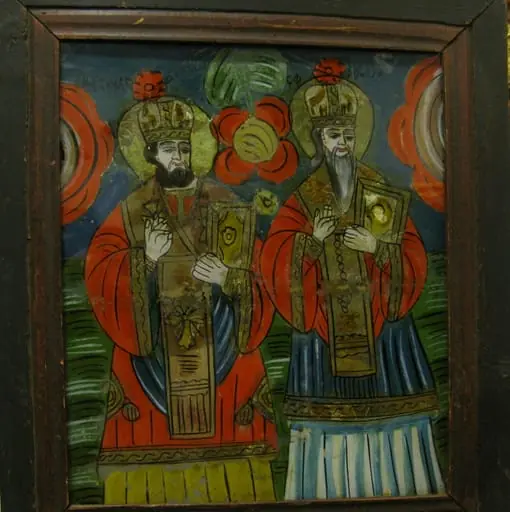 Sf. Nicolae și Vasile
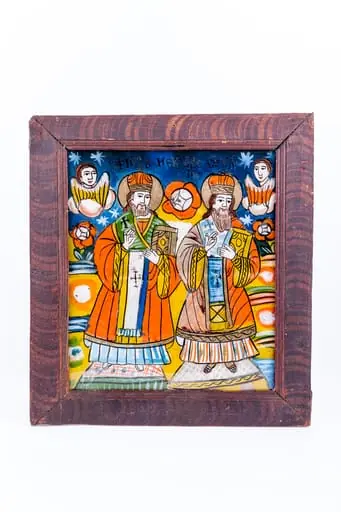 Sfinții Ierarhi Nicolae făcătorul de minuni și Vasile cel Mare sunt reprezentați împreună, binecuvântând cu mâna dreaptă și ținând în mâna stângă Sfânta Evanghelie. Sunt îmbrăcați în veșmânt-sacos și cu felon roșu vermillon și epitrahil albastru, verde, galben-ocru. Împreună slujesc și săvârșesc Sfânta Liturghie. În registrul îndepărtat superior, este pictat cerul albastru cu stele albe și ruje mari roșii. În registrul superior, în colțurile din stânga și din dreapta, este câte un înger pe o mandorlă. Cromatica este armonioasă: roșu vermillon, verde, albastru, galben-ocru, alb. Sfinții arhierei poartă și mithră arhierească. Amândoi Sfinții Ierarhi au aureole aurii. Rama este pictată cu tușe negre pe maro-roșcat, alternanță de brunuri. Este o icoană specifică picturii de Țara Oltului, din centrul Șcheii Brașovului. Din inscripția româno-chirilică se traduce Sf Nicolae Sf Vasile. În registrul inferior, fondul este format din câmpuri alternative de galben, albastru și verde.
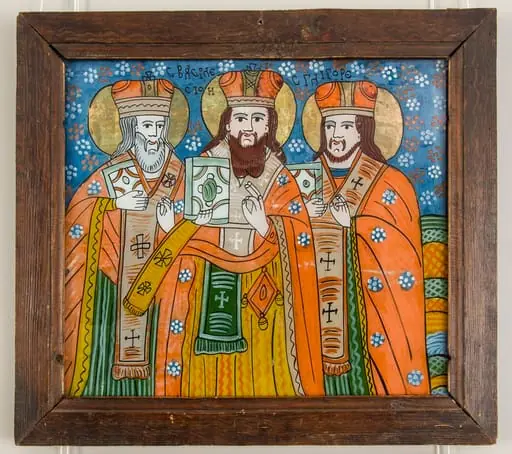 Sf. Trei Ierarhi
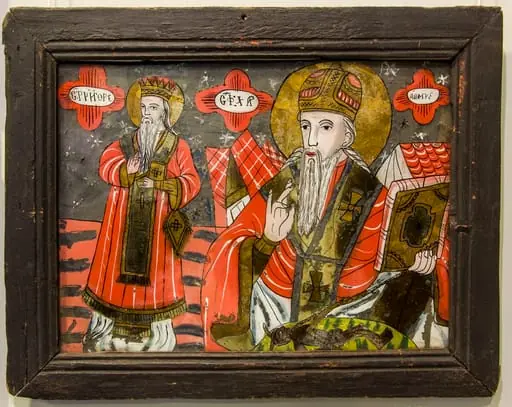 Sf. Grigore și Haralambie
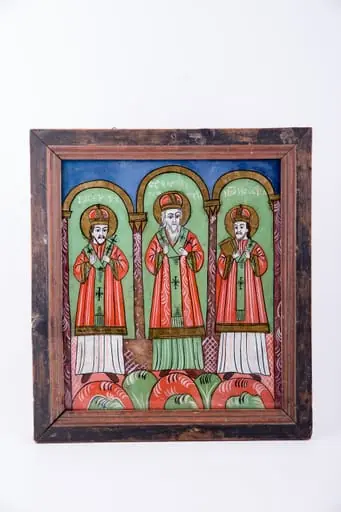 Cei Trei Sfinți Ierarhi Vasile cel Mare, Grigorie de Dumnezeu Cuvântătorul și Ioan Gură-de-Aur slujesc și săvârșesc Sfânta Liturghie împreună. Sunt înveșmântați în veșminte liturgice: sacos verde-alb-verde, felon roșu vermillon, epitrahil verde cu câte patru cruci. Sfântul Vasile cel Mare are Sfânta Evanghelie în mâna dreaptă. Sfântul Ierarh Grigorie de Dumnezeu Cuvântătorul Binecuvintează. Cei trei Sfinți Ierarhi stau cu picioarele pe perinițe rotunde de culori alternative: roșu, verde, alb. Fiecare sfânt ierarh este încadrat de două coloane și o boltă de biserică. Sunt prezente elemente arhitectură bisericească. Fondul registrului superior este albastru. Cromatica este luminoasă și armonioasă: verde, alb, roșu vermillon, roșu, albastru, negru. Este o icoană specifică picturii de Țara Făgărașului, cu un desen fin cu conturul negru și cromatica pastelată. După stilul picturii întregii compoziții, icoane poate să aparțină lui Matei Țimforea.
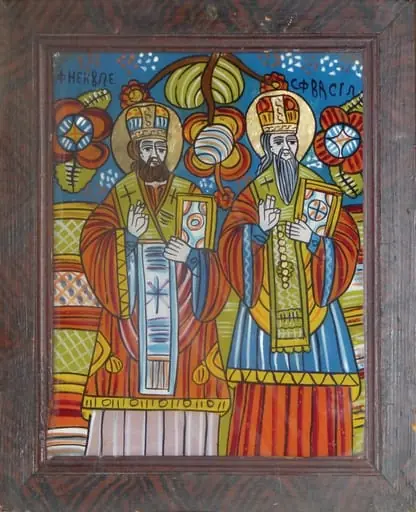 Sfinții Nicolae și Vasile cel Mare
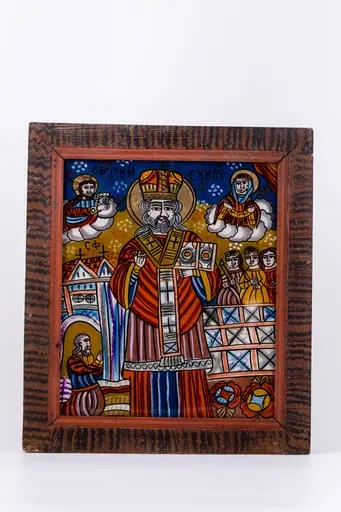 Sfântul Mare Ierarh Nicolae, făcător de minuni, îmbrăcat în veșminte liturgice, de ierarh, sacos roz-stacojiu, felon roșu vermillon-stacojiu, cu interiorul albastru și epitrahil-patrafir gri-bronziu, cu patru cruci negre brodate. Ține în mâna stângă Sfânta Evanghelie și cu mâna dreaptă Binecuvântează. Este unul dintre cei mai populari și iubiți sfinți, ocrotitor al caselor, familiilor și copiilor. Are barbă sură și mithră arhierească și aureolă. În registrul superior, sunt Dumnezeu-Tatăl Binecuvântând și Maica Domnului Ocrotind. Fondul este cerul albastru cobalt-ceruleum, împodobit cu elemente astrale - punctiflorale roșii și albe și un câmp luminos galben-auriu, în registrul mediu. În registrul mediu și inferior, sunt cele trei fete salvate și ajutate de Sfântul Nicolae și tatăl lor îngenuncheat, mulțumind pentru minunea săvârșită. Desenul este fin conturat. Cromatica este armonioasă: roșu vermillon, stacojiu-roz putred, albastru ceruleum și cobalt, galben muștar ocru, bronz, brun, bej, crem, auriu, alb, negru. Inscripția în chirilică se traduce Sfântul Nicolae. Icoana este de Țara Oltului.