Artwork
Sf. Grigore și Haralambie
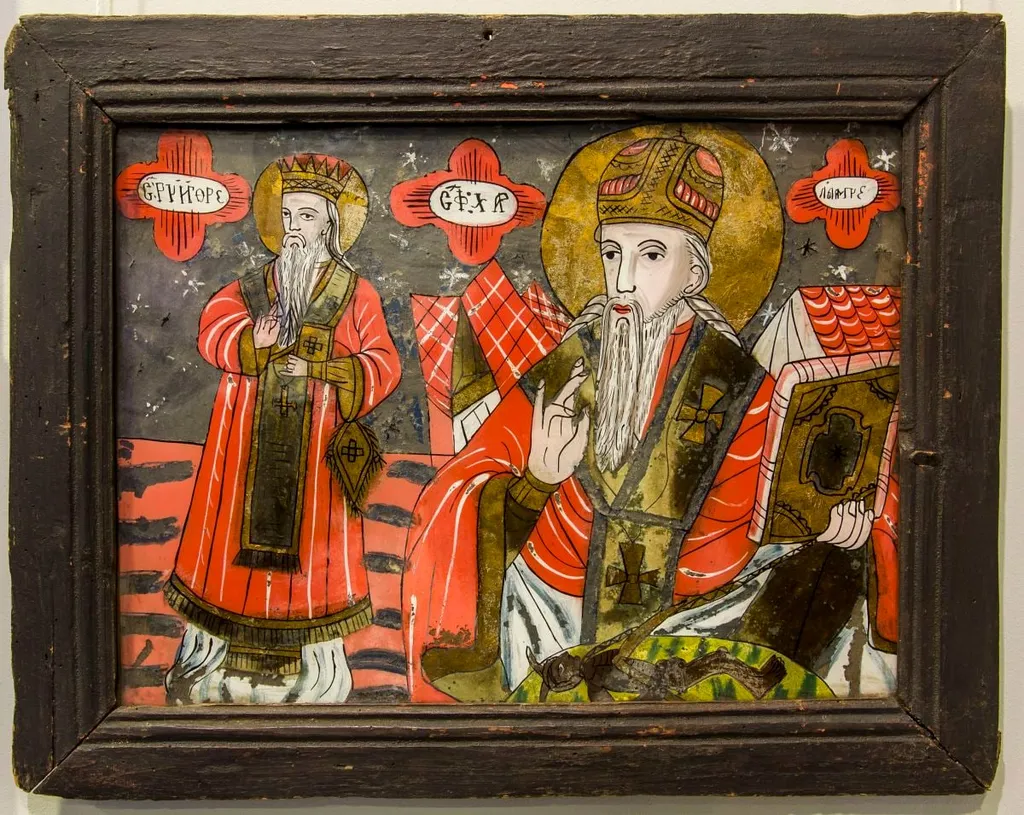
Sf. Grigore și Haralambie is a drawing by Unknown. It dates from 1850 and is held in the collection of the National Museum of Art of Romania. This work depicts two saints, Grigore and Haralambie, rendered in a stylized, non-naturalistic manner.
About this work
Overview
Both figures wear vivid red robes and ornamental gold headpieces, set against a minimal background of simplified architecture and abstract sky patterns.
This work depicts two saints, Grigore and Haralambie, rendered in a stylized, non-naturalistic manner. Both figures wear vivid red robes and ornamental gold headpieces, set against a minimal background of simplified architecture and abstract sky patterns. The absence of shading and the use of flat, unmodulated colors reflect a devotional aesthetic common in certain Eastern Christian traditions, emphasizing symbolic presence over physical realism.
Subject & Meaning
The two figures are identified as saints, likely martyrs or church fathers, distinguished by their regal attire and sacred attributes: one holds a book, symbolizing scripture or teaching; the other, a scroll, suggesting divine revelation. Tiny crosses woven into their garments and red flowers above them serve as hidden markers of sanctity, reinforcing their spiritual status through subtle, intentional details meant for contemplative viewers.
Technique & Style
The painting employs a flat, decorative style with no attempt at perspective or chiaroscuro. Colors—crimson, gold, and ultramarine—are applied uniformly, creating a sense of timelessness. The linear precision of the robes and the deliberate placement of crosses and floral motifs suggest a hand guided by liturgical convention rather than individual expression, aligning with iconographic traditions that prioritize symbolic clarity over naturalism.
History & Provenance
Though specific origins are undocumented, the work’s visual language aligns with late medieval or early modern ecclesiastical art from the Orthodox Christian regions of the Balkans or Eastern Europe. Its preservation suggests it was once part of a religious setting—perhaps a church wall or portable icon—used in private or communal devotion, where such coded details held spiritual significance for the faithful.
Context
In Orthodox Christian art, saints were often portrayed with standardized attributes and symbolic elements to convey theological truths quickly and clearly. The use of flat color, hierarchical scale, and hidden symbols like crosses in fabric mirrored liturgical texts and oral traditions. This style resisted Renaissance naturalism, favoring instead a visual language rooted in sacred continuity and communal memory.
Legacy
This work exemplifies a persistent tradition in Eastern Christian art that values symbolic depth over illusionistic technique. Its quiet details—crosses embedded in cloth, floral emblems—invite sustained observation, influencing later revivals of iconographic principles in 19th- and 20th-century religious art. The emphasis on coded meaning continues to inform contemporary liturgical art practices in Orthodox communities.
Artist & collection

 Domestic Scene
 Giacomo and Cardinal Marco, investing Andrea, Abbot of San Zeno, with his Benefice
 The Nymph of Fontainebleau
 Portrait of a Woman
 Madonna and Child with Saints in the Enclosed Garden
 Venus and Minerva
 Family Group of Four on Sofa
 Wall painting from Room H of the Villa of P. Fannius Synistor at Boscoreale
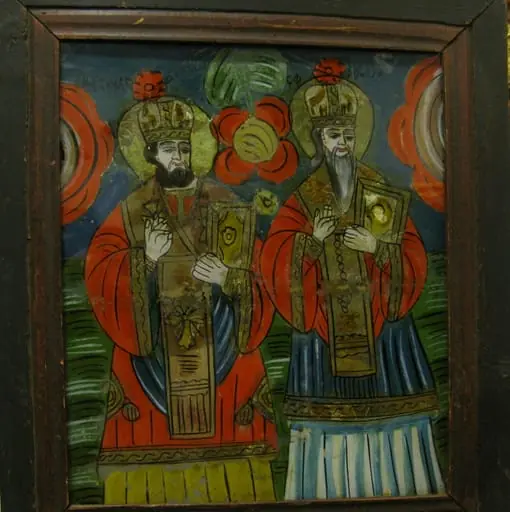 Sf. Nicolae și Vasile
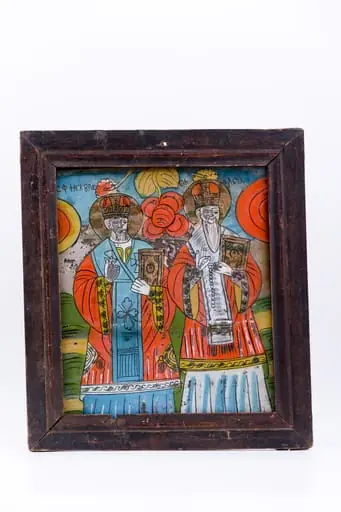 Icoana îi reprezintă pe Sfântul Ierarh Nicolae și Sfântul Vasile cel Mare, amândoi ierarhi, în veșminte liturgice arhierești, binecuvântând. Sfântul Mare Ierarh Nicolae, făcător de minuni, este îmbrăcat în veșminte liturgice, de ierarh, sacos roșu-vermillon, cu epitrahil-patrafir albastru bleu-ciel. Sfântul Nicolae are în mâna stângă Sfânta Evanghelie închisă și cu mâna dreaptă Binecuvântează. Este unul dintre cei mai populari și iubiți sfinți, ocrotitor al caselor, familiilor și copiilor. Are barbă sură, mithră arhierească și aureolă. Alături este Sfântul Ierarh Vasile cel Mare, în veșminte roșii vermillon, cu interiorul galben, sacos gri-albăstrui și epitrahil gri. Fondul este albastru bleu-ciel cu elemente decorative fitomorfe ruje galbene și roșii. Cromatica este armonioasă și pastelată: roșu vermillon, albastru bleu-ciel, verde, galben-ocru, negru, alb. Icoana este de Țara Oltului. Inscripția din româno-chirilică se traduce Sf Nicolae Sf Vasile.
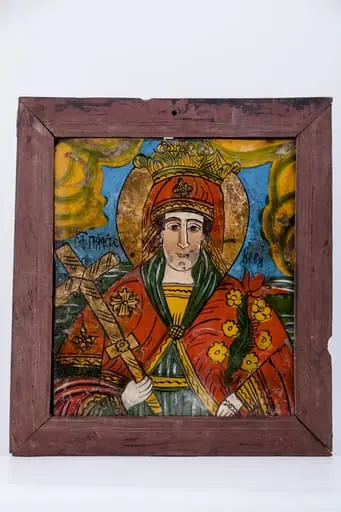 Sfânta Mare Cuvioasă Parascheva de la Iași are crucea în mâna dreaptă și ramură înflorită, cu 6 flori galbene și una roșie în vârf în mâna stângă. Este îmbrăcată în veșmânt roșu vermillon, cu interiorul căptușit cu verde și galben. Peste maforionul roșu, sfânta cuvioasă are aureolă. Fondul icoanei este cerul albastru regal, cu o arcadă de lumină galbenă, în registrul superior și bronziu, în jurul chipului și aureolei Sfintei Paraschiva și o alternanță de câmpuri verzi, dispuse paralel, în registrul mediu și inferior. Este o icoană cu aer cald, tomnatic, de octombrie 14, Praznicul Sfintei Cuvioase Parascheva. Inscripția din româno-chirilică se traduce Sf Paraschiva. Cromatica este armonioasă: roșu vermillon, albastru regal, verde văratic și forest, brun-cafeniu, negru, galben chihlimbar, ocru, bronziu, gri, negru, alb. Icoana este din Țara Oltului.
 Icoașanț
 Icoafolc
 Icoa lem
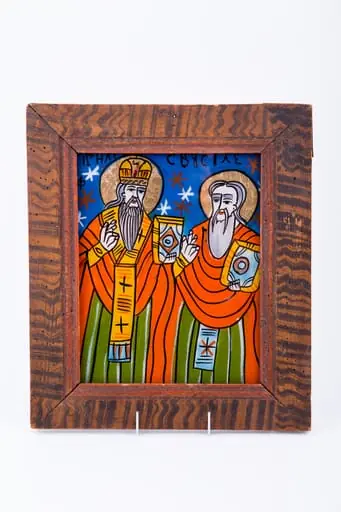 Sfinții Ierarhi Ioan Gură-de-Aur și Vasile cel Mare sunt reprezentați împreună, binecuvântând cu mâna dreaptă și ținând în mâna stângă Sfânta Evanghelie. Sunt îmbrăcați în veșmânt-sacos verde, cu felon roșu vermillon și epitrahil galben-ocru. Împreună slujesc și săvârșesc Sfânta Liturghie. În registrul îndepărtat superior, este pictat cerul albastru cu stele albe și roșii. Cromatica este armonioasă: roșu vermillon, verde, albastru, galben-ocru, alb. Sfântul Ierarh Ioan Gură-de-Aur poartă și mithră arhierească. Amândoi Sfinții Ierarhi au aureole aurii. Rama este pictată cu tușe negre pe maro-roșcat, alternanță de brunuri. Este o icoană specifică picturii de Țara Oltului, din centrul Șcheii Brașovului. Tematica este rară.
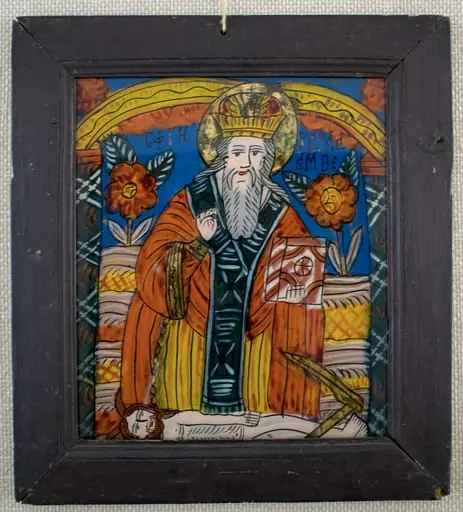
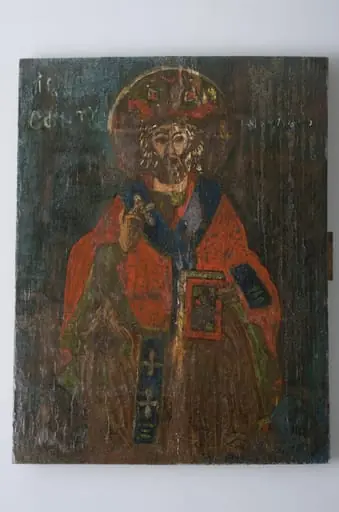 Icoana este pictată pe lemn, reprezentându-l pe Sfântul Nicolae cu veșminte arhierești (felon roșu, omofor albastru și mitră pe cap), ținând Evanghelia închisă cu mâna stângă și binecuvântând cu mâna dreaptă. Cromatică: roșu, albastru, verde, maro închis.
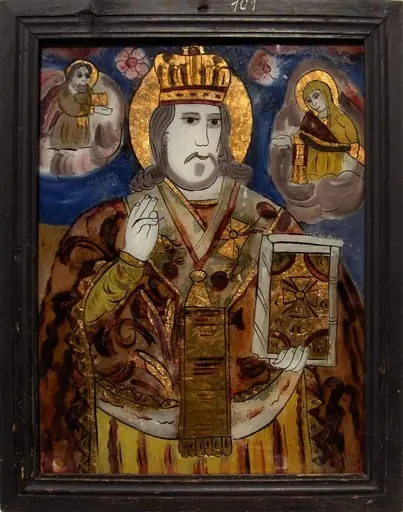 Sf. Nicolae