Artwork
Icoae re
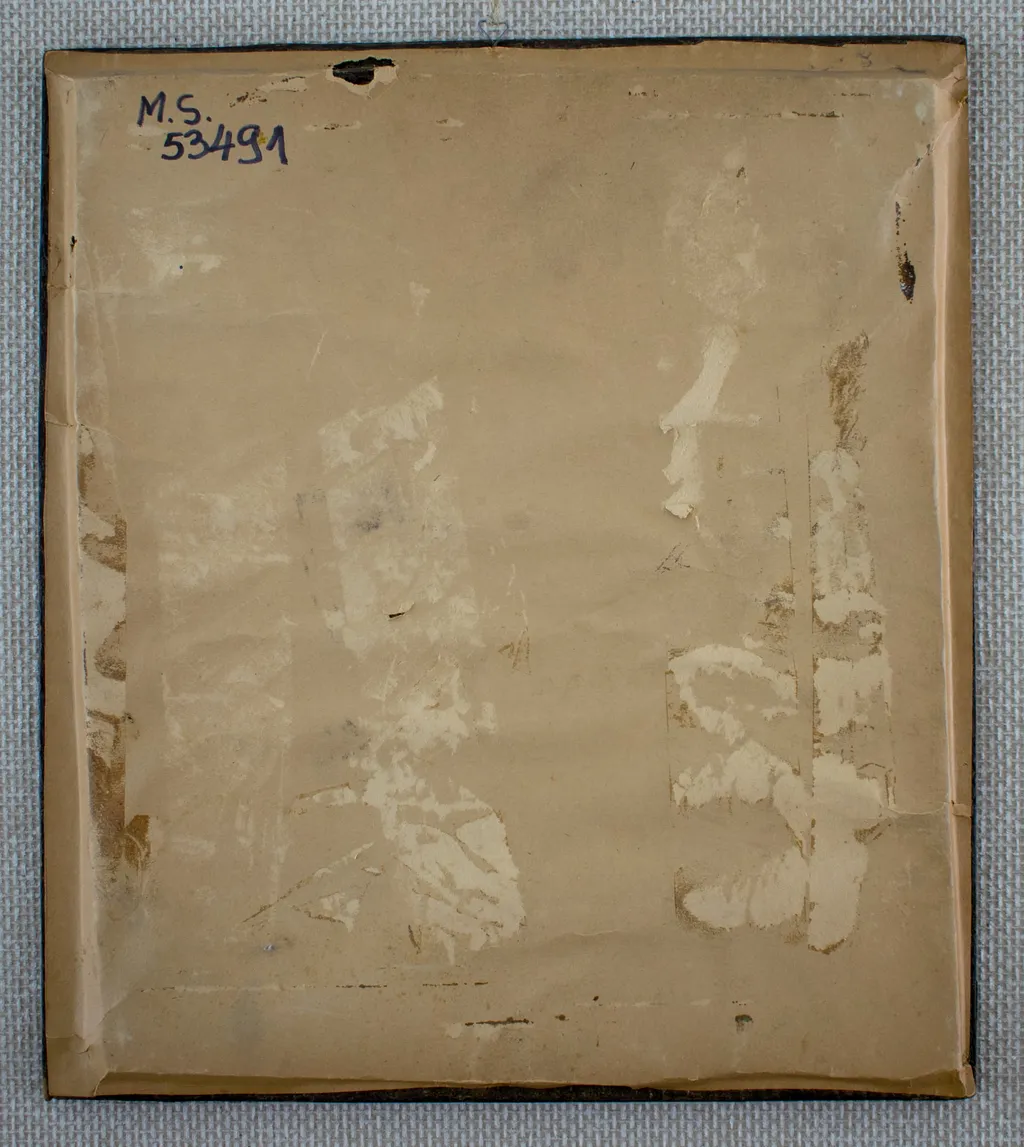
Icoae re is a drawing by Unknown. It dates from 1850 and is held in the collection of the "Dimitrie Gusti" National Village Museum. The image captures the reverse side of a historical drawing, framed by a thin, aged brown paper border.
About this work
Overview
The border shows signs of wear, including tears and discoloration, with faint white marks scattered across its surface.
The image captures the reverse side of a historical drawing, framed by a thin, aged brown paper border. The border shows signs of wear, including tears and discoloration, with faint white marks scattered across its surface. A handwritten label in blue ink, 'M.S. 53491', appears in the top-left corner. The original drawing is entirely obscured, leaving the frame itself as the sole subject of the image.
Subject & Meaning
The focus is not on the concealed artwork but on the physical evidence of its preservation. The worn border and handwritten notation suggest the object was handled, stored, or cataloged over time. The label may indicate institutional archiving, implying the drawing once held scholarly or curatorial significance, though its content remains unknown.
Technique & Style
No artistic technique is visible beyond the framing material. The paper border appears to be a simple, utilitarian mount, likely applied for protection or display. Its irregular edges and aging suggest hand-cutting and long-term exposure. The blue ink inscription is casual, not decorative, pointing to administrative rather than aesthetic intent.
History & Provenance
The label 'M.S. 53491' implies the drawing was part of a cataloged collection, possibly in a museum or archive. The condition of the border—torn, stained, and brittle—indicates decades, if not centuries, of storage or transit. Its current state reflects neglect or indifference, yet the persistence of the label suggests it was once formally documented.
Context
This fragment belongs to a broader tradition of archival preservation, where drawings were mounted and labeled for study or storage. The absence of the original artwork underscores how institutional practices often prioritize documentation over the object itself. The border, once functional, now serves as a relic of unseen labor and forgotten authorship.
Legacy
Though the drawing is lost, the border endures as a trace of its existence. It stands as a quiet testament to the impermanence of artistic records and the fragility of cultural memory. The label and wear invite questions about what was once there, and why it was preserved—or abandoned.
Artist & collection
Museum
"Dimitrie Gusti" National Village Museum
Continue through works from the same source collection.
 Domestic Scene
 Giacomo and Cardinal Marco, investing Andrea, Abbot of San Zeno, with his Benefice
 The Nymph of Fontainebleau
 Portrait of a Woman
 Madonna and Child with Saints in the Enclosed Garden
 Venus and Minerva
 Family Group of Four on Sofa
 Wall painting from Room H of the Villa of P. Fannius Synistor at Boscoreale