Artwork
Icoana îi reprezintă împreună pe Sfântul Ioan Botezătorul și Înaintemergătorul Mântuitorului Iisus Hristos și pe Dumnezeu Tatăl. Sfântul Ioan Botezătorul este îmbrăcat într-un himation sau o sarică de păr de cămilă, încins la brâu și cu o mantie de culoare verde, și aripi albastre turcoaz-smarald de înger. Fondul este albastru cu o pădure de copaci verzi, în pustietate. Desenul este foarte sigur și detaliile realizate minuțios, trăsăturile chipurilor fiind foarte expresive și pictate cu măiestrie. Deasupra Sfântului Ioan Botezătorul este Dumnezeu-Tatăl, din deschiderea Cerurilor, cu mâinile ridicate, ocrotind, acoperind și binecuvântând. Cromatica este armonioasă, dar mai rece, și întunecată, specifică picturii Mărginimii Sibiului: verde mușchi de pădure, albastru ceruleum, acajou, brun, stacojiu, alb, negru. Inscipția din româno-chirilică se traduce Sf Ioan IC XC Iisus Hristos.
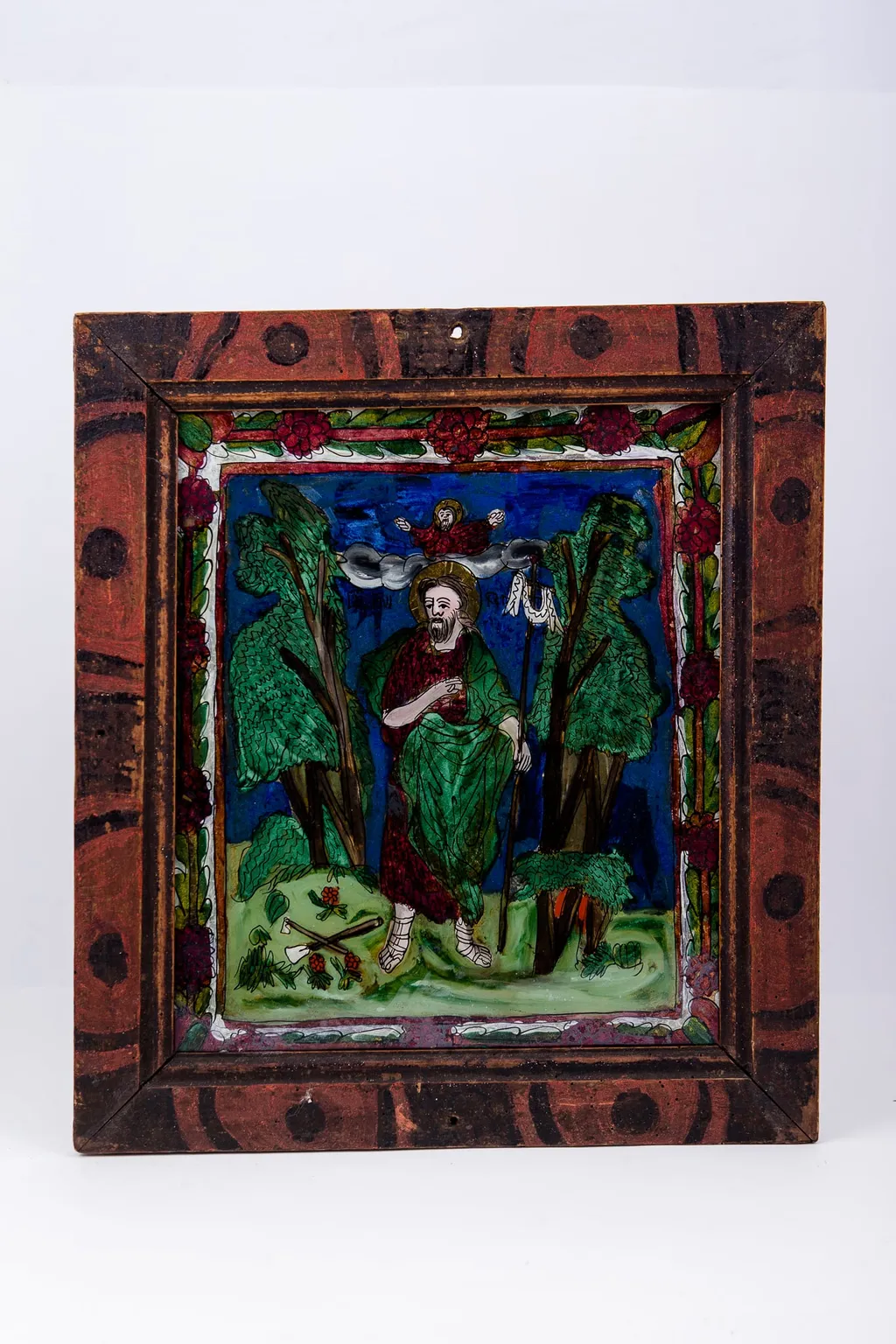
Icoana îi reprezintă împreună pe Sfântul Ioan Botezătorul și Înaintemergătorul Mântuitorului Iisus Hristos și pe Dumnezeu Tatăl. Sfântul Ioan Botezătorul este îmbrăcat într-un himation sau o sarică de păr de cămilă, încins la brâu și cu o mantie de culoare verde, și aripi albastre turcoaz-smarald de înger. Fondul este albastru cu o pădure de copaci verzi, în pustietate. Desenul este foarte sigur și detaliile realizate minuțios, trăsăturile chipurilor fiind foarte expresive și pictate cu măiestrie. Deasupra Sfântului Ioan Botezătorul este Dumnezeu-Tatăl, din deschiderea Cerurilor, cu mâinile ridicate, ocrotind, acoperind și binecuvântând. Cromatica este armonioasă, dar mai rece, și întunecată, specifică picturii Mărginimii Sibiului: verde mușchi de pădure, albastru ceruleum, acajou, brun, stacojiu, alb, negru. Inscipția din româno-chirilică se traduce Sf Ioan IC XC Iisus Hristos. is a drawing by Unknown. It dates from 1850 and is held in the collection of the ASTRA National Museum Complex.
About this work
Overview
The composition follows the liturgical conventions of the Mărginimea Sibiului region, emphasizing spiritual presence through stillness and precise detail.
This icon depicts Saint John the Baptist alongside God the Father and the prefiguration of Christ, arranged vertically in a sacred hierarchy. The saint stands in a barren landscape beneath a dark blue sky, his figure framed by dense trees. The composition follows the liturgical conventions of the Mărginimea Sibiului region, emphasizing spiritual presence through stillness and precise detail. The palette is muted and cool, dominated by forest greens, cerulean blues, and earthy browns.
Subject & Meaning
The icon presents Saint John the Baptist as the forerunner of Christ, identified by his camel-hair garment and wings, symbolizing his angelic role as divine herald. Above him, God the Father emerges from the heavens, arms outstretched in blessing, signifying divine approval of John’s mission. The inscription in Old Church Slavonic script confirms the identities of the figures, anchoring the image in theological tradition and reinforcing its function as a devotional object.
Technique & Style
The painting exhibits meticulous brushwork, with finely rendered facial expressions and textured drapery that convey both weight and movement. The wings are rendered in layered blues—turquoise, emerald, and cobalt—creating a luminous contrast against the dark sky. Details such as individual leaves and scattered flowers are painted with quiet precision, reflecting a regional style that values spiritual clarity over naturalistic illusion.
History & Provenance
This icon originates from the Mărginimea Sibiului region of Transylvania, an area known for its distinct ecclesiastical art tradition during the 18th and 19th centuries. Its wooden frame, aged and rusted, suggests long-term use in a local church or household altar. The script and iconographic choices align with Orthodox liturgical practices of the time, indicating it was likely commissioned for private or communal worship.
Context
Created within a rural Orthodox community, the icon reflects theological themes central to Eastern Christian devotion: prophecy, divine authority, and the intercession of saints. The barren landscape and restrained palette echo monastic ideals of asceticism, while the inclusion of script serves both identification and liturgical instruction. Such icons were not merely decorative but integral to daily prayer and ritual life.
Legacy
The icon exemplifies a regional variant of Byzantine-derived iconography, preserved through local craftsmanship and religious continuity. Its survival offers insight into the devotional habits of Transylvanian Orthodox communities, where artistic tradition was maintained with minimal external influence. Today, it stands as a quiet testament to the endurance of sacred imagery in everyday spiritual practice.
Artist & collection

 Domestic Scene
 Giacomo and Cardinal Marco, investing Andrea, Abbot of San Zeno, with his Benefice
 The Nymph of Fontainebleau
 Portrait of a Woman
 Madonna and Child with Saints in the Enclosed Garden
 Venus and Minerva
 Family Group of Four on Sofa
 Wall painting from Room H of the Villa of P. Fannius Synistor at Boscoreale
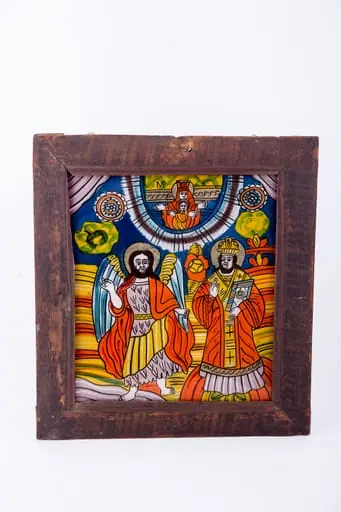 Icoana îi reprezintă pe Sfântul Ioan Botezătorul și Înaintemergătorul Mântuitorului Iisus Hristos și pe Sfântul Mare Ierarh Vasile cel Mare. Cel dintâi este simbolul pocăinței și cel de-al doilea este asprimea dezlegărilor. Sfântul Ioan Botezătorul este îmbrăcat cu o mantie roșie vermillon și ocru și un himation gri-brun sau o haină din păr de cămilă. Este desculț și are aripi de înger. Sfântul Mare Ierarh Vasile cel Mare este îmbrăcat în veșminte liturgice de arhiereu, cu mantie roșie vermillon, sacos alb-gri, epitrahil-patrafir galben, mithră mitopolitană și ține în mâna stânga Sfânta Evanghelie închisă și cu mâna dreaptă binecuvintează. În registrul superior, într-un semicerc de raze, asemenea unei mandorle de nouri, ca într-o deschidere de Ceruri, este Maica Domnului cu Pruncul Iisus Hristos în brațe, amândoi arătând Calea, ocrotind, păzind și binecuvântând. Maica Domnului este Orantă, adică rugătoare. Fondul icoanei este albastru ceruleum, pe care sunt câteva flori mari galben-verzi și doi aștri decorativi. Soarele, luna, stelele și florile adeseori se suprapun simbolic și semantic în icoanele din Țara Oltului. Cromatica este armonioasă, luminoasă și vie: roșu vermillon, galben, ocru, verde, albastru ceruleuum, alb, negru.
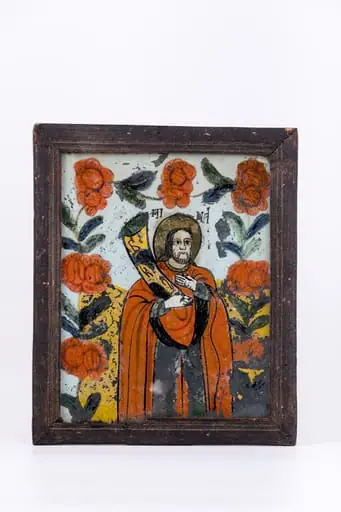 Icoana este foarte rară pentru că îl reprezintă pe Sfântul Mare Mucenic Mina, ocrotitorul celor păgubiți. Este îmbrăcat în veșminte preoțești, cu felon roșu vermillon și sacos gri cenușiu-antracit. Are în mâna dreaptă desfășurat un hrisov de cuvânt de înțelepciune și învățătură. Cu mâna stângă arată totodată înspre inima sa, cu închinăciune către toți și înspre cuvintele hrisovului. Fondul icoanei este împărțit în două registre complementare: cerul albastru bleu-ciel senin și câmpul galben luminos de grâu. Întreaga tematică iconografică este încadrată de un chenar decorativ fitomorf, format dintr-o ghirlandă de 7 ruje - trandafiri și bujori în floare. Icoana este din Nicula-Gherla, la interferența celor două centre de pictură. Inscripția din româno-chirilică se traduce Mina.
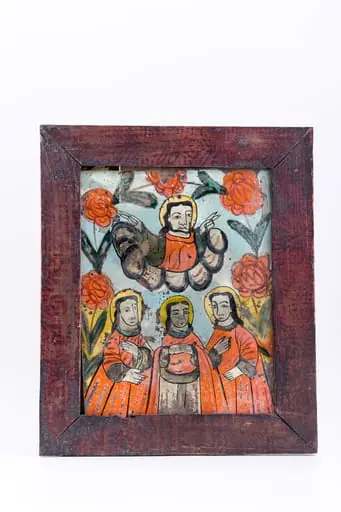 Icoana reprezintă unul dintre praznicele împărătești foarte importante, Înălțarea Domnului Iisus Hristos, care are loc la 40 de zile după Învierea Domnului Iisus Hristos. Icoana este împărțită în două registre, printr-o mandorlă de nouri rotunzi albi-gri. În registrul superior, deasupra mandorlei, este Mântuitorul Iisus Hristos Înălțat la Ceruri și Binecuvântând, spunând: Eu sunt cu voi și nimeni împotriva voastră! În registrul inferior, pe pământ este Maica Domnului, cu doi dintre cei 12 ucenici, prezenți la Înălțare. Întreaga compoziție este încadrată de un chenar decorativ fitomorf, format dintr-o ghirlandă de ruje - 5 trandafiri roșii, cu frunze verzi. Numărul de 5 poate fi interpretat pe de o parte, cele 5 răni ale Mântuitorului Iisus Hristos, și pe de altă parte, cele 50 de zile până la Praznicul Pogorârii Duhului Sfânt - Rusaliile, Cincizecimea. Icoana este de Nicula. Cromatica este luminoasă și armonioasă: roșu vermillon, galben chihlimbar, albastru bleu-ciel, verde brad, gri, alb, negru.
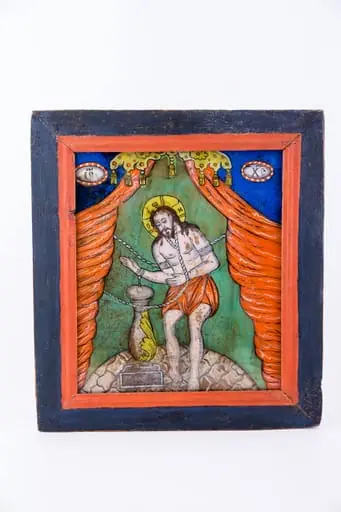 Icoana reprezintă una dintre Patimile Mântuitorului Iisus Hristos. Locul este din curtea casei lui Pilat din Pont, unde a fost chinuit, biciuit și judecat Domnul Iisus Hristos, legat fiind de stâlpul infamiei, pe locul numit pe vremuri Gavata, adică pardosit cu pietre. Iisus Hristos are mijlocul și coapsele înfășurate într-o pânză-țesătură roșie -roșu culoarea muceniciei și a jertfei. Are trupul plin de răni și urme roșii de biciuire. Este legat cu lanțuri și funii. Este într-o poziție mai aplecată, din durere și smerenie. Întreaga narațiune iconografică este dezvăluită și arătată prin gestul ridicării unor draperii albastre cu interiorul roșu, reprezentând și cerurile deschizându-se printr-o înțelegere concret de umană. Deasupra este un candelabru galben de lumină, sugerând Soarele dreptății. Icoana este din Mărginimea Sibiului. Cromatica este vie și directă: roșu, albastru, galben, verde olive. Inscripția din registrul superior în româno-chirilică se traduce IC XC Iisus Hristos.
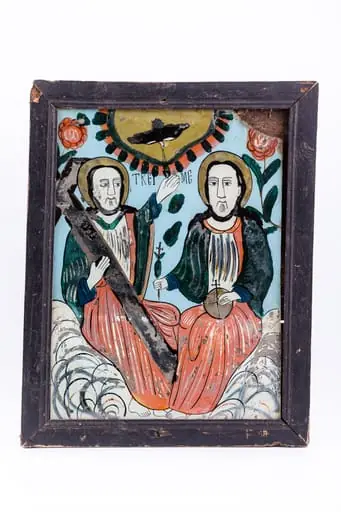 Icoana reprezintă Sfânta Treime. Dumnezeu-Tatăl are globul pământesc, pe genunchi și în mâna dreaptă are o cruce de mână. Dumnezeu-Fiul este alături, ține Crucea pe umărul drept și cu mâna stângă arată înspre Sfântul Duh, Pogorându-se ca un porumbel, astfel reunindu-Se Sfânta Treime. Dumnezeu-Tatăl și Dumnezeu-Fiul sunt îmbrăcați în veșminte în combinație de albastru cobalt, gri cenușiu-antracit și roșu vermillon. Se remarcă desenul fin al broderiei mânecii Tatălui Ceresc. Sfântul Duh se pogoară din miezul galben-solar, deschiderea Cerurilor, cu raze de lumină. Inscripția din româno-chirilică se traduce Treime. În registrul superior, fondul icoanei este cerul albastru bleu-ciel senin, cu câte o rujă - trandafir roșu - în colțurile din stânga și dreapta. În miezul rujelor este semnul zăluței albe, șerpuitoare. În registrul inferior sunt câmpuri de nouri albi-gri, mandorle peste mandorle. Cromatica este luminoasă și armonioasă: roșu vermillon, albastru bleu-ciel, albastru cobalt, alb, gri-antracit, ocru-muștar, alb, negru. Icoana este de Nicula.
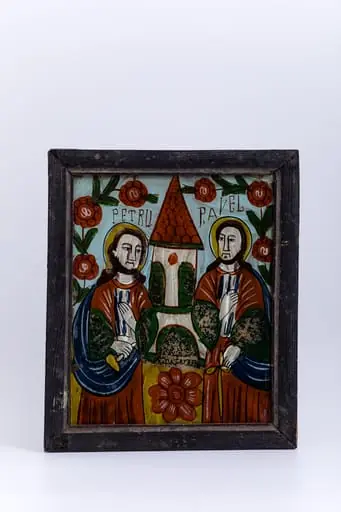 Icoana îi reprezintă pe cei doi Apostoli Sfinții Petru și Pavel, Petru cu cheile Împărăției Cerești în mână și pe Pavel cu sabia Cuvântului în mână, susținând împreună chivotul unei biserici, simbolul Bisericii sobornicești și apostolești. Biserica este situată în registrul îndepărtat, dar este redată în așa fel încât să fie înțeleasă ca și cum ar fi dusă pe umeri de Sfinții Apostoli. Au mantiile roșii vermillon, și veșmintele cu sacos-uri verzi și albastre cobalt. Fondul icoanei este cerul albastru bleu-ciel, în partea superioară, pe margini, și un câmp galben-chihlimbar, în spațiul de miez. În registrul inferior, fondul este un rând de galben chihlimbar-muștar, pe latura superioară. Cheile și crucea sunt simboluri puternice. Se creează astfel un triunghi de semnificații teologice: crucea-chivotul de biserică-cheile Raiului. Chipurile sunt foarte expresive, cu trăsături fine. Inscripția din româno-chirilică se traduce Petru Pavel. Compoziția este rezistentă și cromatica armonioasă: roșu vermillon-stacojiu, albastru cobalt, ultramarin și bleu-marin, verde văratic, galben chihlimbar, brun, gri, alb zinc, negru, auriu. Inscripția din româno-chirilică se traduce Petru Pavel. Icoana este din Nordul Transilvaniei, Nicula.
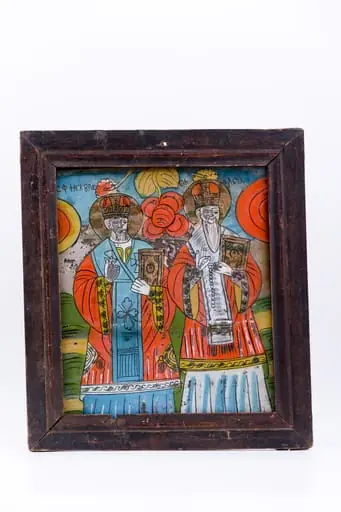 Icoana îi reprezintă pe Sfântul Ierarh Nicolae și Sfântul Vasile cel Mare, amândoi ierarhi, în veșminte liturgice arhierești, binecuvântând. Sfântul Mare Ierarh Nicolae, făcător de minuni, este îmbrăcat în veșminte liturgice, de ierarh, sacos roșu-vermillon, cu epitrahil-patrafir albastru bleu-ciel. Sfântul Nicolae are în mâna stângă Sfânta Evanghelie închisă și cu mâna dreaptă Binecuvântează. Este unul dintre cei mai populari și iubiți sfinți, ocrotitor al caselor, familiilor și copiilor. Are barbă sură, mithră arhierească și aureolă. Alături este Sfântul Ierarh Vasile cel Mare, în veșminte roșii vermillon, cu interiorul galben, sacos gri-albăstrui și epitrahil gri. Fondul este albastru bleu-ciel cu elemente decorative fitomorfe ruje galbene și roșii. Cromatica este armonioasă și pastelată: roșu vermillon, albastru bleu-ciel, verde, galben-ocru, negru, alb. Icoana este de Țara Oltului. Inscripția din româno-chirilică se traduce Sf Nicolae Sf Vasile.
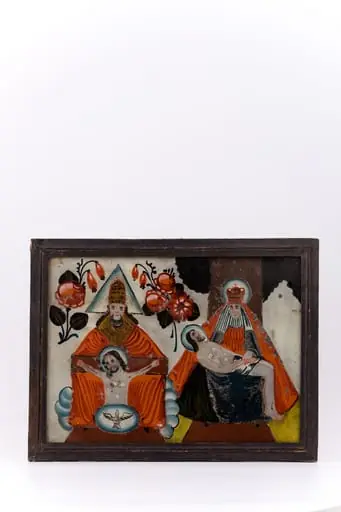 Icoana are o tematică iconografică foarte rară: în cea dintâi parte, este Sfânta Treime: Mântuitorul Iisus Hristos Răstignit pe brațele Lui Dumnezeu-Tatăl și ținut în veșmântul roșu al Pătimirii și Jertfei. Dumnezeu-Tatăl, Împărat al Cerurilor, are pe cap coroană și aureolă triunghiulară, reprezentând Sfânta Treime. Sfântul Duh este reprezentat prin porumbelul alb. Sfânta Treime are în registrul inferior o mandorlă de nouri rotunzi albi-albaștri și în registrul superior o ghirlandă din trandafiri și ramuri cu măceșe, simbolizând Grădina Raiului. În cea de-a doua parte, în dreapta, este Maica Domnului Împărăteasă ținând în brațe pe genunchi Trupul Mântuitorului Iisus Hristos, coborât de pe Cruce, plâns, jelit. Este asemenea unei Piete. Icoana este deosebită și foarte rară, prin compoziția tematică și viziunea iconografică greco-catolică. Fondul icoanei este alb-ivoriu-crem, în registrul superior și galben-solar, în registrul inferior. Cromatica este armonioasă: roșu vermillon-trandafiriu, brun-roșcat-acajou, galben-solar, albastru bleu-ciel, gri, alb , negru. Icoana este din Nordul Transilvaniei, Nicula.
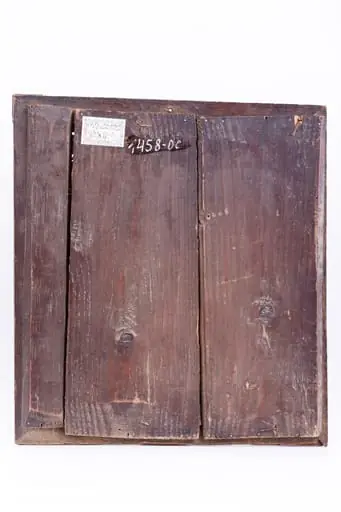
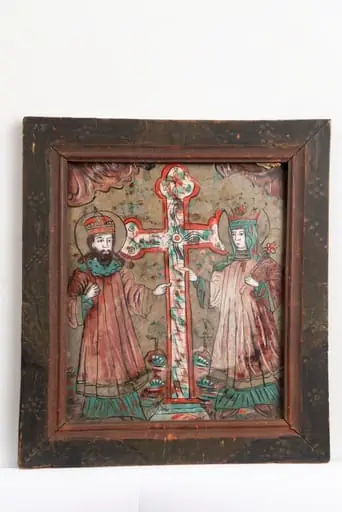 Icoana îi reprezintă pe Sfinții Împărați Constantin și Elena, pictați frontal, în picioare, ținând împreună în mână Crucea Răstignirii, ce domină central compoziția. Împărăteasa Elena ține în mâna stângă o ramură, îar împăratul Constantin are în mâna dreaptă un sceptru. Fondul icoanei e pictat integral doar în partea superioară unde apar în colțuri două ornamente din registrul vegetal, în rest e pictat cu laviuri colorate și decorat cu flori realizate din puncte, fiind vizibil fondul din hârtie argintată. Cromatica icoanei se compune din tonuri de roșu, alb, albastru, maro și gri. Rama icoanei e profilată, bicromă (latura interioară roșie, iar cea exterioară verde, decorată cu motive florale și geometrice) și e formată din îmbinarea a patru baghete de lemn. Sticla are un fragment lipsă, de mici dimensiuni, în partea stângă-sus.
 Icoana îi reprezintă împreună pe Sfântul Mare Ierarh Nicolae, Sfântul Ioan Botezătorul și Sfântul Mare Mucenic Teodor Tiron. Veșmintele Sfântului Nicolae sunt sacos gri și roșu vermillon, cu patrafir-epitrahil auriu cu verde, două bedernițe verzi, de o parte și de alta a veșmântului. În mijloc, este Sfântul Ioan Botezătorul și Înaintemergătorul Domnului Iisus Hristos îmbrăcat cu un himation alb-gri-negru, din păr de cămilă, și o mantie roșie, purtând crucea biruinței. Alături este Sfântul Mare Mucenic Teodor Tiron, îmbrăcat cu haine de oștean-militar, tunică și vestă de zale aurie, cu mantie roșie cu interiorul galben, de lumină. În mâna dreaptă are spada credinței. Fondul icoanei este albastru cobalt, în registrul superior și roz, în registrul inferior. Pe latura inferioară, icoana este încadrată de elemente florale - trei ruje mari, trandafiri roșii, cu frunze verzi. Inscripția din româno-chirilică se traduce Sf Nicolae Sf Ioan Botezătorul Sf Teodor Tiron. Icoana este de Țara Oltului.